
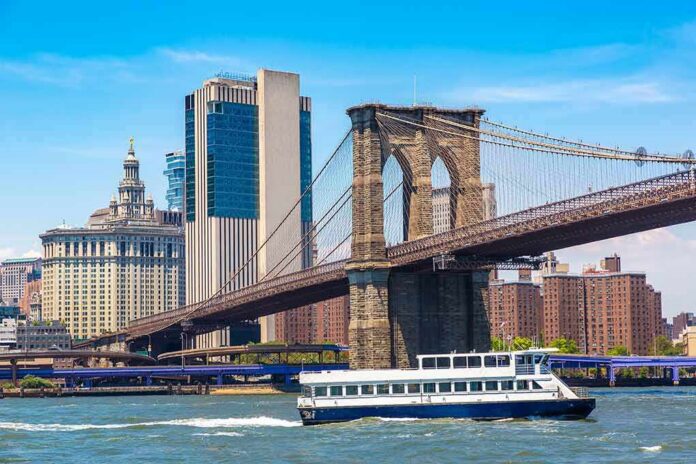
Anti-Immigration and gun-control protesters blocked the Brooklyn Bridge and a 9/11 Memorial vandal was arrested, jolting New Yorkers who depend on safe roads and sacred spaces.
Story Highlights
- Police said at least 14 protesters were taken into custody after a blockade on the bridge.
- Officials said lanes into Manhattan reopened shortly before 1:30 p.m. after heavy backups.
- Reports said red paint was sprayed across engraved 9/11 victims’ names; one man was charged.
- Earlier marches tied the movement to anti-Immigration and gun-control demands on Martin Luther King Jr. Day.
What Happened On The Bridge
New York City police said about 30 protesters formed a line on the Manhattan side of the Brooklyn Bridge and blocked both vehicle and pedestrian traffic. Officers gave orders to clear the lanes. At least 14 people were taken into custody when they refused to move. Officials reopened all lanes shortly before 1:30 p.m., but not before long backups built on the approach. Citizen video showed cars stacked for blocks as the line held firm.
Authorities did not announce a permit for a lane-blocking action. Reports focused on the interruption, the arrests, and the group’s slogans. The chants targeted Immigration and Customs Enforcement, the New York Police Department, and gun violence. The protest framed the bridge action as civil rights advocacy. The legal question is more basic: a blockade is conduct that stops others from traveling. Police treated it as unlawful obstruction and removed the line after warnings.
Why They Say They Protested
Local coverage tied the movement to demands after a recent shooting linked to an Immigration and Customs Enforcement officer and to broader gun-control goals. Earlier, more than 100 people marched across the bridge on Martin Luther King Jr. Day. Marchers invoked Dr. King’s legacy and called for transparency in the Renee Good case. They carried signs and chanted against Immigration and Customs Enforcement and gun violence as they crossed into Manhattan in a peaceful march.
Organizers and allied activists pushed specific gun policies. Reports identified calls for universal background checks and a national registry from a gun-control advocate’s website. The site promoted nonviolent civil resistance. But the public record does not show that the disruptive bridge tactic produced policy shifts or new oversight. The coverage instead centered on traffic, arrests, and later, a separate act of vandalism at the 9/11 Memorial that drew bipartisan condemnation.
The 9/11 Memorial Vandalism Case
Days earlier, red paint appeared across engraved names at the North Pool of the 9/11 Memorial. Reports said a man spray-painted his gun-control website across the panels that hold victims’ names. Police arrested Jonathan Andrew Tijerina on charges that included criminal mischief and making graffiti. Memorial officials called the site a sacred place that honors 2,983 victims and said staff and law enforcement quickly restored the area to its commemorative state.
Is the US immigration system failing? Protesters against it paralyzed traffic on the Brooklyn Bridge in New York. The trigger for the action was the ICE shooting in the Bronx. Officers opened fire on a migrant’s car, and his five-year-old son was inside.
This system has another… pic.twitter.com/gWoCi7TVTI
— Doc Hub (@DocHubX) October 29, 2026
Former New York Governor George Pataki condemned the act as a vile, disgraceful crime. Families go to those panels to mourn. Officials said the graffiti was removed and the memorial was restored, but the damage was done to public trust. The case undercut the movement’s moral claim by tying its message to an attack on a national shrine. That link, fair or not, dominated headlines and made the broader policy pitch even harder to hear.
Public Order, Rights, And Results
Police must protect both speech and safety. Marching on a sidewalk or in a permitted route is speech. Blocking a key artery traps commuters, medics, and parents. That is why officers issue warnings and then clear the lanes. Research shows disruptive tactics get attention, but often reduce support and do not move policy on their own. The coverage here followed that pattern: disruption led; demands lagged. The result was anger on the roads and little to show in law or oversight.
New Yorkers want safe streets, open bridges, and respect for sacred sites. They also expect honest investigations when force is used. Those goals are not in conflict. There is a better way than chaos. Demand records. Attend hearings. Press lawmakers. Do not block bridges or deface names of the fallen. That is not civil rights. That is disorder that hurts working people and erodes goodwill for any cause tied to it.
What To Watch Next
Watch for case updates on charges from the bridge arrests and the 9/11 Memorial vandalism. Look for any formal response from Immigration and Customs Enforcement about the Renee Good investigation, including records or timelines for review. Track whether city officials release permit and arrest paperwork that clarifies who planned the blockade and what warnings were given. Most important, see whether lawmakers advance any policy linked to these events. So far, the answer appears to be no.
Sources:
foxnews.com, whmi.com, pix11.com, origin.syndicator2.univision.com, yahoo.com, brooklyn.news12.com