

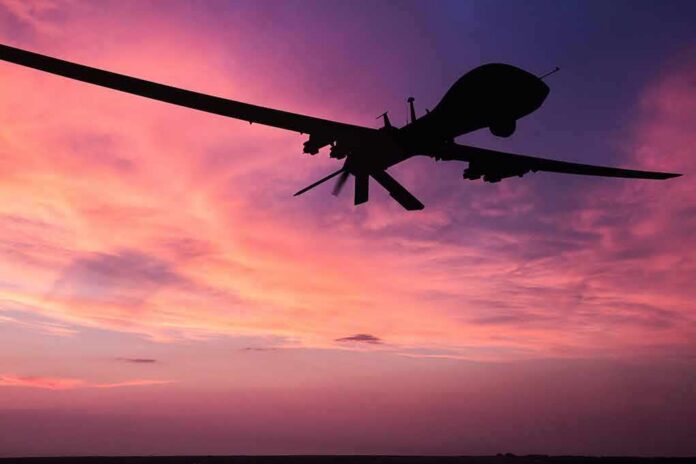
China just trialed new drone-swarm tactics, sharpening a threat some critics say makes America’s $23.4 billion nuclear Trump-class battleship “obsolete.”
Story Snapshot
- Chinese researchers and media tout drone swarms as a warship-killer and push multilayer defenses.
- The U.S. Navy defines the Trump-class as a hardened, forward command-and-control and long-range strike platform.
- A leading policy paper says Trump-class armor, power, and depth boost survival in mass drone and missile attacks.
- Real-world layered defenses—radar, jamming, guns, missiles, and lasers—have beaten swarms before.
What Beijing Is Signaling With Drone Swarms
Chinese military researchers publicly warn that cheap drone swarms can overwhelm big ships. State-linked outlets promote a “naval Great Wall” idea that uses many sensors, electronic warfare, and energy weapons to blunt thousands of drones at once. Chinese testing and media messaging point to a saturation strategy. The goal is to exhaust a ship’s missiles and attention. That message is aimed at U.S. planners and allies who rely on fewer, more capable ships in the Indo-Pacific.
Chinese analysts also spotlight new platforms to launch and support drones at sea. Reports describe a shift toward carriers and vessels that handle large numbers of uncrewed systems, which spreads risk and complicates defense. This push underscores a core idea: numbers matter in a swarm fight. If attackers can flood a defender’s radar and magazines with low-cost drones, even a powerful ship can be stressed. That is the contest the United States must prepare to win.
How The Navy Frames The Trump-Class Mission
The U.S. Navy says the Trump-class is not a destroyer replacement. The service describes the ship as a robust, survivable forward command-and-control platform that can deliver high-volume, long-range offensive firepower. That mission demands large electrical power, magazine depth, and hardened systems. A National Institute for Public Policy assessment argues the class would improve survival against mass drone and missile attacks, with armor adding another layer of protection. The design aims to fight through damage and keep directing the fight forward.
Public debate often fixates on big guns versus drones, but Navy-aligned sources point to layered defense instead. A commentary video claims the concept leans on missiles, directed-energy lasers, and even railgun tech, not heavy artillery, while stressing power for energy-hungry defenses. That vision matches the Navy’s broader approach at sea: stack sensors, jamming, missiles, guns, and lasers under an advanced combat system. The point is not one silver bullet. The point is many tools working together at speed.
Layered Defense: What Has Worked At Sea
Recent combat and testing show layered defense can stop swarms. A U.S. warship in the Red Sea used a mix of jamming, missiles, close-in guns, and other systems to defeat a large drone attack. Reporting highlighted close-in weapons that fire thousands of rounds per minute, plus emerging lasers and upgraded electronic warfare. Separately, the Navy has revived shipboard laser programs that promise many low-cost shots against small drones and fast boats when weather allows. These tools cut the cost curve back toward defenders.
Training is catching up as the threat evolves. U.S. warships now drill to defeat hostile drone boats and air threats together, pairing sensors with rapid fire options and electronic attack. Expert explainers describe the ideal stack: radar to spot, radio-frequency and infrared sensors to classify, electronic warfare to blind, missiles to thin the herd, guns to clean up, and lasers to save costs on repeat shots. This is the “magazine depth” answer to saturation. It is not flashy. It is practical—and it has worked.
What This Means For Taxpayers And Deterrence
Skeptics say swarms make big ships obsolete. Beijing wants us to believe that. The record shows the truth is harder and more hopeful. Survivability rests on power, sensors, armor, and layered defense integrated by strong command systems. That is exactly what the Navy assigns to the Trump-class mission set. A credible policy review backs the survivability case and explains why armor and power matter when missiles and drones come in waves. Strength, not retreat, deters war.
The Bottom Line For America’s Sea Power
America cannot defend freedom of navigation with wishful thinking or soft targets. The Indo-Pacific fight will be a numbers game and a power game. China is racing to field more drones and saturate our ships. The U.S. answer is layered defense, deeper magazines, stronger jamming, and repeat-shot lasers tied to big electric power. The Trump-class aims to anchor that approach while pushing lethal reach forward. Build smart. Train hard. Keep the edge—and keep the peace.
Sources:
19fortyfive.com, scmp.com, warriormaven.com, asiatimes.com, linkedin.com, breakingdefense.com, thedefensewatch.com, globaltimes.cn, popularmechanics.com