
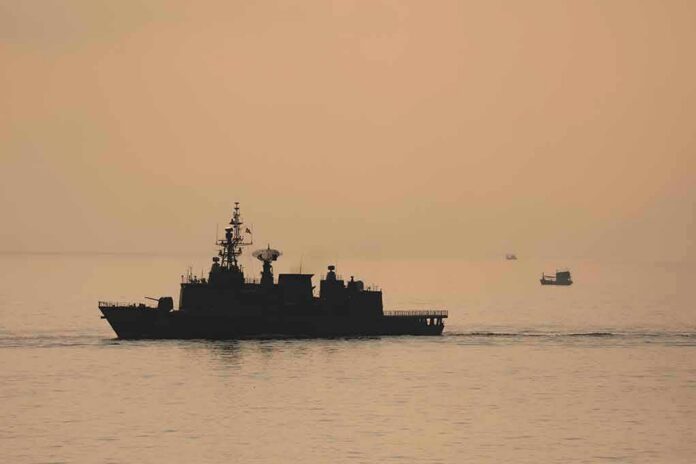
A British swimmer says he passed burning ships in the Strait of Hormuz as confirmed attacks on commercial vessels left crew injured and missing, underscoring a grave threat to civilian navigation.
Story Snapshot
- India confirmed an attack on a Panama-flagged tanker, with injuries and one sailor missing.
- India called recent strikes a “grave threat” to civilian seafarers and demanded free navigation.
- Satellite monitoring reported 500-plus oil-spill events since the war began, with mixed attribution.
- United Kingdom Maritime Trade Operations warned navigation remains severe with hostile action likely.
Confirmed Tanker Attack Raises Civilian-Safety Alarm
India’s Ministry of External Affairs confirmed that the Panama-flagged liquefied petroleum gas tanker MT TARA GAS was attacked off Oman on November 16, 2026. Twenty-one Indian crew were evacuated, two were hospitalized, and one remained missing, according to the official statement. New Delhi condemned the strike and demanded that attacks on commercial shipping stop immediately. The statement focused on the danger to civilian mariners and the need to restore safe passage through international waterways.
Indian media amplified the ministry’s warning, highlighting the human cost and the legal duty to keep sea lanes open. Reports emphasized that continuing attacks were “deeply worrisome” and a “grave threat” to civilian seafarers. They echoed the call for free and unimpeded navigation through the Strait of Hormuz, one of the world’s most vital energy routes. These accounts stressed safety and accountability but did not report confirmed spill volumes from this specific incident.
Swimmer’s Eyewitness Account Matches a Dangerous Maritime Picture
An Al Jazeera English segment featured a British swimmer who said he heard two loud explosions during a crossing, then saw a tanker several kilometers away on fire with fireballs in the sky and a strong chemical smell. The account aligns with a period of documented attacks and stressed routes. The testimony did not identify the vessel or confirm pollutants, but it matched broader warnings that civilians near these waters face sudden, severe hazards.
United Kingdom Maritime Trade Operations, the body that tracks commercial risk, labeled the Strait of Hormuz environment “severe.” The group said hostile action is highly likely and warned of navigation interference and potential mining. In separate updates, it described a pattern of engine-room damage incidents since July, and it documented periods when only a single cargo ship crossed the strait in twenty-four hours due to risk and electronic jamming of navigation systems.
Oil-Slick Mapping Signals Wide Environmental Footprints, With Caveats
Reporting on Greenpeace’s satellite monitoring said more than 500 oil-spill instances have been detected across the Gulf, the Strait of Hormuz, and the Arabian Sea since the war began. Some slicks were linked to vessel attacks; other events were detected around the time of strikes but lacked confirmed causes. The same reporting estimated that daily mapped footprints add up to roughly 20,000 square kilometers, about the size of Wales, emphasizing scale while noting attribution limits.
This picture fits a known wartime pattern. Some vessels hit by projectiles have continued under their own power, and in at least one documented case, a liquefied natural gas ship suffered an engine-room strike and fire but reported no environmental impact after extinguishing the blaze. That variation matters for public claims. It shows that every attack does not always create a visible spill, yet the risk to crews and the waterway remains high and unpredictable.
What It Means For Energy Security, Trade, and U.S. Interests
The Strait of Hormuz carries a large share of the world’s oil and gas. Attacks that injure crews and chase ships from the route hit supply chains, raise insurance rates, and threaten higher fuel prices at home. India’s public demand to keep the sea lanes open underscores how allies expect order and deterrence. The United States benefits when trade is steady, families can afford energy, and rogue actors cannot hold the global economy hostage.
British endurance swimmer Lewis Pugh has completed a three-day swim through the Strait of Hormuz to highlight the environmental consequences of war.
Pugh said an oil tanker was struck just minutes after he began swimming, with further attacks on commercial vessels taking place… https://t.co/TnlWwtUPjc
— NewsWire 🇱🇰 (@NewsWireLK) November 23, 2026
For readers here at home, this is simple. Safe seas protect American jobs, retirement accounts, and family budgets. Clear rules, strong escorts, and swift accountability reduce chaos. Official reports confirm the danger to civilian mariners. Satellite mapping suggests wide pollution footprints while admitting gaps. The eyewitness swimmer saw flames and smelled chemicals, which tracks with the official risk picture. The priority now is restoring safe, lawful navigation and stopping attacks before the next crew pays the price.
Sources:
youtube.com, firstindia.co.in, nationalsecurityjournal.org, hindustantimes.com, greenpeace.org, ukmto.org