

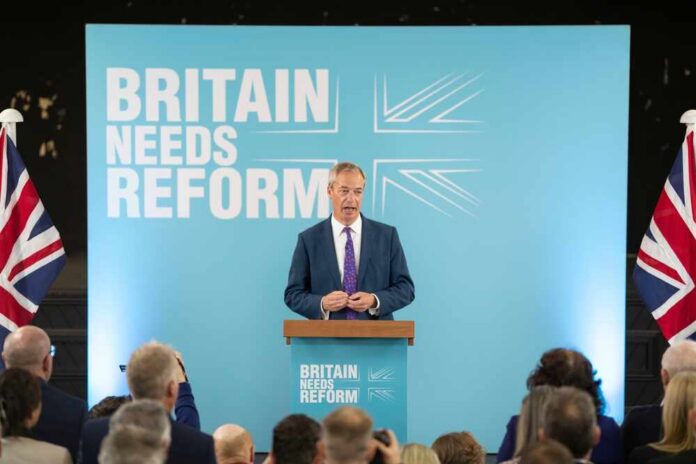
Working-class patriots and older Brexit voters are powering Reform UK’s stunning poll lead, flipping traditional politics on its head and challenging globalist elites across the pond.
Story Highlights
- Reform UK leads polls at 31%, projected to win 335 seats for outright majority despite first-past-the-post hurdles.
- Support peaks at 36% among 60s age group, only 9-12% under 30s, marking sharp generational divide.
- Manual workers back Reform at 39%, professionals at 19%; poorest households at 34% versus richest at 16%.
- Social renters shift dramatically to 37% support, abandoning Labour’s 18%, signaling working-class realignment.
Reform UK’s Demographic Power Base
Nigel Farage’s Reform UK commands 31% in January 2026 Electoral Calculus polling, outpacing Conservatives at 21% and Labour at 17%. Manual workers provide 39% support, dwarfing 19% from higher professionals. Poorest households deliver 34% backing, compared to 16% from highest earners. This inversion rejects elitist conservative stereotypes, echoing frustrations with globalism and immigration that resonate with American conservatives weary of endless foreign entanglements.
Age and Class Divide Reshapes British Politics
Reform UK support surges to 36% among voters in their 60s, plummeting to 9-12% for under-30s. Men favor the party at 30% over women’s 22%, with an 17-point male lead among over-65s. Lower education levels correlate with highest backing, while social renters jump to 37% from Labour’s 18%. Leave voters form the core, confirming Brexit’s enduring realignment from class to values-based divides prioritizing sovereignty and family stability.
Historical Roots in Populist Revolt
Reform UK traces from UKIP and Brexit Party, capitalizing on decades of distrust since 2001 elections. The 2016 Brexit vote shattered class loyalties, birthing social conservative versus liberal fault lines. Post-2024, Labour’s 412 seats contrast Reform’s 15% vote but mere 5 seats under first-past-the-post. Widespread disillusionment with incumbents propels Reform’s year-long poll dominance by March 2026, mirroring demands for America First policies against overspending and open borders.
Polling Leads Meet Electoral Challenges
January projections grant Reform 335 seats for majority, though models vary to 381. Labour risks collapse to 41-85 seats, Conservatives to 70-92. Recent slight declines tie to fading immigration salience from fewer small-boat crossings and tough policies. Only 27% consider voting Reform, hampered by system biases. Immigration ranks second after anti-establishment appeal, fueling working-class shift long ignored by traditional parties.
Brexit’s structural shift promises lasting change, with energy bills and housing topping voter concerns. Reform faces governing a coalition bound by opposition, not uniform vision. Fragmentation creates multi-party races, lowering win thresholds yet heightening uncertainty. Age overrides class at times, as oldest professionals back Reform more than youngest workers.
Sources:
YouGov: How would Britain vote at the start of 2026
Electoral Calculus MRP Poll January 2026
Brookings Institution: Back to the Future? British Politics in 2026
Arden Strategies: Will Reform Stay Ahead in 2026?
Statista: UK Election Polls by Age