

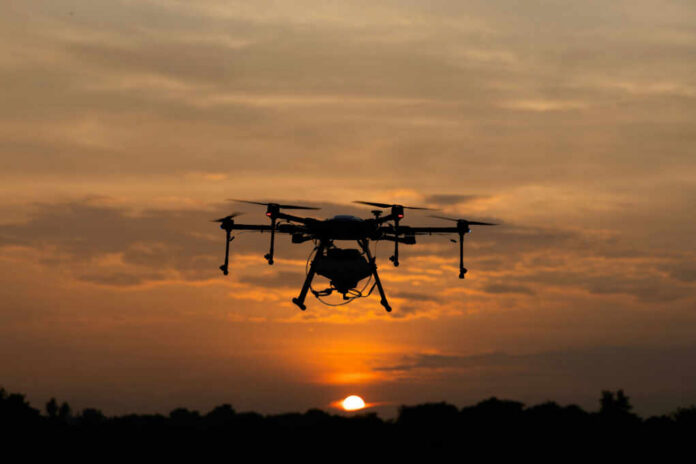
The Air Force’s next air-war plan isn’t just a new jet—it’s a pilot-controlled “family” of AI-ready drones built to overwhelm America’s toughest adversaries.
Story Snapshot
- Full-scale models of the Air Force’s “loyal wingman” drones appeared publicly at the Paris Air Show as the F-47 program moves toward crucial decisions.
- Two main Collaborative Combat Aircraft (CCA) contenders—Anduril’s YFQ-44A “Fury” and General Atomics’ YFQ-42A—are already flying after 2025 test milestones.
- The Air Force’s plan for 1,000+ CCAs reflects a shift from a single “silver bullet” aircraft to a scalable, attritable force package built for the Indo-Pacific.
- Leaders say CCAs may operate in independent squadrons and deploy alongside platforms like the F-15EX and KC-46A, widening operational options.
Paris Air Show Display Signals the “Family of Systems” Future
Paris Air Show attendees saw something that used to live mostly in PowerPoints: full-scale representations of autonomous “loyal wingman” drones meant to fly with the sixth-generation F-47 in the Air Force’s Next-Generation Air Dominance effort. The concept is straightforward: a manned fighter acts as the command node, while lower-cost, attritable aircraft push forward for sensing, jamming, and strike missions in dangerous airspace—especially in Indo-Pacific scenarios.
The public display matters because it shows the program is maturing beyond theory and prototypes. Multiple reports describe a major shift in how air dominance is pursued—less about betting everything on one exquisite aircraft, and more about building a networked package that can absorb losses and keep fighting. That “attritable” design goal is a practical answer to modern air defenses and long ranges where losing a manned jet—and a pilot—would be strategically and politically costly.
Two Drone Prototypes Are Moving Fast, With 2026 as a Decision Year
The Air Force’s current CCA competition centers on two designs: Anduril’s YFQ-44A (often associated with the “Fury” name) and General Atomics’ YFQ-42A. Both crossed major test thresholds in 2025, including ground testing beginning around May and first flights later that year—August for the YFQ-42A and October 31 for Anduril’s YFQ-44A. Those dates put real momentum behind what used to sound like science fiction.
Several outlets describe 2026 as a pivotal year for deciding how production proceeds and whether one design, both designs, or variants move forward. The Air Force has also signaled scale—at least 1,000 CCAs—suggesting this is not a niche add-on but an operational cornerstone. For taxpayers wary after years of Washington’s spending sprees, the key point is that “lower-cost, attritable” systems are being positioned as a way to expand combat power without buying only top-tier manned aircraft at premium prices.
How “Loyal Wingmen” Change Combat: Reach, Risk, and Real-Time Control
The “secret weapon” framing stems from the operational logic. Loyal wingmen are designed to extend the manned aircraft’s eyes and ears, carry sensors and weapons, probe defenses, and take on high-risk tasks that commanders would hesitate to assign to a pilot. Reporting also emphasizes cockpit-relevant control and low-latency coordination, aiming for manned-unmanned teaming that feels less like remote piloting and more like directing a coordinated formation that can rapidly pair sensors to shooters.
That architecture has direct implications for deterring peer competitors. Indo-Pacific planning is repeatedly referenced because distance and contested airspace stress traditional fighter operations. If unmanned teammates can range ahead, relay targeting data, jam enemy radar, or draw fire, the manned platform can stay farther from the threat while still shaping the fight. The Air Force’s earlier demonstrations—like Valkyrie drones sharing data with fighters—are often cited as proof the building blocks are already real, not hypothetical.
Independent Squadrons and Broader Integration Could Expand Deterrence
Air Force leaders have discussed organizing CCAs in independent squadrons, not permanently tied to one fighter unit. That approach could make drone forces more flexible—tasked to support different aircraft types and mission sets as needed. Reporting also notes deployment concepts that pair CCAs with assets such as the F-15EX and KC-46A, which signals a broader force-design shift rather than a single-program experiment. The goal is adaptable mass in a crisis, not boutique capability.
The Air Force’s F-47 Has 1 Secret Weapon: A “Family” of Loyal Wingman Droneshttps://t.co/9tEtqPeAZn
— 19FortyFive (@19_forty_five) February 7, 2026
Some details remain uncertain because core F-47 specifications and operational concepts are still closely held. What is clear from the available reporting is the direction: a Trump-era named F-47 linked to a scalable drone ecosystem, with test milestones already achieved and a major production decision window approaching. For Americans who believe national defense should be serious, focused, and rooted in reality—not ideological distractions—this is a rare example of the Pentagon pursuing capability that directly matches modern threat conditions.
Sources:
F-47’s loyal wingmen drones ‘huge deal’ for US sixth-gen air dominance programme
Forget the old F-22 or F-35: Why the new Mach 2 F-47 NGAD is more than just another stealth fighter
Air Force Begins Testing Loyal Wingman Drones to Fly Alongside NGAD
2026 will test U.S. Air Force’s bet on drone wingmen
Anduril’s drone wingman begins flight tests