

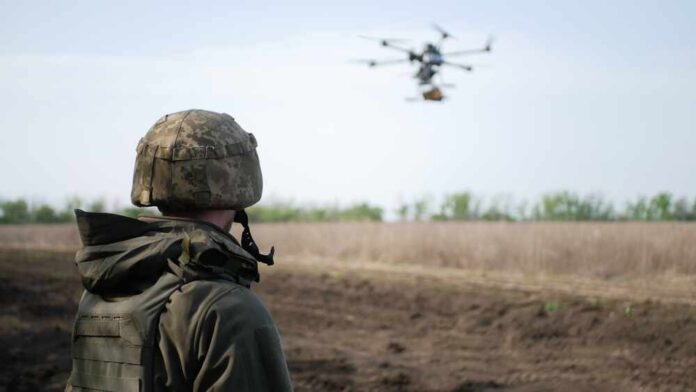
Ukraine’s “drone-on-drone” battlefield is exposing how fast modern war is becoming automated—and how unprepared the West may be for what comes next.
Story Snapshot
- Ukrainian operators describe a “roboticized” fight where drones increasingly hunt, jam, and destroy other drones, not just troops.
- Russia’s shift to fiber-optic drones and expanded electronic warfare has reduced the effectiveness of many radio-controlled FPV systems.
- Analysts warn Russia is scaling drone training and production faster, narrowing Ukraine’s earlier innovation advantage.
- Reports of widespread FPV use against civilian areas raise legal, moral, and strategic questions for U.S. and allied policy.
Drone-vs-Drone Combat Becomes the New Front Line
Ukrainian drone crews describe a war where unmanned aircraft do not merely spot targets—they fight each other for control of airspace just above the trenches. The operational emphasis has shifted toward intercepting enemy quadcopters, defeating jammers, and maintaining video links long enough to strike. The emerging picture is not a single “wonder weapon,” but an industrial system: operators, relays, repair cells, and rapid replacement cycles that keep drones in the air.
Open-source reporting and military analysis point to drones driving an extraordinary share of casualties and battlefield effects in Ukraine. Small FPV drones have filled roles once dominated by artillery spotting or manned reconnaissance, while larger “bomber” drones drop munitions and return to fly again. The conflict is also forcing constant adaptation: when one side improves jamming, the other side changes frequencies, adds autonomy, or shifts to guidance methods that do not rely on radio links.
Fiber-Optic Drones and Electronic Warfare Shift the Balance
Russian forces have increasingly paired electronic warfare with fiber-optic controlled drones, a combination designed to blunt Ukraine’s strengths. Electronic warfare can disrupt or degrade many radio-controlled FPV systems, and some reporting indicates Ukrainian FPV failure rates spiked during periods of intense jamming. Fiber-optic drones, by contrast, can be guided through a physical cable that is far harder to jam, changing how close to the front lines supplies and vehicles can safely move.
Atlantic Council analysis argues Russia has learned from Ukraine’s early drone edge and is now “winning the drone war” in important respects, largely through scaling and adaptation rather than novelty. Russian units have reportedly expanded “kill zones” where supply routes and staging areas are persistently threatened. The strategic lesson is sobering: innovation matters, but mass production, standardized training, and continuous battlefield feedback loops can matter more once both sides understand the technology.
Automation and AI: Resilience When Links Go Dark
As jamming becomes routine, both sides have incentives to automate more of the drone’s functions—stabilization, navigation assistance, target recognition, and terminal guidance. Some accounts tie Ukraine’s longer-range strikes to increasing reliance on software-enabled planning and autonomy, while Russian systems also incorporate machine-learning improvements and upgraded sensors. The trendline points to fewer “one-off” drones and more repeatable, semi-automated workflows that reduce dependence on perfect communications in a contested spectrum.
Civilian Harm Claims Raise Stakes for U.S. Policy and Values
Institute for the Study of War research argues Russia’s FPV drone campaign has institutionalized intentional civilian harm as a tool of war, a claim that—if sustained by evidence—would deepen the moral and strategic divide between Russian and Western approaches. For U.S. decision-makers and voters, the immediate relevance is not abstract: the tools, tactics, and legal arguments shaped in Ukraine can migrate quickly. How America and its allies respond will influence future deterrence and the rules that govern lethal autonomy.
For Americans watching from afar, Ukraine’s drone war is also a warning about defense readiness and spending priorities. The conflict suggests future wars could burn through cheap, expendable systems at a pace that punishes bureaucratic procurement and rewards flexible production. With Washington still arguing over budgets, borders, and overseas commitments, the central question becomes whether U.S. strategy can protect national interests without slipping into open-ended escalation—while still preparing for the kind of high-tech battlefield that is rapidly becoming normal.