
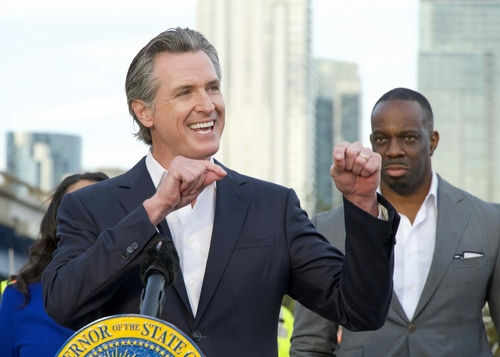
Gavin Newsom is betting Democrats can win by turning politics into personal online trolling—right as he auditions for national power in the 2026 midterm cycle.
Story Snapshot
- Gov. Gavin Newsom says he trolls President Donald Trump to “fight fire with fire” and “punch a bully back,” according to a February 2026 interview.
- Newsom is touring red-state territory to energize Democrats after Trump’s 2024 victory and to build a wider profile ahead of 2028 speculation.
- Available reporting centers on Newsom’s rhetoric and strategy, but provides limited concrete examples of the specific posts or memes he’s referencing.
- Newsom’s media approach highlights how political messaging is increasingly driven by attention tactics rather than policy debates.
Newsom’s “Punch Back” Pitch: A Strategy Built for Viral Politics
Gov. Gavin Newsom used a February 24, 2026, interview tied to his memoir Young Man in a Hurry to explain why he attacks President Donald Trump on social media. Newsom described his trolling as “putting a mirror up” to Trump’s style, arguing Democrats must respond in kind rather than sit out the fight. The reporting frames this as intentional political branding, not a one-off outburst.
Newsom’s wording matters because it’s not primarily about legislation, budgets, or governing outcomes. It’s about character warfare and the idea that ridicule is now a standard tool of opposition. For conservative voters exhausted by years of left-wing cultural pressure and elite lectures, the irony is hard to miss: Democrats who once demanded “civility” now openly market schoolyard taunts as leadership—especially when the target is Trump.
Red-State Tours and a 2028 Shadow Hanging Over 2026
Newsom’s interview comes as he travels outside California, including stops in places like Manning, South Carolina, to argue Democrats shouldn’t abandon red states and rural communities. The story positions these events as part pep rally, part repositioning exercise after the 2024 election. With Newsom nearing the end of his California tenure and building name recognition nationally, the coverage also notes the obvious subtext: his moves align with long-term presidential ambitions.
The research also highlights a second track in Newsom’s visibility strategy: high-profile media conversations that draw attention precisely because they cross ideological lines. Reports note that Newsom has spoken with conservative figures such as Steve Bannon and Ben Shapiro on his podcast, generating criticism from within his own party. That tension suggests his coalition-building pitch is real—but so is the internal Democratic fight over whether persuasion matters more than purity politics.
What We Can and Can’t Verify About the “Weird Big Hair” Meme Angle
Coverage references Newsom mocking Trump’s “brash style,” and the broader chatter around “weird big hair” memes fits that theme. Still, the provided reporting focuses more on Newsom explaining his intent than documenting specific examples of the posts he means. That’s an important limitation for readers trying to judge whether this is an isolated messaging tactic or a sustained campaign of personal mockery with a clear record of what was said and when.
Even with limited detail on the exact memes, the political direction is clear from Newsom’s own framing: the point is escalation. When a major governor publicly justifies antagonistic, personal messaging as a necessary method, it pushes American politics further away from policy accountability and closer to influencer culture. Conservatives who prioritize constitutional boundaries and real-world outcomes should see the warning sign: viral conflict is easier than governing, and it often becomes the substitute.
Why This Messaging Moment Matters More Than a Social Media Spat
Newsom is presenting his trolling as a way to “meet this political moment,” but the available facts describe a communications strategy, not a governing plan. The short-term impact is straightforward: it keeps him in headlines, energizes activists, and signals he’s willing to brawl. The longer-term impact is harder to measure from current data, yet the reporting does flag a risk: it can deepen division inside the Democratic Party and normalize even more personality-driven politics.
For Trump supporters, the political context is unavoidable. Trump is president again, and the Biden era is over—yet the opposition’s energy, at least in this snapshot, is centered on personal provocation and media theatrics. Readers looking for a serious debate on inflation, borders, spending, and federal overreach won’t find much of that in Newsom’s pitch. The documented takeaway is simpler: Newsom wants to be the face of resistance, and he’s choosing trolling as a centerpiece.
Sources:
Gavin Newsom says he’s ‘punching a bully back’ when he trolls Trump
Why Gavin Newsom refuses to be a bystander in this political moment