

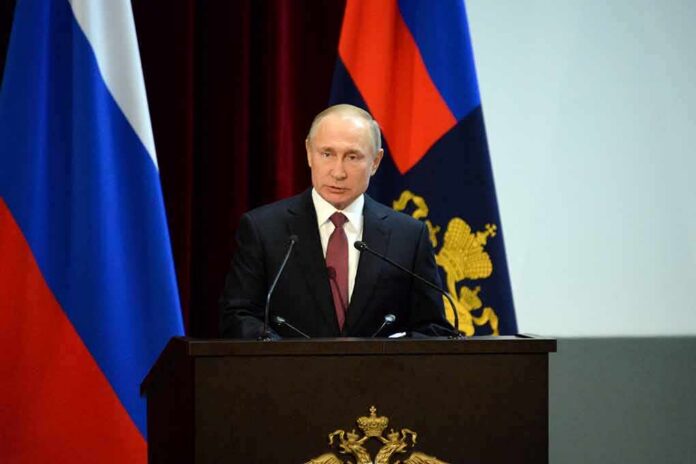
Witkoff’s “humanitarian” praise for Vladimir Putin, delivered while securing an American’s release, ignited bipartisan blowback and a debate over how the United States handles wrongful detentions.
Story Highlights
- President Trump said Russia freed U.S. citizen Stephen Hubbard with no swap required.
- Envoy Steve Witkoff publicly thanked Putin and called him a “humanitarian” during their meeting.
- Senator John Cornyn rejected the label and called Putin a “stone cold killer”.
- The clash spotlights the risks of “hostage diplomacy” and mixed signals in U.S.-Russia dealings.
What Sparked The Uproar: A Thank‑You And A Loaded Word
Steve Witkoff, President Trump’s special envoy, met Vladimir Putin in St. Petersburg and thanked him for freeing 74‑year‑old American Stephen Hubbard after more than four years in Russian custody. Witkoff added that Putin was a “humanitarian,” a remark captured on camera during the exchange. The description came as Putin said Hubbard was at the airport ready to depart, and as the White House framed the release as unilateral rather than a prisoner trade.
President Trump said the release required no “swap,” casting it as a win that did not trade away U.S. leverage. Reports also noted the United States had deemed Hubbard wrongfully detained, which made his freedom a clear humanitarian outcome for his family. Still, the comment praising Putin’s character moved the focus from an American’s homecoming to a fight over labels, timing, and the message sent to adversaries who detain U.S. citizens.
The Facts On Hubbard’s Release And The Competing Frames
Reports stated Putin tied the release to a direct request from President Trump and that Hubbard would depart from Pulkovo Airport the same day. Coverage emphasized that the action was not a prisoner exchange, which separates it from many past cases that required concessions. That framing supports a narrow humanitarian outcome: one American goes free without a swap. It does not by itself prove a broader pattern of humanitarian conduct by Russia’s leader.
CBS reported that Trump also connected the release to the decision to halt new sanctions from taking effect the prior week. That link raises a core policy question: was the release goodwill, leverage, or both? Without public documents on the decision chain, terms, or legal orders, the record shows a result and two narratives. One celebrates an American’s return. The other warns that praise, absent proof of broader change, can whitewash coercion.
Backlash From Capitol Hill And The Political Cost
Senator John Cornyn responded directly on X, writing, “No. Putin is stone cold killer,” rejecting Witkoff’s label. The Hill reported similar criticism from other lawmakers, who argued that the word “humanitarian” ignores Russia’s conduct in Ukraine. Cornyn has pushed efforts to document Russian war crimes, signaling why many in Congress bristled at any moral gloss on the Kremlin, even in the context of freeing an American.
This bipartisan blowback shows a predictable pattern. Public flattery of an adversary invites a storm, even when tied to a concrete win. Voters see the moral stakes in plain terms. Lawmakers also fear that soft language rewards hostage diplomacy, where detaining regimes push for lighter sanctions, trade perks, or reputational boosts in return for releases—gains that can encourage more arrests of Americans, not fewer.
What Conservatives Should Watch: Wins, Words, And Leverage
Conservatives can credit the Trump Administration for getting an American out with no swap, which protects U.S. strength. At the same time, officials must guard their language. Praise that stretches past the facts risks weakening the moral line that keeps pressure on hostile regimes. The safer north star is simple: welcome home our citizens, keep sanctions leverage ready, and avoid public words that adversaries can spin as absolution.
**𝕏-1. [new] US envoy Witkoff meets Putin in St. Petersburg; Russia agrees to resume trilateral Ukraine talks**
**Frame — what people think:** A breakthrough in Trump’s push to end the Ukraine war via shuttle diplomacy, yielding hostage release and renewed trilateral talks.… https://t.co/da9Vc8YCgk
— GrumpyNews, emotionally clean news. (@GrumpyNews_) October 21, 2026
Next steps should focus on documentation, not speculation. The administration can release non-sensitive details that confirm the nature of the ask, any conditions, and the legal basis Russia used to free Hubbard. Congress can continue oversight on wrongful detentions and strengthen tools that punish state hostage-taking. That mix—tough policy, clear proof, and measured words—secures Americans while protecting U.S. credibility and constitutional values against coercive diplomacy.
Sources:
cbsnews.com, nytimes.com, npr.org, cbc.ca, thehill.com, yahoo.com, cornyn.senate.gov, rmf24.pl