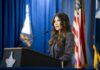

A Catholic activist’s bold defense of anti-Zionism at a White House antisemitism hearing triggered her swift ouster from Trump’s Religious Liberty Commission, exposing raw fissures in conservative ranks.
Story Snapshot
- Carrie Prejean Boller interrupted testimony to defend Candace Owens and challenge Israel’s Gaza actions, prompting chair Dan Patrick to halt her and remove her days later.
- The February 9, 2026, hearing in Washington, D.C., spotlighted clashes between pro-Israel evangelicals and anti-Zionist Catholics over antisemitism definitions.
- Boller refused resignation calls, accusing Patrick of a “Zionist political agenda,” while Owens praised her as speaking truth against “Zionists.”
- Incident reveals MAGA infighting, testing Trump’s coalition on religious liberty priorities versus Israel loyalty.
- As of February 12, Boller remained listed on the White House site despite Patrick’s X announcement of her removal.
Commission Formation and Boller’s Appointment
President Trump established the Religious Liberty Commission in May 2025 via executive order. The body advises the White House Faith Office and Domestic Policy Council on religious liberty policies amid rising campus antisemitism since the October 2023 Israel-Hamas war. Carrie Prejean Boller joined in June 2025. Known for her 2009 Miss California USA stance against same-sex marriage and anti-COVID restriction activism, she brought Catholic perspectives to the panel. Trump delegated operations to chair Texas Lt. Gov. Dan Patrick, an evangelical leader.
Disruption at the Antisemitism Hearing
On February 9, 2026, the commission’s fifth public hearing in Washington, D.C., examined religious liberty issues tied to antisemitism, including the ideologies behind it and private-sector threats. Witness Shabbos Kestenbaum, a former Harvard student and antisemitism activist, testified on campus incidents. Boller interrupted to defend Candace Owens against antisemitism charges. She questioned equating anti-Zionism with antisemitism, challenged Israel’s Gaza operations, and declared Catholics reject Zionism. Patrick halted her questioning to restore order.
Escalation and Removal Decision
Boller refused resignation demands on February 10-11, posting on X that Patrick lacked authority and pursued a “Zionist political agenda.” She vowed not to “bend the knee to Israel.” Patrick announced her removal on February 11 via X, stating she “hijacked” the hearing for a personal political agenda. This marked his unilateral decision as chair to enforce decorum. Owens defended Boller on February 12, calling her words true against “Zionists” hostile to Catholics. Kestenbaum praised the ouster.
Divisions and Power Dynamics
Patrick’s chair authority overrode Boller’s equal-member claims, reflecting evangelical pro-Israel dominance over Catholic anti-Zionist views. Motivations diverged: Boller championed Owens’ free speech and Christian doctrine over Israel loyalty; Patrick prioritized antisemitism focus. Tensions mirror MAGA splits between pro-Israel establishment and populist skeptics. Trump stayed silent, delegating to Patrick. Influencers like Owens amplified the clash via social media, turning it viral.
Implications for Religious Policy
Short-term, the episode fractures the commission, risking delays in its antisemitism report. Long-term, it pressures Trump’s religious policies toward pro-Israel alignment or Catholic inclusion. Evangelicals and pro-Israel groups gain; anti-Zionist Catholics feel alienated; Jewish communities welcome relief; MAGA base divides. Socially, it fuels culture wars on Israel; politically, it tests coalition unity before midterms. Scrutiny rises on faith advisory bodies, echoing Interfaith Alliance lawsuits over “Judeo-Christian” bias.
Sources:
Trump Religious Liberty Commission Boots Member After Contentious Antisemitism Hearing
Donald Trump’s Religious Liberty Commission Descends Into Unholy Mess Over Beauty Queen’s Expulsion
FACA Complaint by Democracy Forward