

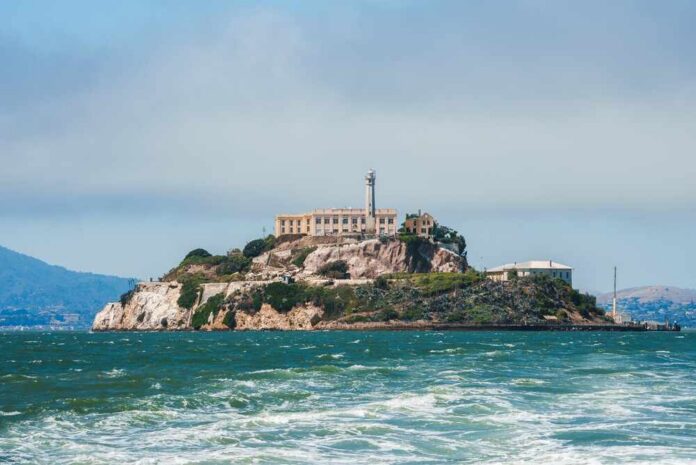
Trump’s plan to turn Alcatraz back into a federal prison is colliding with Washington’s budget reality—and conservatives are asking why “tough on crime” always seems to come with a multi-billion-dollar price tag.
Story Snapshot
- The White House FY2027 budget proposal requests $152 million to begin rebuilding Alcatraz into a modern high-security prison.
- The administration’s request follows President Trump’s earlier directive to reopen and expand Alcatraz for “ruthless and violent offenders.”
- Alcatraz has been a National Park Service tourist site for decades, so a prison conversion would require major operational and political changes.
- Supporters see a tough-on-crime symbol; critics highlight the historic cost problem and the projected total price near $2 billion.
$152 Million to Start: What the Budget Request Actually Does
The White House has asked Congress for $152 million in the fiscal year 2027 budget proposal to cover the first year of rebuilding Alcatraz into what it describes as a “state-of-the-art secure prison.” The money would go to the Federal Bureau of Prisons under the Department of Justice, and it is presented as a beginning rather than a full commitment. The larger concept reportedly approaches roughly $2 billion, but Congress has not approved any of it.
The request matters because it moves the idea from a headline-grabbing presidential directive into the budget process where real tradeoffs begin. Conservatives who have watched Washington burn money for decades tend to support law-and-order policies, but many also want spending discipline and results. A down payment of $152 million invites a basic question: is this a targeted solution to violent crime and prison security, or the first step into another open-ended federal project that balloons beyond its original promise?
From “Escape-Proof” Legend to Park Service Attraction—And Back Again?
Alcatraz operated as a federal penitentiary from 1934 to 1963 and built its reputation on geography as much as bars: an island in San Francisco Bay, frigid waters, and strong currents. The facility ultimately closed after years of cost problems, with the site later shifting to the National Park Service and becoming a major tourist destination. Any return to prison status would require unwinding decades of management, infrastructure, and public access built around tourism rather than incarceration.
That history cuts both ways for the administration’s pitch. The island’s isolation can look like a natural answer for housing the most violent offenders, especially when the federal system faces capacity and security pressures. At the same time, Alcatraz’s last chapter as a prison ended in part because it was expensive to operate compared with other facilities. Rebuilding it into a modern prison means more than repairs; it means designing a high-security complex that meets today’s standards in a challenging location.
Congress Holds the Power: A Proposal Is Not a Vote
The administration’s budget request is a proposal, not a binding decision. Congress must review and approve any appropriation, and lawmakers can reject, reduce, or redirect the funds. That political reality is central to how this story develops, because the project would likely require multiple years of funding to reach anything like full operation. For fiscal conservatives, the key test is whether lawmakers demand hard numbers, clear milestones, and a credible plan before writing checks.
The proposal also tees up a governance fight between federal agencies and local stakeholders. The National Park Service currently operates Alcatraz as a public site, and converting it into an active prison could disrupt tourism patterns tied to the Bay Area economy. Those tensions give opponents leverage in the appropriations process, especially if they argue the project is more symbolism than strategy. Supporters counter that public safety and prison security should outweigh a sightseeing economy built on a former penitentiary.
Politics, Backlash, and the Conservative Debate Over Priorities
Democratic critics have already signaled they will attack the idea as wasteful, with Rep. Nancy Pelosi quoted calling it Trump’s “stupidest initiative yet.” That kind of messaging is designed to paint the plan as unserious and to force Republican appropriators into a defensive crouch. The White House, by contrast, appears to be framing the project as a tough-on-crime statement that matches the president’s earlier call to reopen a “substantially enlarged and rebuilt” Alcatraz for violent offenders.
For Trump-supporting voters, the deeper issue is whether “tough on crime” can be delivered without repeating the federal habit of overspending and underdelivering. Many conservatives want dangerous criminals off the streets and behind bars, but they also want a government that respects limits, sets priorities, and doesn’t treat taxpayers like an endless slush fund. With only early-stage budget details available so far, the public still lacks key information: projected operating costs, staffing needs, timelines, and how the plan compares with expanding existing high-security capacity elsewhere.
Sources:
Trump requested $152 million to rebuild Alcatraz prison, closed in 1969
Trump seeks $152 million to reopen Alcatraz as active prison