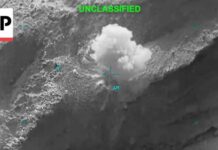


As Ukrainian drones hammer Russia’s oil export hubs, some are now straying into NATO airspace over Europe, raising fresh questions about war, borders, and energy security that Washington’s globalists helped create.
Story Snapshot
- Ukraine is openly targeting Russian oil export terminals to choke off Moscow’s war revenue.
- Major Russian ports like Primorsk, Ust-Luga, and Novorossiysk have been forced to halt or cut exports after drone strikes.
- Some Ukrainian drones have crossed into Baltic and Nordic airspace, stirring concern among European allies.
- The campaign is disrupting global oil supplies and reminding Americans how fragile energy security becomes when policy is driven by green ideology and foreign entanglements.
Ukraine Targets Putin’s Oil Lifelines On The Seas
Ukrainian leaders are no longer vague about their strategy: they are going after the oil cash that fuels Vladimir Putin’s war machine.[3] Ukrainian drones have repeatedly struck Russia’s key oil export infrastructure, including the huge Primorsk terminal on the Baltic Sea and oil facilities tied to what Kyiv calls Russia’s “shadow fleet” of tankers used to dodge Western sanctions.[3] President Volodymyr Zelenskyy has publicly boasted that strikes have disabled tankers and damaged port infrastructure, arguing that every barrel Russia cannot sell is one less funding Moscow’s invasion.[3]
Russian officials and regional governors have been forced to admit the impact. In Russia’s northwest, Governor Alexander Drozdenko acknowledged that a nighttime drone strike triggered a blaze at Primorsk, Russia’s largest Baltic oil port, while separate attacks hit other oil sites in the region.[3] In the Black Sea, drone and missile strikes have also slammed Novorossiysk, one of Russia’s main export hubs, temporarily halting shipments equal to about two percent of global oil supply and pushing world prices higher.[8] These are not pinprick raids; they are systemic hits on export arteries.
Russia’s Export Capacity Takes A Major Hit
Independent reporting backs up Kyiv’s claim that this is more than symbolism. Reuters, cited by multiple outlets, estimates that Ukrainian drone attacks have knocked out roughly forty percent of Russia’s total oil export capacity, cutting into volumes from both Baltic and Black Sea ports.[2] Loadings at Primorsk and Ust-Luga have been suspended more than once after repeated strikes set storage tanks and loading racks ablaze, with smoke from Ust-Luga’s fires reportedly visible from Finland and stretching for dozens of kilometers along the Gulf of Finland coastline.[1][2]
These attacks are also rippling across Russia’s wider export network. Earlier operations damaged infrastructure tied to the Druzhba pipeline, which carries Russian oil to European markets, and naval drone strikes near Novorossiysk disrupted exports for both Russia and Kazakhstan, sparking a protest from Kazakhstan that accused Ukraine of hitting what it called an “exclusively civilian facility.”[7] For Europeans who still depend on imported energy, these shocks are a reminder of the strategic cost of shutting down reliable production at home while leaning on unstable foreign suppliers.
Stray Drones And NATO Airspace Concerns
As Ukraine pushes its drone range deeper into Russian territory and up toward the Baltic Sea, some systems have not stayed neatly within Russian borders. Reporting notes that Ukrainian drones have crashed in neighboring countries such as Estonia, Latvia, and Finland, with at least one Ukrainian model identified after coming down near the Finnish city of Kouvola.[2] Officials in those states have described incidents without casualties or major damage, consistent with drones going off course rather than deliberate strikes on NATO territory.[2]
The battle in the skies helps explain why things can go wrong. Russia’s defense ministry has claimed to destroy swarms of incoming drones—hundreds in a single night in some cases—using dense air defenses and heavy electronic warfare measures.[1][2][3] Analysts describe Ukraine deliberately probing and degrading Russian radar and surface-to-air missile sites to open corridors for long-range drones.[5] In a crowded, jammed battlespace like that, navigation failures and interference become more plausible, though there is still no hard forensic proof in the public record tying specific border incursions to Russian jamming.[2][5]
Legal, Safety, And Information Battles In Europe
Supporters of Ukraine’s campaign argue that oil terminals, refineries, and export tankers are legitimate military targets because their revenue directly funds Russia’s invasion.[3][5] Think tank analysis frames the strikes as modern warfare against an adversary’s war economy, pointing out that energy infrastructure has long been targeted in major conflicts.[5][7] What is missing so far is a detailed legal opinion under international law, or transparent evidence of how each strike is vetted to reduce civilian risk, leaving critics room to claim escalation or recklessness.[3][5][7]
Ukraine's Drone Campaign Shuts Down Russian Oil Refinery — Syzran Offline for a Month as Kyiv Hits Deeper Into Russia
Ukraine struck the Syzran oil refinery in western Russia on Thursday, killing two people and forcing the facility offline for potentially a month.… pic.twitter.com/pIbI9YFjDS
— Unbiased Headlines (@UnbiasedHdlns) May 25, 2026
Public opinion is being shaped less by dry legal debates and more by dramatic images: burning terminals, halted tankers, and headlines about drones straying into NATO skies.[1][2][3] Russian officials blast out their own narrative, trumpeting shootdowns and casting every errant drone as proof that Ukraine is irresponsible and dangerous near alliance borders.[1][2] Without clear, technical investigations of each airspace incident and without strong, unified messaging from Western governments, that information war leaves room for confusion—a dynamic Americans have seen before when foreign conflicts, energy shocks, and media spin collide.
Sources:
[1] Web – Ukraine Hits Russian Black Sea Oil Terminal For Second Time In 4 …
[2] Web – Key Russian Oil Terminal Hit Again By Drones – Radio Free Europe
[3] Web – Ukrainian strikes hit key Russian oil infrastructure … – CBS News
[5] Web – Russia threatens Europe as Ukraine escalates strikes on Putin’s oil …
[7] Web – Quantifying Ukraine’s Strikes on Russian Energy Infrastructure
[8] YouTube – Russia, Ukraine trade drone strikes on cities and oil refineries