
The most unsettling part of the Bryan Kocis case is not the brutality of the killing, but how a quiet suburban house fire almost convinced the world that the real story was just smoke and bad luck.
Story Snapshot
- A burned body in a Pennsylvania house looked like a tragic fire, until stab wounds and a nearly severed throat said otherwise.
- Dental records, digital breadcrumbs, and money motives pulled detectives past the ashes into a world of rival porn producers.[1][3]
- Juries and plea deals locked in the official story, but the public mostly got the cable-ready, streamlined version.[1][3]
- The case shows how arson, technology, and media spin can decide which truth about a murder survives.[1][4]
The night a fire tried to erase a homicide
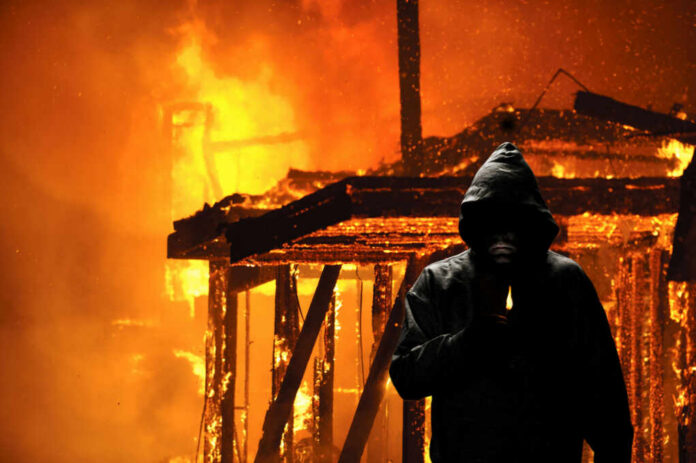
On a winter night in 2007, firefighters rolled up to what looked like every chief’s nightmare and every neighbor’s gossip: a house in Dallas Township, Pennsylvania, engulfed in flames.[1] When crews finally pushed through the smoke, they found what the fire had tried to hide. The body on the floor was burned beyond recognition, but the wounds told a different story. Reports say Bryan Kocis had been stabbed roughly two dozen times, his throat slashed so deeply it was nearly a decapitation.[1]
The fire, in other words, was not the crime. It was the cover. That distinction matters. The blaze could have written off Kocis’s death as a tragic accident, especially in a system already overloaded with real ones. Instead, the autopsy and scene work pushed investigators toward homicide, and toward the uncomfortable reality that someone was willing to turn a man’s home into an inferno to make a murder disappear.[1] This is where serious policing and basic common sense converged.
From charred remains to a name, a business, and enemies
The burned corpse in that house did not carry a wallet, but it did carry teeth. Dental records confirmed the remains were those of Bryan Kocis, a gay porn entrepreneur behind Cobra Video who had already seen controversy over his work and over his choice of talent.[1][4] Once his identity was confirmed, the victim stopped being an anonymous fire casualty and became a businessman with a list of rivals, lawsuits, and financial entanglements. That shift in frame is crucial in any homicide investigation.
Detectives did not find the story by sifting through ashes alone. Reporting describes how investigators followed phone records, a rental car trail, and motel registrations to two Virginia Beach escorts and producers, Harlow Cuadra and Joseph Kerekes.[3] These were not vague hunches. Cellphone pings placed them on the road to Pennsylvania. A rental car tied their movements to Kocis’s town. Motel paperwork and receipts sketched out dates, times, and opportunity windows.[3] That kind of digital trail is the twenty-first-century equivalent of muddy boot prints.
Greed, recorded words, and courtroom certainty
According to later coverage, the motive that emerged was not mystery-novel elaborate. It was greed. Cuadra and Kerekes allegedly saw Kocis as both a gatekeeper to a valuable performer and an obstacle to their business ambitions.[3][4] In a culture where we pretend everyone is purely driven by passion and self-expression, this case hammered home an old conservative insight: when big money collides with weak character, law and morality usually get trampled first.
The case did not hinge solely on circumstantial data points. Reports describe taped conversations and confessions in which the men implicated themselves in the killing.[3] One of them, Kerekes, eventually pleaded guilty to second-degree murder and related charges, trading a trial for a life sentence.[1][3][4] The other, Cuadra, went before a jury and was convicted of first-degree murder and more, drawing a life term without parole.[1][3] Those outcomes mean that, in the eyes of the law, the murder-plus-arson narrative is not just a theory; it is the established reality.
What the public never sees behind the true-crime polish
Television retellings and summaries now present the sequence as settled: Kocis was murdered, then his house was set on fire to destroy evidence and confuse investigators.[1] That consistent storyline across articles, books, and documentaries reflects a genuine convergence of evidence. Yet the material most people actually encounter is a thinned-out version of the record. Viewers get the wiretaps and dramatic reenactments, not the fire-marshal diagrams, the full autopsy, or the hours of forensic testimony.
The gaps matter if you care about how truth is built and defended. The accessible sources here are secondary and entertainment-driven; they do not reproduce the medical examiner’s detailed conclusions about pre-fire versus post-fire injuries, or the fire investigator’s technical basis for calling the blaze an intentional cover-up rather than a tragic accident.[1][3] They also do not quote defense experts at length. That does not mean the convictions are unsound. It does mean anyone serious about challenging or confirming the narrative should want the actual reports, not just the dramatized shorthand.
What this case says about justice in a digital, media-saturated age
The Kocis case sits at the intersection of three forces that now shape most serious crime stories: forensic science, digital paper trails, and media packaging. Fire no longer reliably erases a body or a past; teeth, electronics, and network records fight back.[1][3] At the same time, once prosecutors win a conviction, institutions tend to close ranks around that version of events, and television producers polish it into something simple enough to fit between commercials.[4]
For readers who value both law and truth, the lesson is twofold. First, be grateful that killers cannot count on a can of accelerant to outsmart modern forensics. Second, be cautious about treating any cable-ready narrative as the final word simply because it aligns with a verdict and makes for good ratings. Justice requires facts, not just fire, and facts live in transcripts, reports, and evidence logs that most people never see.[1][4]
Sources:
[1] YouTube – The House Fire Hid A Murder | Lethally Blonde | ID
[3] Web – The Case of the Cobra Killer | Out.com
[4] Web – Cobra killer: “We were blurred and blinded by greed, and … – WTKR