
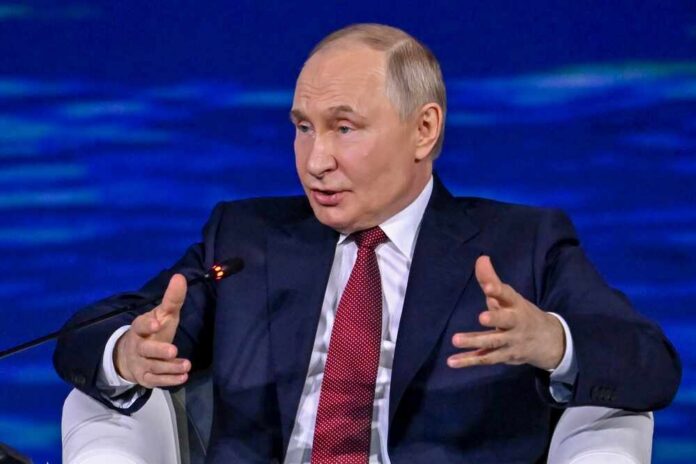
Vladimir Putin looks strong from the outside, but the cracks now run through his war, his budget, and his grip on the future.
Story Snapshot
- Russia is fighting a long war, and the costs keep rising faster than the Kremlin can hide them.
- The budget is under strain, while defense spending still gets priority over relief elsewhere.
- Military pressure, fuel trouble, and public discontent are feeding a harder question: how long can this balance hold?
- Even so, Russia still has coercive power, and that keeps collapse from being automatic.
A War That Eats Everything Around It
The central problem is not one crisis. It is three at once. Russia faces battlefield strain, fiscal pressure, and political fatigue at the same time. Le Monde reports that the first four months of 2026 already produced a budget deficit 55 percent above the annual forecast, while the government cut its growth outlook from 1.3 percent to 0.4 percent [1]. That kind of downgrade matters because it shows the state is losing room to breathe.
The Kremlin still chooses war over repair. Bloomberg Television reports that Putin told officials to find savings but not to cut defense spending, even as the deficit climbed to 2.5 percent of gross domestic product [10]. That is the hard part of the story. A ruler can order sacrifice for a while. He cannot do it forever without making other parts of the system pay the bill.
Pressure Inside Russia Is Real, But It Is Uneven
Discontent is not the same thing as revolt. Le Monde says authorities still keep control over elites, and ordinary people adapt to worsening conditions [1]. That matters because Russian politics is not a free market of opinion. It is a managed system built to absorb anger, redirect blame, and close off easy exits. In that setting, public frustration can grow for years before it becomes a direct threat to the ruler.
That is why the counter-case cannot be dismissed. CSIS says Putin’s pain tolerance is high, while social pressure at home remains limited [9]. In plain terms, he has shown he can accept damage that would shake weaker leaders. He also keeps pressing the same aims in Ukraine rather than retreating from them [9]. For him, backing down may look more dangerous than pressing on.
The Military Problem Is Not Solved by Optics
The war still drains Russia’s strength. Le Monde describes a stagnant economy, a stalemate in Ukraine, and more Ukrainian attacks on Russian soil [1]. Those are not small irritants. They are the daily signs of a grinding conflict that no longer promises a quick win. The longer the war lasts, the more it turns into a contest of endurance, not just force.
At the same time, Russia has not run out of tools. The Council on Foreign Relations says Ukrainian strikes and Russian nuclear threats continue to shape the conflict [6]. That is important because outside governments do not treat Russia as a cornered state. They treat it as a dangerous one. A cornered leader can be reckless, but a leader with credible escalation threats still has leverage.
Fuel shortages show how the pressure reaches daily life. The Russian government has used export bans and extra imports from Belarus to ease gasoline trouble . Those steps may buy time, but they also admit the problem exists. Wartime systems can patch holes. They cannot make them disappear. When a state starts managing shortages instead of preventing them, the stress has already moved deeper into the machine.
Why Collapse Is Not the Same as Weakness
The strongest case against the “nothing can save him” frame is simple: authoritarian systems can look brittle and still survive. CSIS argues that Russia continues to pursue its main goals, including forcing Ukraine into neutrality and keeping the war going [9]. That means Putin still acts like a man who believes time is on his side. He may be wrong, but he is not behaving like someone preparing to quit.
Yet the deeper risk is that survival and strength are not the same thing. A regime can keep going while still becoming poorer, harsher, and more dependent on force. That is the trap. The war does not need to end in instant collapse to become dangerous for Putin. It only needs to keep making each new year more expensive than the last. That is the pressure point worth watching.
Sources:
[1] Web – Putin Is in a Perilous Position. Nothing Is Going To Save Him.
[6] Web – What Putin Fears Most | Journal of Democracy
[9] Web – Putin’s Crisis | FRONTLINE | PBS | Official Site | Documentary Series
[10] Web – Putin’s Two-Front War – Council on Foreign Relations