

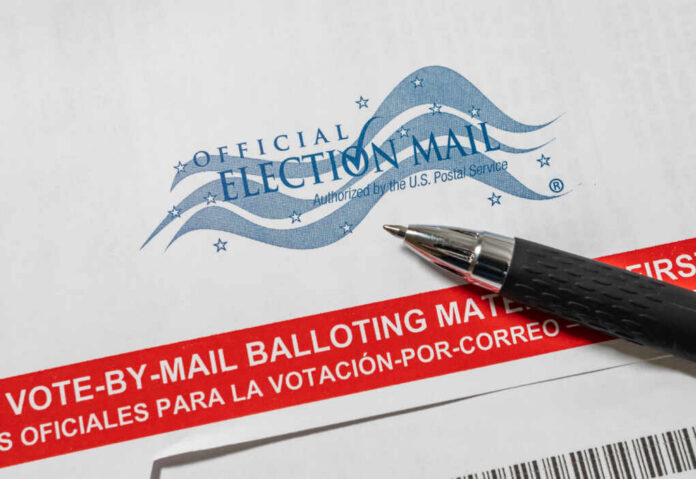
Wisconsin election officials say Green Bay’s clerk broke state law by mailing duplicate absentee ballots, and then let it happen again just months later.
Story Snapshot
- Green Bay’s clerk twice mailed **duplicate absentee ballots** to voters in 2026, despite a formal warning after the first incident.
- Wisconsin Elections Commission staff found **probable cause** that state law was violated when 152 voters got two ballots in April.
- Officials clearly state **“at no time” may two identical live ballots go to the same voter**, rejecting the clerk’s defense.
- Republicans are demanding a deeper investigation and tougher safeguards to protect **election integrity** statewide.
WEC Staff: Duplicate Ballots Cross the Line, Not Just a Glitch
Wisconsin Elections Commission staff reviewed Green Bay’s April election and concluded there is probable cause the city clerk violated state law by sending duplicate absentee ballots to 152 voters. Their draft memo lays out a simple rule: “At no time should there be two identical ‘live’ ballots issued to the same elector,” making clear this is more than a harmless mistake. Staff recommend ordering Clerk Celestine Jeffreys to follow the law and issue only one ballot per voter, unless a specific, valid reason exists.
Commission staff also highlight that Wisconsin’s system already expects clerks to tightly track every request, ballot issued, ballot returned, and ballot counted. Those safeguards only work if local officials follow them. In Green Bay, the clerk sent second ballots without using required “spoiling” steps for the first ones. Even if double votes were caught later, officials stress that issuing two live ballots is itself the problem, because it breaks the chain of custody voters must be able to trust.
Green Bay Clerk Blames Printing Errors as Mistakes Repeat
Green Bay City Clerk Celestine Jeffreys has tried to frame both incidents as printing mishaps, not lawbreaking. For the April election, she said a mid-March blizzard closed city hall, staff rushed, mailing labels were printed twice, and 152 voters received duplicate ballots before anyone noticed. City officials admit the error and say none of the duplicate ballots were ultimately counted, pointing to daily audits of returned ballots and careful review at “central count” as backstops against double voting.
The trouble for Jeffreys is that the issue happened again for the August primary. Over the weekend, the city announced that voters in seven wards and part of an eighth may have received duplicate ballots, with about 5,000 absentee ballots mailed overall. Jeffreys again blamed a “certificate label printing error” and promised a letter telling affected voters to use only one ballot. However, city officials have not disclosed how many duplicate ballots were sent this time, raising questions about how serious they are about fixing the underlying process.
Republicans Press for Investigation and Real Safeguards
The Republican Party of Wisconsin is not satisfied with Green Bay’s “no harm, no foul” defense and has formally asked the Wisconsin Elections Commission to investigate both mailings. In its brief, the party says the city’s response “should shock the conscience” and argues that the law does not turn a blind eye just because officials claim no one voted twice. Their complaint stresses that issuing unauthorized duplicate ballots without following spoiling procedures breaks absentee ballot rules and undermines confidence in the system.
After the second round of duplicate ballots, Wisconsin Republicans renewed calls for a full probe and stronger safeguards statewide. They point out that Green Bay’s clerk and the Elections Commission had advance notice after the April incident, yet voters were again sent two ballots before the August primary. For many conservatives, this looks less like a one-time glitch and more like a pattern of sloppy election management in a Democrat-run city, echoing similar mass-duplicate mailings seen in Madison in 2023. The message from the right is simple: if officials cannot even send one ballot per voter, citizens cannot be asked to simply “trust the process.”
Why This Matters for Mail Voting and Trump-Era Election Integrity
Across the country, mail-in voting expanded after 2020 and remains well above pre-pandemic levels. Research shows proven fraud in mail voting is rare, but it also notes that complex systems can suffer administrative errors. Incidents like Green Bay and Madison, where thousands of duplicate absentee ballots were mailed due to data or printing problems, fit that pattern. Each time, local officials insist barcodes and envelopes prevent double counting, yet they ask voters to accept confusion and mistakes as the new normal.
For Trump supporters who watched left-leaning cities push mass mail voting while dismissing concerns, the Green Bay case hits a nerve. Wisconsin Elections Commission staff are now saying clearly that sending two live ballots to one voter is not okay under state law. Still, the final ruling is pending, and media voices already downplay the issue as a minor glitch that “doesn’t cause issues.” Conservatives see a different risk: every time rules are bent for convenience, the door opens wider for abuse, confusion, and loss of trust in the vote — the very foundation of our constitutional republic.
Sources:
townhall.com, fox11online.com, wislawjournal.com, wispolitics.com, pro.stateaffairs.com, facebook.com, myvote.wi.gov, vote411.org, wpr.org