
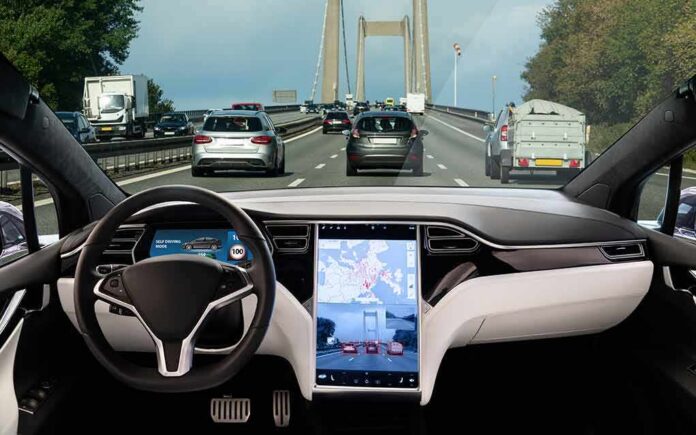
Tesla says its new self-driving update cuts safety-critical driver takeovers by 25 times, but it won’t share the baseline that proves it.
Story Highlights
- Tesla claims a 25-fold drop in “critical interventions” with Full Self-Driving v15, tied to a new vision system.
- The company has not published the starting rate, miles, or method, limiting outside verification.
- Analysts warn intervention gains do not equal lower crash rates or ready robotaxi economics.
- Studies say robotaxi costs hinge on high utilization and clear safety data, not marketing claims.
Tesla’s 25x Claim And What It Actually Measures
Tesla began rolling out Full Self-Driving version 15 in the United States and said it improves “critical intervention” performance by 25 times. Tesla tied the gain to a new shared vision encoder trained on millions of internet videos for better handling of risky moments. The company framed the metric as a fleet-wide effect, not a single demo. Tesla’s self-driving lead said the boost is hard to notice on one drive and shows up over millions of miles.
Outside outlets reported the core weakness: Tesla did not share the underlying rate, the total miles, or the definition of “critical.” Without that denominator, no one can tell whether drivers took over once every few hundred miles or far more rarely in version 14, so the new result cannot be checked or compared to set safety bars. Commentators also stressed the claim is about intervention frequency, not a crash rate or a comparison to human driving.
Verification Gaps And Why They Matter For Safety
Automotive World highlighted that Tesla supplied only the multiplier and withheld the base figure needed to compute miles between critical interventions. The outlet noted crowdsourced logs suggested version 14 managed a couple thousand miles between critical events, implying around fifty thousand miles if the 25x figure held fleetwide, but stressed those miles are not Tesla’s published data. Analysts warned that a large relative gain does not prove fewer crashes, because interventions and crashes are different measures.
Academic and industry reviews show that takeover and disengagement rates vary widely and lack a standard method. That makes cross-company claims easy to market but hard to compare or audit. One review notes that disengagement metrics must be tied to a defined operating area, weather, traffic mix, and exposure miles to carry safety meaning. Without a published method, outsiders cannot tell which driver actions qualified as “critical,” or how near misses were handled in the count.
Economics: Savings Need Real Miles, Real Costs, Real Audits
The big pocketbook question for families is simple: will robotaxis lower costs for rides or commuting? Economic studies say the answer depends most on very high utilization, long annual mileage, and controlled operating expenses like insurance, cleaning, and remote support. A peer-reviewed summary notes that capacity use and yearly miles drive competitiveness more than hype, with vehicle cost and lifespan also key. That means marketing multipliers do not settle the savings case.
Independent modeling finds that autonomous taxi services can beat traditional taxi costs when labor shares drop, but only if vehicles run many hours per day and avoid long idle time. If utilization stays low, per-mile costs rise fast due to fixed capital, maintenance, and oversight expenses. Prior work from universities and trade studies has warned that insurance, sanitation, and safety staff can erase savings when fleets are small or geofenced too tightly.
What Would Prove Robotaxis Can Boost The Economy
Clear evidence would include audited miles between safety-critical takeovers, per-mile crash and injury rates versus human drivers on the same roads, and transparent accounting for vehicle cost, charging, cleaning, remote help, repairs, and insurance. Regulators and riders also need to see results for bad weather, work zones, and emergency vehicles. Publishing a full method and an auditable dataset would let third parties verify both safety and costs before cities open wider lanes to driverless service.
TESLA $TSLA — Robotaxi Finds a New Business Inside Tesla
Tesla is beginning to use Robotaxi rides for customers waiting on vehicle repairs, potentially reducing a recurring service expense while putting its autonomous fleet to work.
An Austin owner reported receiving an in-app…
— MentoviaX (@MentoviaX) November 20, 2026
For conservative households squeezed by years of inflation and high energy prices, real savings beat slogans. If robotaxis cut family transport costs without sacrificing safety or freedom to choose, that is a win. But if companies hide the math and rush deployment, taxpayers could face bailouts, higher insurance, or new mandates. The path forward is simple common sense: prove it with data, keep government from picking winners, and let open competition deliver the best ride at the best price.
Sources:
zerohedge.com, beinsure.com, dealroom.co, digitaltrends.com, arenaev.com, siliconnoon.com