

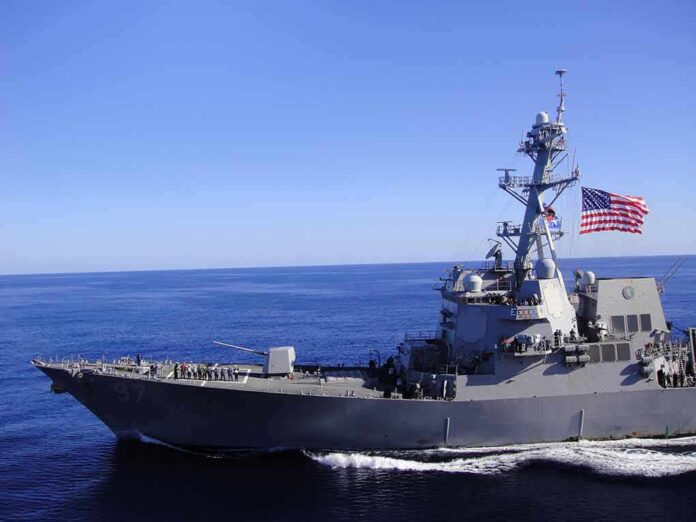
A new Congressional Budget Office review says the Navy’s shipbuilding plan would cost 18 percent more than the service claims, driven in part by 15 nuclear-powered “Trump-class” battleships.
Story Snapshot
- The Congressional Budget Office pegs average shipbuilding costs at about $54 billion per year for 30 years, 18 percent above the Navy’s estimate.
- Fifteen planned nuclear-powered guided-missile battleships are a major cost driver, with the full program estimated around $275 billion.
- The Navy argues the ships would carry deep magazines and serve as command hubs for dispersed forces.
- Government watchdogs warn that shipyard capacity and historic cost growth remain hard constraints.
CBO Flags Higher Long-Term Costs Than Navy Projects
The Congressional Budget Office reported that the Navy’s fiscal year 2027 shipbuilding plan would average about $53.8 billion per year in 2026 dollars over the next three decades. That figure is roughly 18 percent more than the Navy’s internal estimate, indicating a sizable gap that Congress must reconcile as budgets tighten. The finding matters for taxpayers who want strong defense without blank checks. It also matters for deterrence, because underfunded plans create delays that adversaries notice.
The new estimate follows a pattern. The Congressional Budget Office has repeatedly found that Navy shipbuilding plans lean on optimistic schedules and prices. The office’s broader defense analysis shows that rising costs, specialized labor shortages, and inflation inside the shipbuilding sector put steady upward pressure on final bills. This is not theory. It is what recent programs delivered. The message is clear: price the fleet honestly now, or pay more later with less capability in hand.
Fifteen “Trump-Class” Battleships Drive Debate
The Navy’s plan includes 15 nuclear-powered guided-missile battleships, sometimes called the Trump class. The ships are envisioned as large, heavily armed platforms with deep missile magazines and advanced command spaces. Public descriptions say they would carry 128 vertical-launch cells and 12 hypersonic missile tubes, and could lead groups of crewed and uncrewed vessels across wide seas. Supporters say the design restores punch and reach. Skeptics fear one big target that concentrates risk and spending in too few hulls.
The cost picture fuels that skepticism. The Congressional Budget Office estimates the 15-ship program at roughly $275 billion in 2026 dollars through mid-century, a sum that would compete with submarines, destroyers, and support ships for scarce yard slots and skilled workers. Independent reporting echoes a steep first-ship price near $23 billion, with follow-on ships still in the high teens, all before typical overrun risk. Cost risk is not a partisan talking point. It is a real constraint that can crowd out other warfighting needs.
Navy Rationale: Magazine Depth And Command For Dispersed Ops
The Navy’s public case centers on magazine depth, reach, and control. The service says a battleship with large missile capacity can fire first, reload later, and still fight after a hit. It also says the class would be built to command dispersed forces, linking destroyers, unmanned vessels, and land-based fires across a vast theater. That argument aligns with a push to fight as a network, not a cluster. If the network holds, the ship’s size could serve more as a hub than a single point of failure.
Analysts question whether a few very large hubs fit the Navy’s own goal to spread firepower. Outside studies say equivalent tonnage in proven destroyers could field more total launch cells while sharing risk across more ships. That is not a small point in the age of long-range missiles and drones. If shipyards already lag, adding a giant, complex class can slow the entire line. The choice is not between strength and thrift. It is about which mix of ships gives the most fight for the dollar and the clock.
Industrial Base, Schedule Risk, And What Congress Must Weigh
Government Accountability Office reporting warns that the Navy’s shipbuilding playbook has produced cost growth, late deliveries, and shortfalls in promised performance. Those reports urge tighter controls, realistic schedules, and proven designs before serial buys begin. The Trump administration wants a stronger, more lethal Navy. That requires a shipyard base that can build on time and at scale. Congress will need to test claims about capacity, labor pipelines, and supplier health before it authorizes full-rate production.
The Senate's proposed reduction in funding for the Trump class battleship is a significant development, but it is not yet a final congressional cancellation.
The Navy requested approximately $1.84 billion for FY2027, including $1 billion in advance procurement, and nearly $837…
— USAI Media (@USAI_Media) November 21, 2026
For conservative readers, the bottom line is stewardship and strength. Deterrence demands hard power that works on day one. Budgets demand truth in pricing and tough choices. The Congressional Budget Office’s numbers set a high bar for proof. If the Navy can show that the Trump-class delivers unmatched reach and command at sustainable cost, it will earn support. If not, lawmakers should shift dollars to proven hulls, submarines, and munitions that raise combat power now, not someday.
Sources:
piqmarkets.com, congress.gov, navytimes.com, taskandpurpose.com, ilfoglio.it, yahoo.com, 19fortyfive.com