
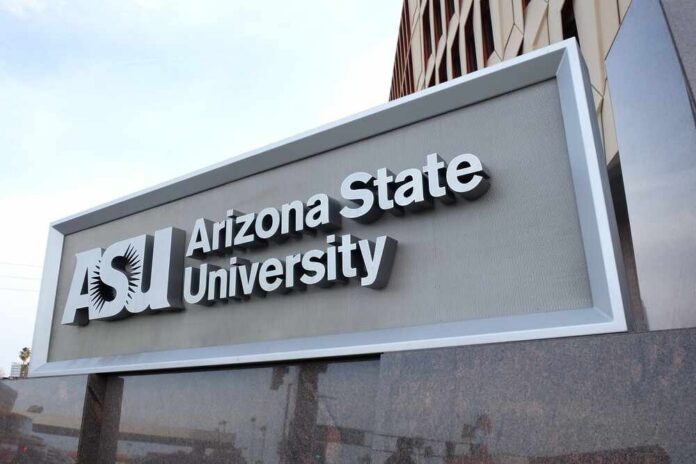
Even after six U.S. service members were confirmed killed in the Iran operation, activists at Arizona State University staged an anti-war protest that exposed how divided America’s campuses remain on national security.
Story Snapshot
- Anti-war protesters gathered March 2, 2026 at ASU’s Tempe campus to condemn U.S. military action involving Iran.
- The protest followed a major escalation: joint U.S.-Israel strikes that reportedly killed Iran’s supreme leader, Ayatollah Ali Khamenei, and other regime officials.
- A notable counter-voice came from Iranian-born ASU student Hasti Golmoradi, who publicly supported the U.S. action and criticized the protest’s moral blind spots.
- President Trump said the operation could last four to five weeks, with the possibility of going longer.
ASU protest reflects a familiar campus split over America’s use of force
Arizona State University’s Tempe campus became the scene of a new foreign-policy clash on March 2, 2026, when anti-war protesters gathered to denounce U.S. military action involving Iran. The reporting described the demonstration as part of a wider reaction to the rapid escalation in U.S.-Iran military operations. Some protesters declined on-camera interviews, limiting what the public can verify about their specific claims, goals, or demands beyond opposition to the strikes.
Coverage also emphasized that this was not a simple “students versus government” storyline. An Iranian-born ASU student, Hasti Golmoradi, spoke publicly in support of the operation, creating a direct contrast with the anti-war crowd. That internal disagreement matters because it shows how quickly campus politics can flatten complex overseas realities into slogans—especially when those realities involve an authoritarian regime, regional security, and American troops taking casualties.
What triggered the protests: a joint U.S.-Israel strike and an expanding operation
The protest came after a weekend of joint U.S. and Israeli strikes against Iran. Reporting said the strikes killed Iran’s supreme leader, Ayatollah Ali Khamenei, along with several regime officials. Iranian officials reported hundreds of deaths from the strikes, including three U.S. service members, while U.S. military confirmation placed the U.S. death toll at six service members as of March 2. Those numbers underline that the operation is not theoretical or cost-free.
President Trump stated the military operation could last another four or five weeks and could extend beyond that timeline. With that guidance, the immediate national debate is less about whether the action is “a single strike” and more about how the administration defines mission scope, end state, and acceptable risk. The available reporting does not include detailed operational objectives or independent verification of casualty claims beyond the U.S. military’s confirmation of U.S. losses.
An Iranian student’s defense of the strikes complicates the protest narrative
Golmoradi’s public remarks formed the most specific, verifiable argument captured in the reporting. She said the United States was “on the right side of history” and framed the operation as a path toward broader peace. She also criticized the anti-war activists for what she described as selective outrage, asking where the protest movement was when the Islamic Republic was killing Iranians. That argument, coming from someone with family ties and personal stakes, directly challenges the protest’s moral framing.
Her perspective also highlights a key limitation in the public record of the demonstration: the anti-war protesters’ reasoning was not fully documented because some declined to give on-camera commentary. Without those statements, it is harder to assess whether the protest was focused on civilian harm, constitutional war powers, America-first restraint, or blanket opposition to U.S. involvement abroad. What can be said from the reporting is that the protest message did not present a unified, publicly articulated alternative plan.
Why the moment matters for conservatives watching institutions and civic culture
For many conservative Americans, the ASU scene fits a pattern: large institutions moving quickly to amplify ideological activism while offering limited clarity on facts, tradeoffs, or consequences. The reporting shows real, confirmed U.S. casualties, an ongoing operation, and a debate over a regime accused of brutal repression—yet the most visible campus action was opposition to the strikes, not a public debate acknowledging both the cost of war and the cost of leaving tyrannies untouched.
ASU Radical Left and Palestinian Groups Lead Pro Iran Anti US Airstrikes Protest https://t.co/LbT7E0gRhg
— ConservativeLibrarian (@ConserLibrarian) March 16, 2026
At the same time, the reporting also shows something that gets lost in the “campus monolith” stereotype: dissent exists on campus too, including from immigrants and first-generation Americans who understand what authoritarian governments do to ordinary people. Golmoradi’s comments illustrate that “anti-war” branding does not automatically equal moral seriousness, and that calls for restraint must still answer hard questions about deterrence, threats to Americans, and what happens when violent regimes face no consequences.
Sources:
https://www.statepress.com/article/2026/01/politics-jan-20-protests-2026-ice