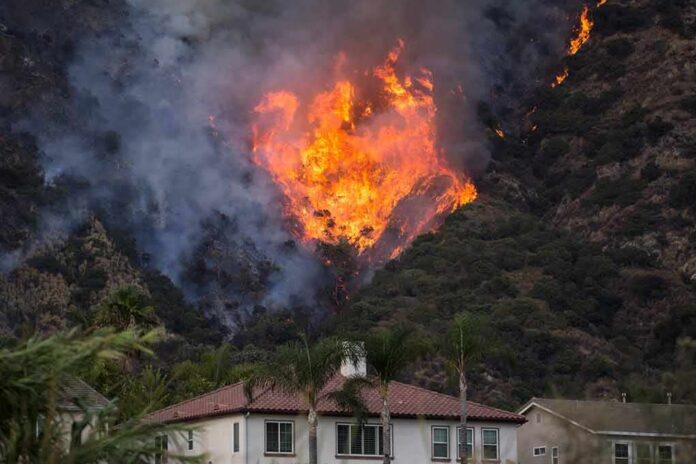
Federal prosecutors charged a 70-year-old Santa Clarita man with arson after a wildfire scorched more than 1,000 acres of federal land in the Angeles National Forest.
Story Highlights
- Federal complaint charges Rodney Ameile Saba with arson tied to the Bouquet Fire
- Prosecutors say Saba admitted a cigarette landed on fireworks and set off the blaze
- Investigators placed the ignition behind his home around 2:13 p.m. on October 3
- About 1,048 acres of federal land burned in the Angeles National Forest
Federal Charge Filed After Fire Damaged National Forest Land
The United States Attorney’s Office filed a federal criminal complaint charging Rodney Ameile Saba with arson in connection with the Bouquet Fire, which burned inside the Angeles National Forest. Prosecutors said the fire damaged about 1,048 acres of federally managed land, triggering evacuations and a large response from fire crews. The complaint anchors the case in federal jurisdiction because national forest land was harmed. A court will set the schedule ahead, including any detention decisions and a preliminary hearing.
Prosecutors said United States Forest Service investigators ruled out other likely causes and assessed that fireworks probably started the fire. Investigators documented an ignition point behind Saba’s residence on Bouquet Canyon Road at about 2:13 p.m. on October 3, according to the complaint. That timeline lines up with reports of a fast-moving brush fire that forced evacuations and stretched resources as winds and dry fuel helped the flames spread across rugged terrain. Fire crews later gained control as weather and containment lines improved.
Alleged Admission Describes Cigarette Hitting Fireworks
The federal complaint, as described by local reporting, says Saba admitted he threw a cigarette from his porch and that it landed on fireworks, which exploded and sparked the blaze. That alleged statement ties the ignition mechanism to a simple act that had major consequences. The report does not publish the verbatim transcript of the interview or the full complaint text. A court process will test how the government proves intent and causation under the arson statute.
Early fire coverage focused on acreage, evacuations, and firefighting updates. Those reports did not name a suspect or detail the ignition source while crews worked to stop the spread. As investigators processed the scene and interviewed witnesses, the federal charge followed. A criminal complaint is an allegation, not a conviction. The government must prove each element beyond a reasonable doubt at trial. The defense may contest intent, cause, or other issues allowed under federal law.
Why Federal Land Damage Triggers Tough Consequences
Wildfires on federal land carry serious penalties because they destroy public resources, endanger homes, and drain local and federal budgets. The Angeles National Forest is managed for recreation, water, habitat, and public safety. When a fire crosses into that land, federal law applies. The complaint cites damage within the forest to establish federal interest in the case. That matters for restitution and accountability, especially when thousands of acres, expensive air support, and mass evacuations are involved.
This case also fits a broader pattern: most wildfires in the United States start from human activity, not lightning. Research has found that people cause the clear majority of recorded wildfires, through accidents, negligence, or intentional acts. That does not mean all human-caused fires are arson. The law treats intentional lighting, reckless acts, and simple negligence differently. Prosecutors will argue the facts meet the arson standard; the defense can challenge that in court.
Fireworks, Drought Conditions, And Common-Sense Prevention
Prosecutors say investigators ruled out lightning, campfires, and debris burning, and concluded fireworks probably sparked the blaze, consistent with the alleged admission. Fireworks are illegal in many fire-prone areas because one spark can set dry brush ablaze. Tossing a lit cigarette is risky even without fireworks nearby. Common-sense rules matter: keep ignition sources away from fuel, respect burn bans, and report unsafe behavior. When people ignore basic safety, families, ranchers, and first responders pay the price.
The Bouquet Fire reportedly burned 1,048 acres of California’s Angeles National Forest. Federal prosecutors have charged a 70-year-old Santa Clarita man with arson, alleging that he ignited fireworks with a cigarette, sparking the blaze. If convicted, he faces up to 20 years in…
— Master Thought (@MasterThousmg) October 10, 2026
Conservatives know the stakes here. Wildfire costs land, homes, and life. It also drains public funds that should go to roads, schools, and veterans. Personal responsibility is not a slogan; it is a duty. If the government proves its case, a single careless act torched more than 1,000 acres of federal land and put whole neighborhoods on edge. That is why strict enforcement, clear penalties, and local education work together to protect communities and the country we love.
Sources:
nypost.com, abc7.com, ground.news