

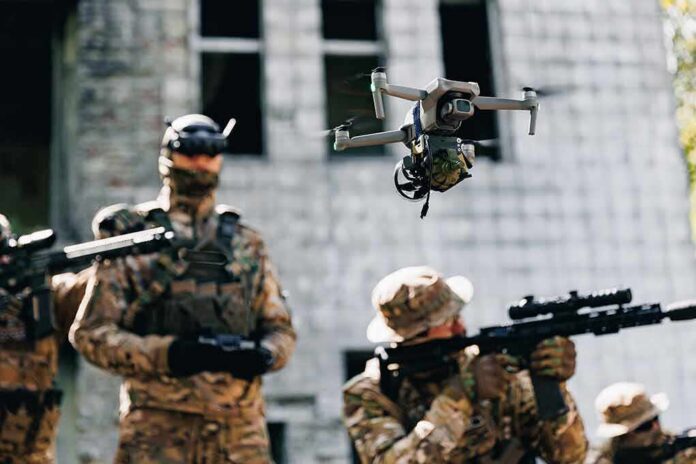
U.S. soldiers used a high-energy laser in Texas to burn three cartel-operated drones out of the sky, and drone incursions then plunged across the sector.
Story Highlights
- The Pentagon said an Army laser downed three cartel-linked drones near the border.
- U.S. Northern Command reported follow-on takedowns, totaling 11 drones within days.
- Officials said cartel drone activity dropped about 75% after the laser deployment.
- A new airspace agreement enabled safer domestic laser operations this year.
Laser Engagements Against Cartel Drones in Texas
U.S. Northern Command said soldiers operating an Army Multipurpose High Energy Laser system shot down three unmanned aircraft late on a Tuesday and early Wednesday in the Rio Grande Valley. Pentagon officials said the drones were allegedly run by drug cartels and posed a threat to operations at the border. Reuters later reported the laser downed 11 cartel drones within the first week of deployment, marking the first sustained use of directed energy against this threat set on U.S. soil.
CBS News reported the early engagements took place after months of training and coordination with civil aviation authorities. Officials said the system’s fielding coincided with a sharp drop in hostile drone flights, as cartels tested the airspace less often when their aircraft stopped returning. Defense officials emphasized that the laser is a precision tool. It targets sensors and frames at the speed of light, reducing risk of stray rounds near homes, farms, and ports of entry.
Measured Impact: A Steep Drop in Incursions
Military and border officials said suspected cartel drone activity in the sector fell by roughly three quarters after the laser came online. Reuters cited commanders who tallied 11 shootdowns in the opening days, which they linked to fewer sightings and fewer attempts to probe U.S. positions. CBS News described the same trend and tied it to the public confirmation that soldiers could defeat intruding drones quickly and cheaply, denying cartels the “eye in the sky” they use to scout agents and stage smuggling runs.
For conservative readers, this is what execution looks like. President Trump’s team promised stronger tools at the line, and soldiers are now using a lawful, controlled system to defeat a cross-border threat in real time. Lasers cost far less per shot than missiles or interceptors and avoid the spread of debris. This approach protects agents, ranch families, and towns along the river while raising the risk for cartels that violate our airspace.
Airspace Rules, Safety, and Coordination
Recent coordination between the Federal Aviation Administration and the Department of Defense cleared the way for safe, domestic laser use against unauthorized drones. Deseret’s reporting noted a spring agreement that set procedures, so units can act within defined airspace while protecting civil aviation and commercial traffic. That framework matters. Border skies are busy with Customs and Border Protection aircraft and local flights. Clear lanes and notifications help soldiers act fast without endangering friendly assets.
The Army also stressed that the laser is one layer of a larger shield. Border defense employs radar, electro-optical and infrared sensors, and radio-frequency tools to detect and track small aircraft. The laser provides a clean defeat option when operators confirm a hostile craft and the backdrop is safe. This layered approach reduces guesswork and makes sure actions match policy and law, which is essential inside the United States.
Why This Matters to Security and Sovereignty
Cartels use drones to map patrols, guide smugglers, and spot gaps. Those flights erode control of our border and put agents in danger. Directed energy changes the cost equation for bad actors. When a drone can be killed in seconds, at low cost, repeat attempts lose value. That is deterrence you can measure. A reported 75% drop in activity signals fewer eyes on our agents and fewer precision cues for smugglers to exploit.
The U.S. Army is testing new counter-drone systems along the Mexico border after officials reported 378 drone incursions in 30 days.
The military also says 11 cartel-linked drones have been brought down using laser technology since August.#USMexicoBorder #Drones #USArmy pic.twitter.com/q3m8Yp79uS
— Global Critique (@Global_Critique) October 5, 2026
This story also shows proper limits on government power. The military coordinated with civil agencies and flew within set rules. Officials talked about specific incidents and logged outcomes. The focus stayed on illegal aircraft, not on Americans. That balance—strong action, tight control, clear oversight—is what many families along the border have asked for. Results on the ground now match those promises, and the numbers back it up.
What Comes Next on the Border Tech Front
Defense leaders say counter-drone work will keep expanding. Lasers are part of a toolkit that also includes jamming and interceptors. As cartels adapt, U.S. forces will mix sensors and defeat systems to keep the edge. The goal is simple: deny aerial surveillance to criminals while protecting communities and lawful air traffic. Officials credit the early laser success with driving that mission forward and showing how modern tech can serve border security today.
Sources:
feedpress.me, nbcnews.com, reuters.com, ground.news, cbsnews.com