

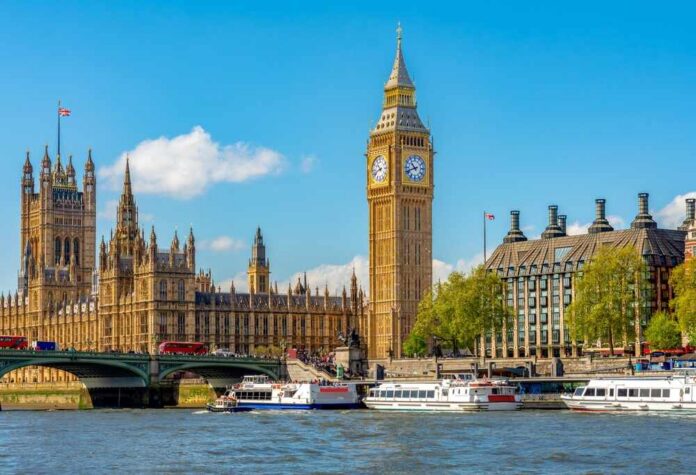
The real story behind London’s record-busting heat dome is not just that the city felt like Athens, but how close it came to previewing the country’s future summers.
Story Snapshot
- London’s latest “heat dome” did not come out of nowhere; it sits on top of a decades-long warming trend in the United Kingdom.[3]
- United Kingdom temperature records have not just nudged higher; the national record was smashed by 1.6 degrees Celsius in 2022.[1]
- Scientists say human-driven warming is making forty-degree heat in Britain far more likely, while cities like London amplify that heat at night.[3]
- Policy advocates now push for a national heat resilience strategy, arguing that record temperatures are no longer rare outliers.
London’s heat dome and why it felt so extreme
Reports of London running hotter than Athens under a “heat dome” sound like media exaggeration until you look at the temperature history behind the headline. The United Kingdom’s weather records show that the hottest days have clustered in the last few decades, not randomly scattered through the last century. A heat dome, the high-pressure lid that traps hot air, provided the immediate spark. The fuel, however, was a background climate that has steadily shifted toward higher summer extremes.[3]
Weather presenters described a stubborn high-pressure system camped over northwestern Europe, diverting the usual Atlantic storms and allowing the sun to bake the ground day after day. That setup is classic meteorology, not science fiction. The question that matters is how much hotter such a pattern runs in a warmed climate. Climate scientists now argue that you cannot separate the two cleanly; the dice that weather throws are the same, but the numbers on the faces have changed.[3]
From rare anomaly to repeating headline
The Natural History Museum points out that the 2022 heatwave did not just edge past the old national record; it blew past it by 1.6 degrees Celsius, an unusually large jump for a well-observed climate record.[1] Records, especially in a country with dense measurements, typically fall by tenths of a degree. When they leap by more than a degree, that suggests the old climate bounds are no longer holding. That kind of step change should get the attention of anyone who thinks in terms of risk and prudence.
The United Kingdom Met Office states that each of the last four decades has been warmer than the one before it, all the way back to 1850.[3] This is not a gentle wobble around a stable average; it is a staircase. On that staircase, heatwave frequency, length, and intensity have all increased, and the agency links those trends directly to human activity warming the planet.[3] Conservative common sense says that when the pattern is this clear, denial is not skepticism; it is wishful thinking.
Why London specifically feels like a pressure cooker
Londoners are not just experiencing the global signal; they live in a city that magnifies heat. The Met Office notes that urban heat islands amplify night-time extremes, making cities significantly warmer than nearby rural areas after dark.[3] Concrete, asphalt, and brick soak up daytime heat and then slowly bleed it back, precisely when older residents and people with medical conditions most need relief. That means the same heat dome that gives a village a brutal afternoon can give London a dangerous night.
Health researchers and climate analysts have already counted thousands of heat-related deaths during recent European heatwaves, with London among the hardest-hit cities in some events. Even if exact numbers fluctuate, the pattern is consistent: the combination of hotter baselines and dense urban living hits the vulnerable first. Framed that way, record temperatures are not trivia; they are early warning flares for hospital systems, power grids, and families trying to protect elderly parents in walk-up flats.
Natural weather pattern or climate alarmism?
Critics of climate narratives often point out that the immediate cause of these events is a natural pattern such as a blocking high or heat dome, not a smokestack. That is true as far as it goes. The same high-pressure mechanics produced severe heat long before anyone burned coal at scale. But the Met Office and the latest global climate assessments draw a clear line: human influence has warmed the atmosphere, ocean, and land, and hot extremes have become more frequent and more intense since 1950.[3]
Temperatures in London were set to beat those in Athens as a heat dome settled across parts of the UK and northwestern Europe, threatening to challenge records for weather at this time of the year pic.twitter.com/ndgh0GfM6T
— Reuters (@Reuters) May 25, 2026
That means the proper question is not “Was this heat dome natural?” but “How much hotter did a natural heat dome run because of human-caused warming?” On that point, mainstream institutions are blunt. The Met Office says climate change is increasing the chance of forty-degree temperatures in the United Kingdom.[3] The Natural History Museum goes further, warning that forty-degree heatwaves could occur every few years if emissions continue, not once-in-a-century freaks.[1] That forecast aligns with a risk-averse, stewardship-minded view of national planning.
From weather shock to heat resilience
Policy thinkers have begun to treat these record events as stress tests. The London School of Economics Grantham Institute recalls that after the 2022 forty-degree heat, the government declared a climate emergency and yet still lacks a full national heat resilience strategy. Their argument is not abstract. A country that built its housing, railways, and hospitals for cool, damp summers now faces repeated scorching days that buckle rails, overload emergency rooms, and idle workers.
A practical, conservative response does not chase every apocalyptic claim, but it also does not shrug at repeated, measurable extremes. Hard data from the Met Office, long-term record shifts documented by national institutions, and the visible strain on cities like London all point the same way: the floor of summer heat is rising, and the ceiling is breaking tiles.[1][3] Whether one calls it a heat dome, a warning shot, or simply the new normal, the smart move is to prepare before the next record falls.
Sources:
[1] Web – 40⁰C heatwaves could happen every few years because of climate …
[3] Web – UK and Global extreme events – Heatwaves – Met Office