
NATO’s hesitation over securing the Strait of Hormuz is colliding with President Trump’s troop cuts in Europe, forcing allies to finally decide whether they will step up or keep free‑riding on American power.
Story Snapshot
- NATO allies are openly debating a mission to protect shipping in the Strait of Hormuz as Iran’s blockade squeezes global energy flows.
- President Trump is pulling thousands of U.S. troops out of Europe, warning allies he will not subsidize their security forever.
- Several European governments pledge ships and minehunters, but others resist putting the NATO flag on the mission.
- The outcome will show whether NATO is a serious partner on energy security or a talk shop that expects America to do the hard work.
Trump Pressure Meets NATO Drift In A Critical Oil Chokepoint
Western leaders know the Strait of Hormuz is not some distant geography lesson; it is the narrow sea lane where roughly one-fifth of the world’s oil normally flows, and Iran’s war-driven blockade has turned it into a live economic weapon.[1][3] President Donald Trump has pressed European allies for months to help secure this chokepoint, tying his demand directly to long-standing complaints that the United States carries too much of NATO’s defense burden.[1] As Washington signals more troop withdrawals from Europe, that pressure is no longer theoretical.
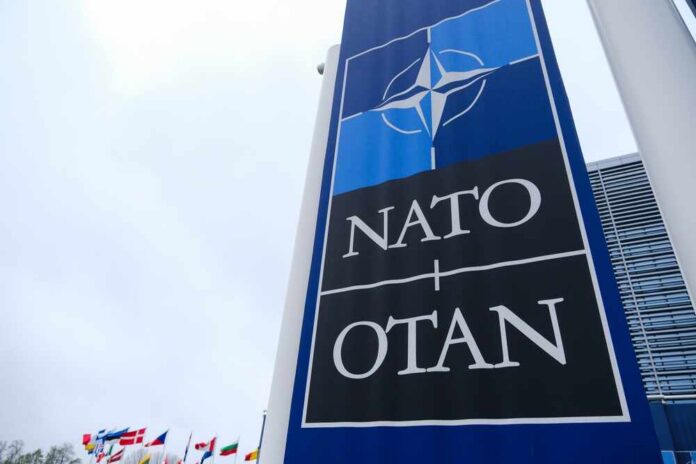
NATO Secretary General Mark Rutte has publicly acknowledged that allies are now weighing a more direct role in protecting commercial ships moving through the strait.[1] Rutte said that if the North Atlantic Treaty Organization can help, “there is no reason not to be helpful,” and added that “if NATO can play a role, it would be great,” language that would have been unthinkable during the old Obama-Biden era of strategic drift. Those remarks came after talks with President Trump, who has been blunt that Europe must stop treating cheap Middle Eastern energy and U.S. naval power as automatic entitlements.
Allied Ships, Minehunters, And A Coalition That Stops Short Of NATO
Concrete offers are finally appearing on the table, at least from some capitals. Rutte pointed to the Netherlands’ willingness to send specialized minehunting ships, while Stars and Stripes reported that frigates and advanced radar technology are also under consideration to help clear and monitor the waterway.[1] Fox News likewise described discussions about minehunters, frigates, and surveillance assets, showing that serious naval capability is available if political leaders authorize it. These are exactly the kinds of tools needed to reopen a mined or threatened shipping corridor without rushing into a full-scale shooting war.
At the same time, a separate coalition has quietly grown up outside formal NATO channels. The United Kingdom has been leading a group of more than forty countries preparing to help clear the strait and escort commercial traffic once conditions allow.[1] Germany, France, the United Kingdom, Italy, and Spain have all said they will contribute to ensuring freedom of navigation, issuing a joint statement promising participation.[1] That coalition model suits European politicians who want to be seen doing something without inviting debates at home about whether NATO is sliding into another Middle East war.
Unanimity Rules, Anonymous Diplomats, And The Drag Of European Caution
Behind the cautious language, there is a familiar story conservatives have seen for decades: when it is time to act, a divided Europe hides behind process. Marine Link reports that any official NATO mission in Hormuz would require unanimous approval from all thirty-two alliance members, and several have already signaled opposition.[2] Diplomats quoted in that report say “many allies do not see a role for NATO as such,” and one even admits that is “why we have a coalition (rather than a NATO mission).”[2] In other words, some governments still want American leadership without the NATO flag or responsibility.
NATO’s top military commander for Europe, United States Air Force General Alexus Grynkewich, confirmed that reality when he told reporters in Brussels that the alliance is not drawing up formal plans yet and would need a political decision before doing so.[2] He said he is “absolutely” thinking about a Hormuz operation, but emphasized that “the political direction comes first, and then the formal planning happens after that.”[2][3] That comment underscores the core problem: the militaries know what needs to be done to keep trade free and energy flowing, but civilian leaders in Europe are reluctant to risk confrontation or admit how dependent their economies are on stable Gulf shipping.
What This Means For American Conservatives: Burden-Sharing Or Business As Usual?
For American readers who have watched NATO duck hard choices for years, the Hormuz debate is a test of whether Trump’s tough medicine is finally working. Stars and Stripes notes that Trump has pushed allies to increase their military presence in the strait and has even issued an ultimatum that countries must make specific offers of what they will provide.[1] That demand lines up with his broader decision to pull thousands of U.S. troops out of Europe, making clear that American taxpayers will not fund European security while those same governments hesitate over defending global energy flows.
In just 24 hours, #NATO, #India, and #China each made decisive moves around the Strait of Hormuz. A potential naval protection mission. Emergency energy supply action. A direct diplomatic intervention from Xi.#Forbes pic.twitter.com/McmuxYnxnp
— Forbes Middle East (@Forbes_MENA_) May 20, 2026
The fact that twenty-plus nations, including many NATO members and Pacific allies like Japan and South Korea, have rallied around a Hormuz security effort shows there is recognition of the threat. Yet the reluctance to formalize a NATO mission reveals the deeper structural problem conservatives have long criticized: an alliance culture that prefers statements and coalitions to binding commitments and clear lines of responsibility. Whether the strait stays blocked or slowly reopens, this episode should remind Americans that energy security, strong borders, and serious defense spending cannot be outsourced to committees in Brussels; they depend on leaders willing to act, not just talk.
Sources:
[1] Web – NATO allies begin outlining effort to secure Hormuz | Stars and …
[2] Web – NATO Not Drawing Up Plans For Hormuz Mission – Marine Link
[3] YouTube – NATO Considers Hormuz Mission to Protect Ships