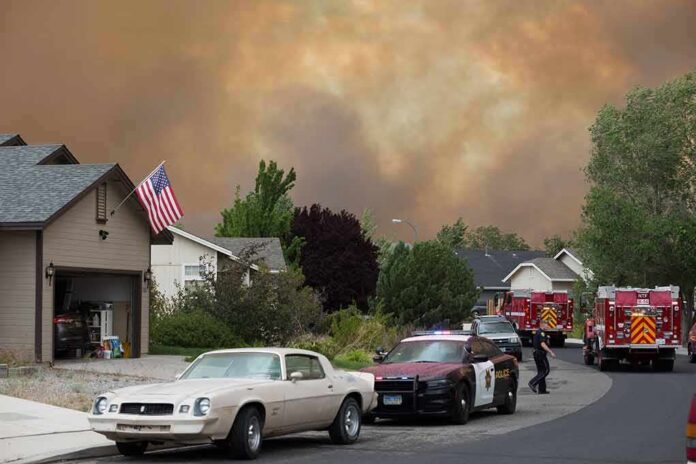
A 724-page state investigation says Los Angeles sent residents late fire warnings as homes burned, exposing a broken alert system and command failures that put families at risk.
Story Highlights
- Independent review details late evacuations and missed warnings during the Palisades fire.
- Helicopter warned of imminent home threat before full evacuation order followed later.
- Report cites tangled alert process and poor communications across agencies.
- LAFD acknowledges missteps while officials point to resource limits and wind.
Report Finds Delayed Alerts As Fire Hit Homes
UL Research Institutes’ Fire Safety Research Institute issued a 724-page review of the January 2025 Palisades fire. The report says many residents got evacuation alerts 40 to 90 minutes after homes had already started burning, and that firefighters were sent home despite dangerous winds. The review emphasizes multiple failures across agencies, not one person, but highlights slow warnings and poor coordination that left neighborhoods exposed when seconds mattered.
Investigators detailed a key timeline gap. A fire helicopter warned at 10:46 a.m. that flames would reach homes within minutes. A broader evacuation order to the coast highway area followed later at 11:29 a.m., as reported from the investigation’s timeline. That delay tracks with the review’s wider finding that the alert system was too complex and hard to run in a fast crisis, leading to mixed signals and slow action when people needed a clear, simple order to leave.
Missed Hotspot Warnings And Staffing Decisions
The review says the Los Angeles Fire Department ignored multiple warnings that the earlier Lachman fire was still smoldering days before it flared into the Palisades fire. The department also struggled to track personnel and coordinate with the Los Angeles Police Department during the response, which slowed evacuations and muddled tasks on the ground. These findings point to a basic breakdown in routine patrols, verification, and command discipline that should be standard during wind-driven fire weather.
Officials have defended parts of the response. City leaders say the Emergency Operations Center was activated at Level 2 for the wind event, resources were pre-deployed, and a Wireless Emergency Alert went out at 12:30 p.m. to people near the fire. The department’s after-action review says a command post formed near noon and unified with county fire and the police department as more staff arrived. These points confirm activity, but they do not erase the timing gaps shown in the independent review.
Communication Breakdowns Across Agencies
The review and follow-on reporting describe unreliable cellular service, inconsistent field reporting, and systems that did not connect across agencies, which made it hard for commanders to share real-time information. The alert and warning process involved many groups with overlapping authority, and some personnel lacked training on key tools. In short, the system was built for paperwork and peacetime, not for a fast burn racing into neighborhoods when one voice and one plan must lead.
Local coverage says the report stops short of blaming one person or office, and it notes the extreme wind conditions that drove the fire. Those facts matter, but they do not change the core findings. People in the path needed warnings before the flames, not after. A clear chain of command, rapid alerts, and reliable communications are not luxuries. They are the minimum that every family expects when government takes charge of evacuations.
What Needs To Change Now
The review calls for stronger regional preparation, clear evacuation priorities, sturdier infrastructure, and standard procedures to check and patrol fires after they appear knocked down. It also urges better coordination between the fire department and police during evacuations and tighter personnel tracking so leaders know who is where at every minute. These steps reflect common sense: simplify the alert pipeline, train to the tools, and practice joint command until it is muscle memory.
Los Angeles residents paid the price for slow alerts and a tangled command map. Families deserve a system that warns early and moves fast. State and local leaders must lock in reforms, publish clear timelines for fixes, and open the radios, logs, and alert audits to the public. Weather will always test the system, but confusion and delay are choices. Build a system that treats every minute like it could save a life, because it can.
Sources:
facebook.com, nypost.com, westsidecurrent.com, apnews.com, cbsnews.com, latimes.com, iheart.com, emergency.lacity.gov, malibucity.org