

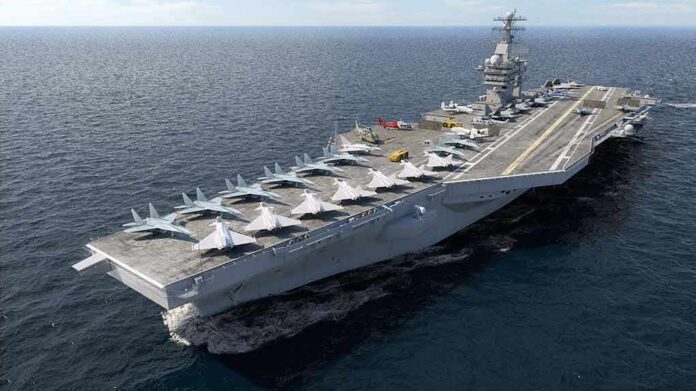
The U.S. Navy awarded Boeing more than $20 billion to build its next-generation F/A-XX fighter, locking in America’s carrier air power for the 2030s and beyond.
Story Highlights
- The Navy selected Boeing to develop and deliver the F/A-XX sixth-generation fighter.
- The award is valued at more than $20 billion for full-scale development and test aircraft.
- The jet anchors the Navy’s Next Generation Air Dominance family and will replace Super Hornets in the 2030s.
- Boeing beat Northrop Grumman in the final round of the competition.
Navy Selects Boeing For Sixth-Generation F/A-XX Fighter
The United States Navy announced on September 29, 2026, that Boeing won the competition to build its F/A-XX, the service’s sixth-generation, carrier-based fighter. The Pentagon described the award as a multi-billion-dollar contract to produce multiple test aircraft for ground, airworthiness, systems, and weapons integration testing. Boeing said it will design, build, and deliver the aircraft under the deal, confirming its role as prime on the Navy’s flagship air dominance effort. Reuters reported the award at about $20 billion.
The program sits inside the Navy’s Next Generation Air Dominance family of systems. Reports describe F/A-XX as the future centerpiece of the carrier air wing when it comes online in the 2030s, while today’s F/A-18E/F Super Hornet fleet continues service into the 2040s. Multiple outlets say the development award covers full-scale engineering work and test articles, not a production buy. That means flight testing and integration will drive the schedule before any production decision.
Scope, Timing, And What Comes Next
Pentagon summaries and trade reporting say the contract funds several test aircraft to validate airworthiness and integrate sensors and weapons. Aviation Week and Inside Defense each noted the development focus and the plan for weapons integration events during test. The announcement followed months of delay tied to budget debates, then a late push to resource the program in the fiscal year 2026 bills. Outlets reported Congress added roughly $890 million to support the effort, enabling the award timing.
Boeing’s win arrived as the Navy also moved to prepare shutdown plans for the F/A-18E/F and EA-18G lines, signaling a clean handoff to the new jet over the next decade. Aviation Week reported a separate $16.7 million action for that planning on the same day, underscoring how the Navy is aligning its industrial base for the transition. Specific design details for F/A-XX remain classified, and reporting does not disclose performance, weapons fit, or signature numbers at this stage.
Competition, Industrial Base, And Strategic Stakes
Reuters and defense outlets said Boeing beat Northrop Grumman in the final round, after years of quiet competition. The win gives Boeing control of the Navy’s sixth-generation fighter path, while other reporting notes the company also holds the United States Air Force’s F-47 effort, raising natural questions about capacity and oversight across programs. A Government Accountability Office report has described the Navy’s Next Generation Air Dominance as a distinct effort from the Air Force’s program, with different needs and timelines.
Defense experts have warned that fewer competitors can increase strategic risk and reduce future innovation, especially as programs grow in size and secrecy. RAND research has argued against joint fighter acquisition that can lock the market and limit competition over time. Those concerns heighten the need for strict cost control, tough testing, and steady congressional oversight as F/A-XX moves through engineering and flight test. The development focus of this award makes those gates even more important.
Why This Matters For Readiness And Deterrence
Pacific threats are growing, and carrier groups must keep air superiority across long ranges. The Navy frames F/A-XX as a core answer to that problem, pairing the crewed fighter with sensors, drones, and weapons in a family of systems. Reports expect initial production in the 2030s, with Super Hornets continuing through the 2040s to bridge the gap. That path protects the carrier wing while avoiding a coverage dip during the changeover from legacy to next-generation aircraft.
5/10
Boeing $BA was the defense winner: a $20B+ Navy contract for the sixth-gen F/A-XX fighter. Northrop Grumman $NOC was the loser, -3.5% on the same news. Winner-loser trades don't get cleaner than that.— AscentValue (@Ascent_Value) September 30, 2026
For conservative readers, the takeaway is clear: strong defense spending must deliver real combat power, not red tape. This award gives the fleet a plan to outpace China’s naval aviation and keep our sailors safe. The contract funds test jets and hard data first, then production if results justify it. That is the right order. Congress and the Navy should keep the pressure on cost, schedule, and performance so every dollar strengthens American air dominance at sea.
Sources:
insidedefense.com, reuters.com, investors.boeing.com, theaviationist.com, aviationweek.com, yahoo.com, finance.yahoo.com, janes.com