

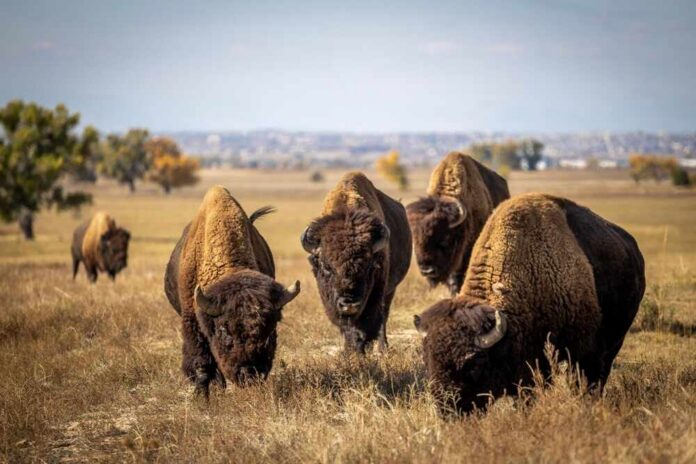
The fight over who gets to use America’s public lands just put nearly 1,000 bison on the chopping block in Montana.
Story Snapshot
- The Bureau of Land Management revoked grazing permits tied to American Prairie’s bison on seven federal allotments in Montana’s Phillips County.
- Interior Secretary Doug Burgum proposed the cancellation in January 2026 after years of rancher complaints and legal conflict.
- The dispute is about federal grazing permissions—not a confirmed, physical “deportation” plan—though removal from the allotments could follow.
- Ranching groups and Montana officials called the move a victory for livestock and rural communities; the nonprofit says the decision is unfair and disruptive.
BLM revocation turns “bison restoration” into a public-lands flashpoint
The Bureau of Land Management finalized a decision revoking American Prairie’s federal grazing permits tied to more than 950 bison on seven allotments in Phillips County, north-central Montana. The nonprofit has run bison behind electric fencing on these public parcels for roughly two decades, but the latest action reverses a Biden-era framework that treated conservation grazing as comparable to traditional livestock use. The revocation is expected to take practical effect in spring 2026.
Political headlines have used the word “deport,” but the confirmed government action described in reporting is a permit cancellation on federal land, not a documented plan to load and transport bison across state lines. Still, if bison can no longer legally occupy those allotments, the result may function like an eviction: American Prairie could be forced to move animals elsewhere or reduce the herd, depending on what options remain available.
Why ranchers fought the bison permits—and why the nonprofit fought back
Local cattle ranchers and groups such as the Montana Stockgrowers Association argued that bison do not qualify as a “production-oriented” use in the same way cattle do, and they warned about competition for grass on discounted federal leases. Ranchers also raised livestock-health concerns, including disease risk. American Prairie, backed by wealthy donors, has framed its project as ecosystem restoration—an attempt to rebuild prairie habitat using bison grazing patterns.
The nonprofit’s CEO, Alison Fox, said the revocation is “unfair” and inconsistent with established public-lands grazing practice. On the other side, Montana officials who had pushed for the change for years celebrated the decision as protection for ranching communities. The clash illustrates a broader reality about Washington’s power: a change in administration can flip federal land policy quickly, leaving local economies, conservation plans, and long-running investments exposed.
A familiar 2026 pattern: policy whiplash, elite influence, and public distrust
For conservatives, the case is a reminder that public lands policy often gets shaped by unelected bureaucracy and lawsuit-driven pressure rather than clear, durable rules set by Congress. For liberals, it looks like another example of government siding with established industry over conservation goals. Either way, the outcome reinforces the bipartisan suspicion that “the system” responds fastest to organized power—whether that power comes from well-funded nonprofits or entrenched trade associations.
What happens next for the bison, the allotments, and Montana politics
The immediate question is what American Prairie does with the herd once the revocation becomes final in practice. Reporting indicates the permits were revoked after years of legal challenges, and further legal action remains a possibility, though the public record cited here does not confirm the nonprofit’s next step. What is clear is the land-use priority: the decision opens the door for cattle grazing to regain primacy on those federal allotments.
Trump to deport hundreds of bison from Montana https://t.co/fWOIOVIiGH
— The Times and Sunday Times (@thetimes) May 5, 2026
The longer-term significance may be precedent. If conservation-focused grazing is treated as second-class compared to conventional livestock operations, future projects—potentially including those involving tribal or private herds—could face steeper hurdles when they depend on federal allotments. In a country where distrust of federal management is rising on both left and right, the Montana bison dispute is less about a single herd and more about who truly controls America’s shared resources.
Sources:
https://www.sej.org/headlines/trump-administration-targets-bison-federal-grazing-lands
https://www.nationalreview.com/2026/01/a-battle-over-bison-in-montana-sets-a-dangerous-precedent/