

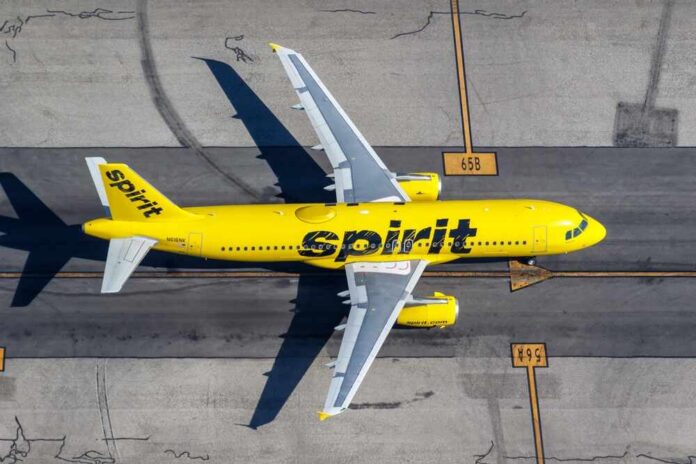
Ann Coulter’s claim that a “pointless” Iran war helped finish off Spirit Airlines spotlights how foreign-policy shocks can boomerang into everyday American life—jobs, prices, and whether families can still afford to travel.
Story Snapshot
- Ann Coulter blamed President Trump’s Iran military actions for delivering the “final death knell” to Spirit Airlines as the carrier moved toward shutdown.
- Spirit’s collapse followed years of financial strain, failed restructuring efforts, and a blocked JetBlue tie-up, leaving little margin for new cost shocks.
- A near $500 million Trump administration rescue effort reportedly failed, and Spirit moved toward ceasing operations.
- The episode is reviving an old right-of-center debate: how to balance America First strength abroad with the economic costs that can hit Americans at home.
Coulter’s “Final Death Knell” Line Connects War and Working-Class Travel
Ann Coulter drew national attention after blaming President Donald Trump’s military actions in Iran for being the “final death knell” for Spirit Airlines. The remark, reported as being made on a Saturday with no precise date provided, fused geopolitics with a highly tangible domestic symbol: the ultra-low-cost airline that many price-sensitive travelers relied on. The sources do not provide detail on the Iran escalation timeline, limiting how directly the causal link can be verified.
Spirit’s business model made it especially vulnerable to sudden cost increases because it competed largely on low base fares while charging fees for add-ons. When Americans feel squeezed by inflation or high energy costs, bargain travel becomes a pressure valve, and losing a discount carrier can make family trips, last-minute travel for emergencies, and cost-conscious business travel harder. Coulter’s line is provocative, but it points to a real political fault line: whether wars abroad translate into higher costs at home.
Spirit’s Shutdown Was Years in the Making, With Rescue Talks Falling Apart
Spirit Airlines, founded in 1980 and known as an ultra-low-cost carrier, entered 2026 after prolonged strain from competition, debt burdens, and repeated strategic setbacks. The reporting cited in the research also references a JetBlue attempt that was blocked in 2024, removing a potential lifeline or exit ramp. In the latest twist, a government rescue effort described as nearing $500 million from the Trump administration reportedly failed, and Spirit moved toward shutting down.
The failure of a high-profile rescue effort matters politically even to voters skeptical of corporate bailouts. Conservatives who prefer limited government often dislike using taxpayer-backed interventions to prop up private companies, while also recognizing the downstream impact of sudden mass layoffs and lost services. With Spirit, the stakes include disrupted travel plans and the future of low-cost competition. The sources do not specify exactly why the rescue collapsed, only that it did.
Fuel Costs, Middle East Risk, and What the Research Can—and Can’t—Prove
The research frames fuel as a key pressure point because aviation fuel is a major airline expense and can rise during Middle East conflict. That broad relationship is well understood across the industry, and the provided materials note that analysts have tied fuel spikes to conflicts, offering indirect support for Coulter’s cost argument. Still, the available sources do not quantify a specific Iran-war-driven jump in Spirit’s fuel bill or show a direct line from any one military action to the shutdown decision.
That distinction matters for readers trying to separate rhetoric from proof. Spirit’s years of financial fragility, combined with failed restructuring and merger setbacks, present a straightforward explanation for why the company had little resilience. If fuel or broader uncertainty rose, it may have worsened an already brittle situation. But with only limited detail on both the Iran timeline and Spirit’s internal financials in the provided research, Coulter’s causation claim remains more suggestive than conclusively demonstrated.
The Political Fault Line: America First Strength vs. Domestic Cost Blowback
In a second Trump term with Republicans controlling Congress, the political debate is less about whether the GOP can pass policy and more about which priorities should come first when crises collide. A conservative case for projecting strength abroad typically emphasizes deterrence and preventing larger wars later. A conservative case against open-ended conflict stresses fiscal discipline, non-intervention, and avoiding price shocks that punish working families—especially when Americans already distrust “elites” who seem insulated from the consequences.
Ann Coulter Blames Trump 'Pointless' Iran War for Being 'Final Death Knell' For Spirit Airlines https://t.co/ckGE89bksD pic.twitter.com/wsDK9MKLzw
— Mediaite (@Mediaite) May 2, 2026
Spirit’s shutdown also reinforces a broader public frustration that cuts across party lines: many Americans believe government and corporate power frequently intertwine without delivering stability for ordinary people. The research points to a near-rescue that failed, suggesting uncertainty even when Washington engages. Whether voters blame mismanagement, market realities, or foreign-policy spillovers, the practical result is the same—fewer low-cost options, potential fare increases over time, and another reminder that national decisions can land hardest on people with the least flexibility.
Sources:
https://balgarianovinite.com/en/ann-coulter-blames-trump-pointless-iran-war-fo/
https://www.cbsnews.com/philadelphia/tag/ann-coulter/