

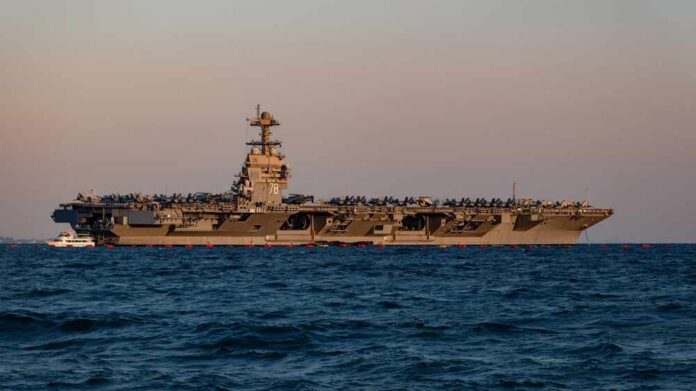
The U.S. Navy’s $13 billion flagship carrier USS Gerald R. Ford continues to suffer from critical system failures that prevent it from operating at sea for more than 35 days without returning to port, raising serious questions about whether American taxpayers are funding a floating monument to government waste rather than the world’s most advanced warship.
Story Snapshot
- Pentagon reports confirm the USS Gerald R. Ford cannot sustain operations beyond 35 days at sea, falling short of legacy Nimitz-class carriers
- March 2025 fire aboard the Ford injured 200 sailors, adding to a growing list of safety and operational concerns
- Chronic failures plague advanced systems including electromagnetic catapults, weapons elevators, and even basic sewage systems requiring $400,000 acid washes
- Total program cost for ten Ford-class carriers approaches $120 billion amid persistent delays and reliability issues
Billion-Dollar Reliability Crisis
The USS Gerald R. Ford entered service in 2017, six years behind schedule and billions over budget, yet Pentagon Director of Operational Test and Evaluation reports to Congress reveal the carrier still cannot demonstrate uninterrupted sea operations exceeding 35 days. This limitation undermines the fundamental purpose of a carrier battle group: projecting American power globally without dependence on friendly ports. The January 2025 DOT&E assessment found Ford’s sortie generation rates trail not only the proven Nimitz-class carriers but also fall short of targets that World War II-era carriers achieved during Operation Desert Storm, a particularly damning comparison for a vessel incorporating over 23 cutting-edge technologies.
Technology Promises Meet Operational Reality
Huntington Ingalls Industries designed the Ford-class around revolutionary systems including the Electromagnetic Aircraft Launch System replacing traditional steam catapults, Advanced Arresting Gear for recovering aircraft, and Advanced Weapons Elevators for rapid munitions handling. These innovations promised 25 percent more aircraft sorties and reduced crew requirements. Instead, EMALS and AAG have suffered repeated breakdowns requiring specialized maintenance tools and extensive crew retraining. Government Accountability Office investigators documented that weapons elevators were non-operational at delivery, while the vacuum sewage system scaled from commercial aircraft has experienced unexpectedly frequent clogs aboard a vessel housing over 4,000 personnel, necessitating costly acid treatments that have become a symbol of the program’s troubled execution.
Safety Concerns Compound Cost Overruns
A March 2025 fire aboard the Ford injured 200 sailors, highlighting safety vulnerabilities that accompany the integration of unproven technologies under high operational tempo. This incident followed September 2024 reports of faulty welds discovered on Ford-class vessels, raising structural integrity questions. Navy leadership faces mounting pressure to deploy the carrier despite persistent deficiencies, creating potential risks for crews operating equipment that has not achieved full reliability standards. The second Ford-class carrier, USS John F. Kennedy, remains in late-stage construction inheriting some of the same design flaws, including problematic toilet systems and undersized supply elevators that require manual handling of materials originally intended for automated palletized delivery.
Taxpayer Investment Versus Strategic Value
With construction costs exceeding $13 billion for CVN-78 alone and total program expenditures approaching $120 billion for ten planned carriers, the Ford-class represents one of the most expensive defense acquisitions in American history. Congressional oversight reports have scrutinized the return on this investment, particularly as geopolitical threats from peer adversaries demand reliable naval power projection. The carrier’s inability to sustain extended deployments without port access creates operational gaps that could prove critical during protracted conflicts. While Navy officials express optimism that follow-on ships CVN-79 and CVN-80 will incorporate lessons learned from Ford’s operational experience, critics argue the program exemplifies a troubling pattern: defense contractors and Pentagon bureaucrats prioritizing technological ambition and job security over delivering combat-ready platforms that sailors can depend on when American interests are threatened on the world’s oceans.
$13,000,000,000 Up In Smoke? The Ford-Class Aircraft Carrier Questions That Make U.S. Navy Admirals Sweathttps://t.co/q46RbUtjAb
— 19FortyFive (@19_forty_five) April 16, 2026
The Ford-class saga raises fundamental questions about accountability in defense spending. Voters across the political spectrum increasingly question whether Washington elites can be trusted to manage massive programs that consume tax dollars while delivering weapons systems that may not perform as promised when the nation needs them most. The admirals may be sweating these questions, but so should the American people who fund this troubled fleet.
Sources:
The Problem With the US Navy’s Ford-Class Aircraft Carriers – The National Interest
The New Ford Class Aircraft Carriers Have a Warning for the U.S. Navy – National Security Journal
New Report on the Navy’s Troubled Ford-Class Aircraft Carrier Is Literally the Sh*ts – The War Zone
The Navy’s Ford-Class $120 Billion Aircraft Carrier Nightmare Has Just Begun – 19FortyFive
USS Gerald Ford Fire Injures 200 Sailors – Responsible Statecraft