

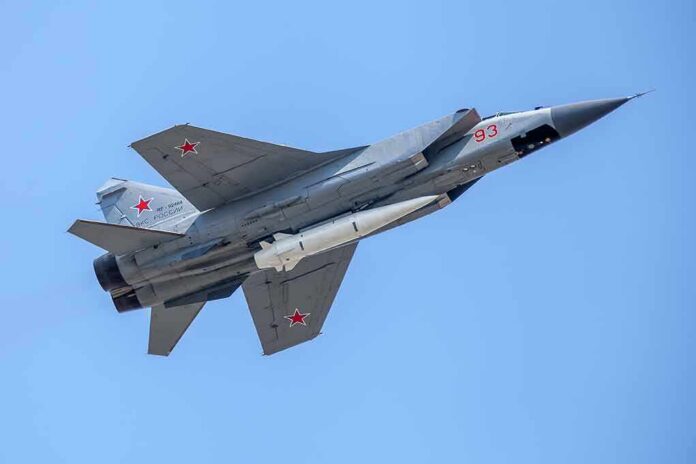
Russia is leaning on the world’s fastest combat jet to fight in Ukraine—but it cannot build new ones to replace it.
Story Highlights
- Russia’s MiG-31 interceptors have scored long-range kills with R-37 missiles in the Ukraine war.
- Upgraded MiG-31BM aircraft carry powerful Zaslon-AM radars and R-37M missiles reaching 300–400 km.
- Production lines for new MiG-31 airframes are dead; Moscow refurbishes aging jets instead.
- Sanctions and industry limits slow parts, upgrades, and any true successor program.
Russia’s Reliance On Speed And Reach
Russian forces have used MiG-31 interceptors to hit Ukrainian aircraft from far away, often beyond visual range. Reports credit the jet’s height and speed with giving it a safe perch while launching very long-range R-37 missiles. Those kills matter. They threaten tankers, radar planes, and strike aircraft that need space to work. When a jet can fire first from hundreds of kilometers out, it shapes the fight before the other side even sees it coming.
The MiG-31BM upgrade pairs that reach with sensors built for wide-area hunting. The Zaslon-AM radar is reported to spot fighter-sized targets at about 320 kilometers. It can track two dozen at once and engage up to eight, which fits the role of a high-speed interceptor guarding wide, cold skies. The R-37M missile, designed for long shots, gives the jet a punch that Western pilots must respect if they stray too close to Russian airspace or protected zones.
Fastest Operational Combat Jet, With Real Limits
The MiG-31 is widely listed as the fastest operational combat aircraft, topping out near Mach 2.83 at very high altitude. That speed helps it climb quickly, sweep large areas, and set up long-range missile shots. But speed brings tradeoffs. The airframe is not a dogfighter and is limited to about 4.5 g in tight turns, which makes close combat a bad idea. Pushing above Mach 3 risks engine and airframe damage, so crews treat max speed with care.
The jet can also carry the Kh-47 Kinzhal, a hypersonic air-launched weapon for striking land targets at long distances. That option turns a pure interceptor into a flexible platform that can threaten rear-area sites. While online posts and videos discuss the Kinzhal role often, open, verified combat logs remain sparse in public view. That lack of official data from Moscow limits how far analysts can go beyond known performance facts.
The Catch: No New Airframes, Sanctions Bite
Russia stopped building new MiG-31 airframes long ago. Today’s fleet survives on refurbished jets pulled from storage, life extension work, and selective upgrades. Analysts who follow Moscow’s industry say the successor program, often called MiG-41 or PAK DP, faces delays and is unlikely to field before the late 2030s. Western sanctions and the loss of high-end microelectronics make timelines worse and limit what can be modernized now.
That industrial reality creates a hard ceiling. The airframes are fast, the radar is strong, and the missiles are deadly. But every high-stress hour burns precious life from jets that cannot be replaced one-for-one. Even Russian press and military watchers note that life-extension plans require restarting production of key parts, a sign the fleet depends on ad-hoc fixes rather than a steady pipeline. That approach works in the near term. It is not a long-term solution.
What It Means For America And NATO Aircrews
Western pilots flying tankers, radar planes, and strike packages must plan around the R-37 threat zone. Crews will need more standoff, better jamming, and tactics that keep vulnerable assets outside the MiG-31’s best range. That may force longer routes, more fuel, and tighter timing. It also underscores why the United States must keep building and fielding advanced sensors, missiles, and countermeasures. You do not win air superiority if you let the enemy shoot first from far away.
At the same time, the MiG-31’s limits give planners options. Forcing the jet to fly more often and farther could stress engines and cut fleet life faster. Denying spare parts through tight sanctions keeps pressure on Russia’s sustainment base. If Moscow cannot replace airframes, every loss or crack matters more. That is how patient, smart pressure can blunt a sharp tool without a risky rush to close-in fights.
Bottom Line: A Deadly Stopgap With An Expiration Date
The facts point to a clear picture. Russia’s MiG-31 remains a fearsome interceptor thanks to height, speed, radar reach, and very long-range missiles that have drawn blood in Ukraine. It is also the fastest operational combat jet on record, which helps it control space and timing. But the fleet rides on old metal, dwindling parts, and a successor that keeps slipping to the right under sanctions and industry strain. The knife is sharp, but the handle is cracking.
For Americans who value peace through strength, the lesson is simple. Keep investing in range, sensing, and electronic warfare. Back up sanctions that slow rival arsenals. And never accept media spins that mock “old” jets while ignoring what their missiles can do today. Respect the threat, beat it with better tools and steadier supply, and make sure our crews never have to fight on the enemy’s terms.
Sources:
19fortyfive.com, nationalinterest.org, reddit.com, facebook.com