

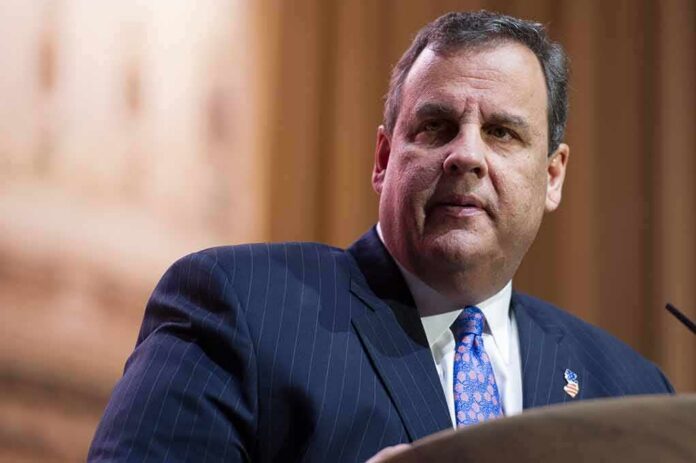
A stage joke about Chris Christie’s weight fell flat and sparked fresh media pile-on, but the real story is how every Christie spat keeps getting used to smear President Trump’s message rather than discuss policy.
Story Highlights
- Reports say a Christie “fat joke” bombed on stage, feeding another media frenzy over Trump’s tone.
- Coverage frames Trump’s Christie posts as personal mockery, often citing past memes and nicknames.
- Analysts track a broader pattern in Trump’s Truth Social use that mixes taunts with political hits.
- Christie has kept the feud alive and leveraged the attention to needle Trump in media slots.
What Reportedly Happened With The Christie Joke
Mediaite reported that President Trump tried a quip about Chris Christie’s weight that did not land with the crowd, then vented backstage about the failed line, which critics cast as more “fat shaming” drama. The flap follows earlier coverage of Trump sharing unflattering Christie images on Truth Social that outlets also labeled as body-based ridicule. The immediate reaction again focused on tone and spectacle, not on any policy argument between the two men.
Past write-ups tied Christie-focused memes to a long-running back and forth. Business Insider previously highlighted an image share that mocked the former governor, describing it as “fat-shaming” after Christie criticized Trump in an interview. Those stories have become the template: Christie jabs at Trump on television, Trump responds online or on stage, and the press zeroes in on the insult style. That cycle keeps the feud in headlines and drowns out debate on border security, inflation, and crime.
How Media Frames Trump’s Posting Pattern
Politico analyzed a month of President Trump’s Truth Social activity and counted dozens of posts focused on rivals and alleged corruption, which they framed as grievance-centered messaging, not policy talk. The Guardian likewise said Trump’s posts often attack opponents, highlight praise, or share images that fuel his brand, emphasizing the person-to-person combat over issue papers. These accounts shape how newsrooms read every Christie exchange: first as insult politics, then as proof of a broader pattern.
That framing matters because it sets the topic agenda. When analysts label the traffic as “grievance” or “trolling,” they push audiences to judge style over substance. For many readers, that translates to fewer stories about sanctuary-city crime, energy costs, or the debt, and more about nicknames and memes. The media incentives are clear. Provocation clicks. Policy does not. The public loses when heat replaces light, especially on budgets, schools, and border enforcement.
Christie’s Role In Keeping The Feud Alive
Chris Christie has worked the spotlight to needle President Trump and then answer back when Trump swings. The Independent noted Christie mocked Trump for “hiding” behind Truth Social and dared him to meet face to face, drawing cameras and social media attention his way. Each exchange becomes a new segment, a new headline, and another reason to skip hard questions about spending, crime, or the classroom. It is a mutual loop that benefits ratings more than voters.
Christie has long pitched himself as the Republican who will “say it” about Trump. That posture guarantees conflict clips. The coverage stack then paints Trump’s response as over-the-line humor or bullying, citing earlier memes and rally lines as the pattern evidence. The feedback loop rewards taunts while families wrestle with grocery prices, mortgage pain, and unsafe streets. Voters deserve a debate on results, not a rerun of personal barbs from 2023 and 2024.
Why This Dust-Up Matters To Conservative Readers
Every minute spent on a flat joke is a minute not spent on the southern border, on the price of gas, or on parents’ rights in schools. The people pushing spectacle know that. They want conservatives arguing about tone while the left advances bigger government, new speech codes, and softer crime policies. The media storyline turns a sideshow into the main event so that real failures stay off the front page. That trade hurts working families most.
Truth Social is a partisan platform, not an independent news source.
It frequently amplifies unverified claims, exaggerations, and political messaging, especially from Donald Trump himself.
This isn’t a criticism — it’s simply what the evidence shows.— N H (@TriestinaNella) July 25, 2026
Conservatives can walk and chew gum. They can enjoy a sharp elbow in politics and still insist the news stay focused on outcomes. Hold all leaders to results. Ask where spending was cut, which rules were scrapped, how many agents hit the border, and how fast energy permits moved. Do not let a bad joke bury the scoreboard. Demand coverage of what changes on your street, in your paycheck, and in your kids’ classrooms. That is the story that counts.
Sources:
usatoday.com, yahoo.com, okmagazine.com