
As courts keep blocking Washington’s grab for unredacted voter rolls, election officials from 25 states are now suing the federal government to stop what they say is a dangerous push toward a national voter surveillance database.
Story Snapshot
- Trump’s Justice Department has demanded full, unredacted voter rolls from nearly every state, and sued dozens that refused.
- Multiple federal judges, including Trump appointees, have ruled the DOJ has no legal right to this sensitive data.
- Civil-rights and voting groups warn the federal effort could build a national voter database and trigger wrongful purges.
- States say they must protect citizens’ privacy and their own constitutional authority over elections from federal overreach.
States Push Back Against Sweeping Federal Voter-Data Demands
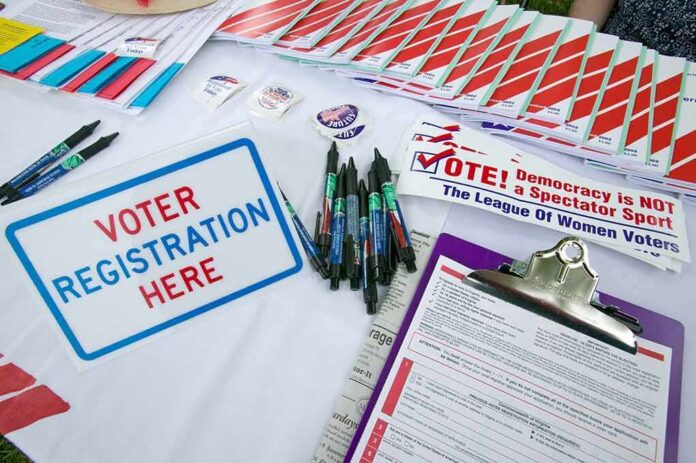
Since 2025, the Trump Justice Department has demanded full, unredacted voter rolls from at least 44 states and the District of Columbia. These files include home addresses, dates of birth, driver’s license numbers, and parts of Social Security numbers. Most states refused to hand over this private data. They instead offered the same public voter lists that campaigns and journalists can buy, which do not expose sensitive identity information. In response, the department has sued roughly 24 to 30 states, plus Washington, D.C., to try to force full compliance.
The Justice Department says it needs these records to check whether states are maintaining voter rolls and to prevent ineligible or noncitizen voting. It has cited federal laws like the Civil Rights Act of 1960 and the National Voter Registration Act as its legal basis. But critics argue these statutes never gave Washington a blank check to seize entire voter-registration databases. One Senate oversight letter flatly states that DOJ “lacks legal authority” to compel states to turn over possession of their voter registration lists. This clash sets up a major fight over where federal oversight ends and state control begins.
Federal Courts Reject DOJ’s Legal Theory and Privacy Posture
So far, federal judges have overwhelmingly sided with the states. Courts in California, Michigan, Oregon, Massachusetts, and Rhode Island have dismissed DOJ lawsuits seeking unredacted voter rolls. In Michigan, Judge Hala Jarbou, a Trump appointee, ruled that none of the three laws DOJ cited — the Civil Rights Act, the National Voter Registration Act, or the Help America Vote Act — actually require states to provide full voter lists. A California court went even further, finding that DOJ’s demand for sensitive voter data violated federal privacy laws, not just state policy.
USA Today reports that the department has lost all 16 federal court decisions issued so far over these demands for voter lists. Fifteen district court judges and the U.S. Court of Appeals for the Sixth Circuit have rejected the DOJ’s position as unlawful. Many of those judges were appointed by Republicans, including several appointed by President Trump himself. That record matters for conservatives: this is not a liberal bench quietly blocking election integrity; it is a bipartisan “no” to a sweeping data grab that judges say Congress never clearly authorized.
Privacy, Surveillance Fears, and the National Database Question
Voting-rights groups now accuse the federal government of trying to build a national voter surveillance system. Common Cause and four individual voters, backed by the American Civil Liberties Union (ACLU), sued the Trump administration to stop DOJ from “illegally stockpiling millions of Americans’ confidential voter data” and creating a national database to surveil and purge voters. Their lawsuit asks a federal court in Washington, D.C., to order DOJ to delete voter data it has already obtained and to bar future use of such records. Reuters notes that this case squarely attacks the idea of a central federal voter list as a threat to lawful voters, not a tool of honest oversight.
States echo these privacy worries. Many say their own laws forbid releasing driver’s license numbers or Social Security digits, even to Washington. Judges in several cases faulted DOJ for failing to explain why it needed such invasive data to check basic voter-list maintenance. The Massachusetts court said DOJ offered “no basis” for demanding that level of detail and did not even try to fix the “clear shortcomings” in its process. For everyday voters, that means federal lawyers were asking for information that could easily be used to track people or exposed in a breach, without a clear, lawful reason.
Federalism, States’ Rights, and Clean Rolls Done the Right Way
The Constitution gives states primary responsibility to run elections, including voter registration systems and lists of eligible voters. Under the Elections Clause, Congress can set some rules for federal races, but states still handle the day-to-day work of keeping voter rolls accurate. A bipartisan policy analysis notes that America has never had a single national voter list, and privacy laws make building one very difficult. That design was intentional. Decentralized election systems protect liberty by preventing any one central authority from controlling who can vote everywhere.
None of this means conservatives should accept dirty voter rolls or illegal voting. Federal law already allows and even requires states to remove dead voters and people who move away, using defined safeguards. The key question in these lawsuits is not whether rolls should be clean; it is who decides how that work is done and how much personal data Washington can stockpile in the name of enforcement. By rejecting DOJ’s demands, courts are saying that the proper way to secure elections is through clear statutes, respect for privacy, and state-led list maintenance — not an open-ended federal database built by litigation.
Dirty California Voter Rolls Are a National Security Threat!
United States Seeks to Intervene in Judicial Watch Lawsuit to Force California to Clean Up 873,000 Inactive Voter Registrations
(Washington, DC) – Judicial Watch announced today that the U.S. Department of Justice has…
— James T Boot (@jamestboot) July 25, 2026
Sources:
joehoft.com, brennancenter.org, statedemocracy.law.wisc.edu, justice.gov, reuters.com, usatoday.com, democracydocket.com, padilla.senate.gov, campaignlegal.org, usconstitution.net, bipartisanpolicy.org, constitutioncenter.org