

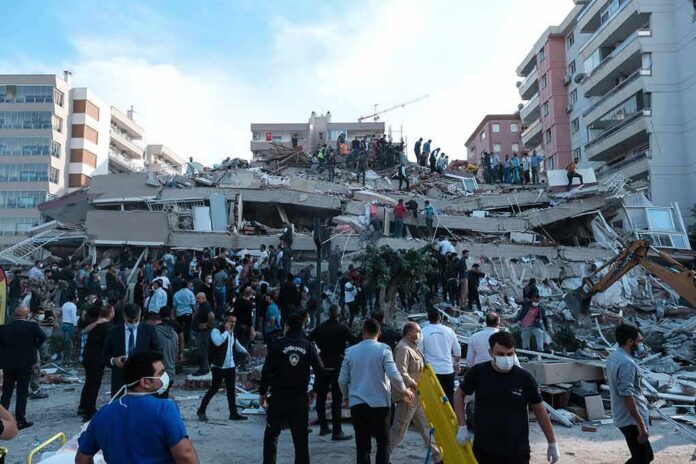
A single Israeli strike in 2023 wiped out 112 Palestinians from the same Gaza clan, and this week their remains were finally laid to rest in a mass funeral.
Story Snapshot
- Gaza’s civil defense says it recovered remains of 112 Palestinians from homes destroyed in a 2023 Israeli strike in Sabra.
- The dead include large numbers of children, women, and people with disabilities from the Al-Hassayneh and Abu Sharia families.
- Thousands of mourners gathered for a rare full funeral after months of rushed burials and mass graves in Gaza.
- The strike and its aftermath highlight the human cost of Israel’s war and the growing strain on U.S. policy and values.
Mass funeral for 112 Palestinians from two Gaza families
Gaza civil defense officials say search teams spent nearly two weeks digging through rubble in the Sabra neighborhood of Gaza City, recovering the remains of 112 Palestinians killed when Israeli warplanes hit family homes on November 23, 2023. The bodies belonged mainly to the Al-Hassayneh and Abu Sharia families, whose multi-story houses collapsed with relatives inside. Many of the dead were close kin, turning the funeral into a single, heartbreaking farewell for an extended clan.
Officials say the recovered dead include around 40 children, 38 women, and seven people with disabilities, showing how deeply the strike cut into civilian life. Relatives carried shrouded bodies and fragments through crowded streets, with loudspeakers reading the names as best they could. In Gaza’s tightly knit society, entire branches of a family tree were erased in minutes. Mourners described the funeral as one of the largest in Palestinian history, a sign of the scale of loss packed into one attack.
Why recovery took so long and how Gaza’s funerals have changed
Civil defense teams say the operation in Sabra lasted about 136 hours of digging with almost no heavy gear, relying on shovels and bare hands. Gaza’s emergency crews face fuel shortages, damaged equipment, and repeat strikes, so many bodies stay buried for months. Across the strip, normal funeral rites have broken down. Reporters describe mass graves, rushed burials, and prayers said in hospital yards because cemeteries are full and bombardment makes large gatherings risky.
Since Israel’s offensive began in October 2023, local health officials and international outlets report tens of thousands of Palestinians killed, most of them women and children. Hospitals and morgues overflow, forcing quick burials and sometimes unmarked graves. That is why the Sabra funeral mattered so much to locals. They finally had time and space to name the dead, line the bodies in rows, and let families say goodbye. For many, this was the first chance to grieve properly for loved ones lost early in the war.
Pattern of strikes hitting homes and even funerals
The Sabra strike fits a wider pattern where Israeli attacks hit homes packed with families, then later strikes hit gatherings mourning the dead. In 2026, Gaza medics and video from Jabalia showed an Israeli strike hitting a wake, killing two people and injuring others despite an announced truce. Reuters and other outlets report separate cases where missiles hit funeral processions themselves, killing additional mourners as they carried coffins through crowded streets.
One hospital in central Gaza told reporters that a strike on a funeral killed at least seven people and wounded 22 more, even as the Israeli military claimed it was targeting a militant cell. In Nuseirat, a funeral for a man killed earlier the same day was also hit, leaving at least eight mourners dead. These incidents deepen fear among civilians who already feel nowhere is safe—neither homes, nor hospitals, nor cemeteries. Each new strike adds more names to the casualty rolls and more trauma to a population already under siege.
What this means for American conservatives watching from afar
For American readers, the Sabra funeral is a sobering reminder of what “foreign policy” looks like on the ground. Thousands of miles away, a single strike destroyed multiple Gaza homes and killed over a hundred people, many of them children and women. The United Nations casualty data and other tallies show that civilians have borne most of the deaths in Gaza, with children making up a large share. That reality raises hard questions about how U.S. weapons, aid, and diplomatic cover are used abroad.
Gaza holds a mass funeral for the remains of 112 Palestinians, including 40 children, 38 women, and seven people with disabilities.
The remains were recovered from the rubble of homes destroyed by Israeli strikes in the Sabra neighbourhood of Gaza City. pic.twitter.com/R6VNsmEQGi
— Gaza Herald (@Gaza_Herald) August 4, 2026
Conservatives value **human life**, family, and honest accounting. They also expect the federal government to spend carefully, defend freedom, and avoid endless wars with unclear goals. As mass funerals like Sabra’s continue, pressure grows on Washington to match its support for Israel with tougher demands to protect civilians and respect basic rights. Supporting an ally should not mean writing a blank check for tactics that wipe out entire families and fuel rage for generations.
Sources:
youtube.com, aljazeera.com, reuters.com, presstv.ir, m.aa.com.tr, apnews.com, oglobo.globo.com, presstv.co.uk, bbc.com