
Iran can launch anti-ship missiles and swarm with drones, but no verified evidence shows it can hit a moving U.S. carrier strike group.
Story Snapshot
- Iran showcases long-range anti-ship drills and layered maritime strike tactics.
- Analysts say those weapons can threaten shipping and complicate carrier operations.
- U.S. Central Command says the USS Abraham Lincoln kept flying and Iranian shots “didn’t even come close”.
- U.S. forces report evading multiple Iranian attacks and striking back at oil tankers.
Iran’s Claimed Range And Strike Packages In Recent Drills
Iranian military drills have featured domestically built anti-ship missiles fired at mock naval targets over 200 kilometers away, including the Qader, Qadir, and Nasr families. State-linked reporting pairs these launches with drone strikes and electronic warfare meant to stress an enemy fleet. Those exercises present a layered attack style from the coast to sea, using mines, coastal batteries, and uncrewed aircraft to crowd a defender. These are demonstrations, not confirmed wartime hits, but they show intent and growing reach.
Press and commentary describe a doctrine designed to deter and slow a stronger navy. Reports outline salvos from shore, swarms of small craft, naval mines, and one-way attack drones to force U.S. ships to maneuver and spend interceptors. Several open-source analysts have long warned that such tools can disrupt carrier flight cycles in narrow waters like the Persian Gulf. That raises costs and risk for any commander, even when the carrier remains operational. Exercises advertise capability; they do not prove combat performance.
Deterrence Works Both Ways: Carriers Still Operate
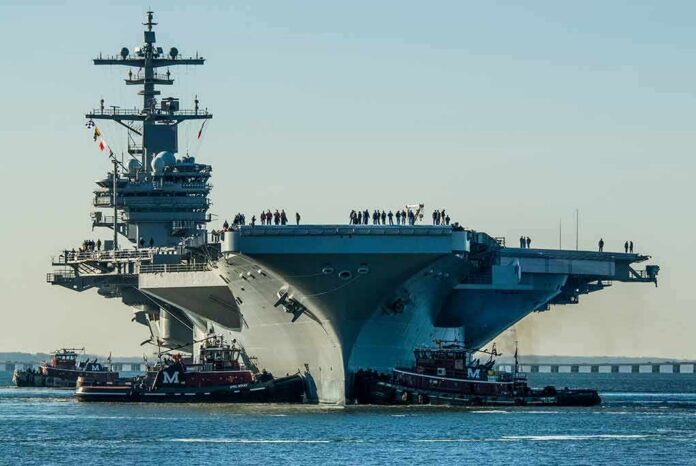
United States Central Command has stated that the USS Abraham Lincoln continued flight operations against military targets while sailing in regional waters, even as Iran claimed attacks. The same statement said hostile shots “didn’t even come close,” pushing back on Tehran’s narrative. Public carrier tracker reports placed major U.S. assets operating nearby through spring and summer 2026, underscoring presence and freedom of navigation patrols. Operation under threat is not the same as retreat; it is deterrence in action.
U.S. officials have also emphasized the carrier’s unique impact on Iran’s decision-making. General Kenneth McKenzie told Congress that an aircraft carrier has a “profound deterring affect principally upon Iran,” noting that Tehran tracks it closely. That attention cuts two ways. Iran advertises its missiles to signal reach, while the carrier’s steady operations signal resolve. In this standoff, credibility comes from actual performance at sea, not slogans. So far, no verified combat record shows a successful Iranian hit on a U.S. carrier group.
What The Evidence Shows, And What It Does Not
Exercise footage and statements prove Iran can launch anti-ship missiles, fly drones, and run layered coastal defenses. Analysts agree those tools can threaten shipping and stress defenders in tight waters. But the harder task is finding, tracking, and striking a moving carrier group protected by Aegis defenses, electronic warfare, air cover, and decoys. The public record here does not include combat telemetry, confirmed battle damage, or sensor-chain proof that Iran has solved that problem. Claims alone do not equal hits.
IF IRAN WAS TO HIT A U S CARRIER
IRAN WOULD BE A PARKIN LOT— DRX (@GaryHealer2) September 6, 2026
Recent U.S. reports describe real Iranian attacks that were evaded, with no American casualties. In response, U.S. forces struck three Iranian oil tankers, disabling or destroying them, showing consequences for aggression. That exchange confirms risk is live in the region. It also shows the U.S. Navy can absorb pressure and act with precision under President Trump’s leadership. For readers worried about deterrence, the facts point to a tough reality: threats are rising, but American carriers are still on station.
Sources:
19fortyfive.com, iranpress.com, presstv.ir, lexingtoninstitute.org, aei.org, en.abna24.com, aljazeera.com, defensenews.com