
President Trump closed a spirited Sioux City stop by dancing to “Y.M.C.A.,” signaling energy and connection with supporters that has become a hallmark of his rallies.
Story Highlights
- C-SPAN video shows Trump dancing to “Y.M.C.A.” after a campaign event, engaging the crowd.
- Trump has said he ends events with the routine and joked that his wife calls it “not presidential”.
- Major outlets have documented the dance as a recurring rally finale since 2020.
- The routine reflects how modern rallies blend policy, media, and showmanship.
Documented Rally Finale: What The Video Shows
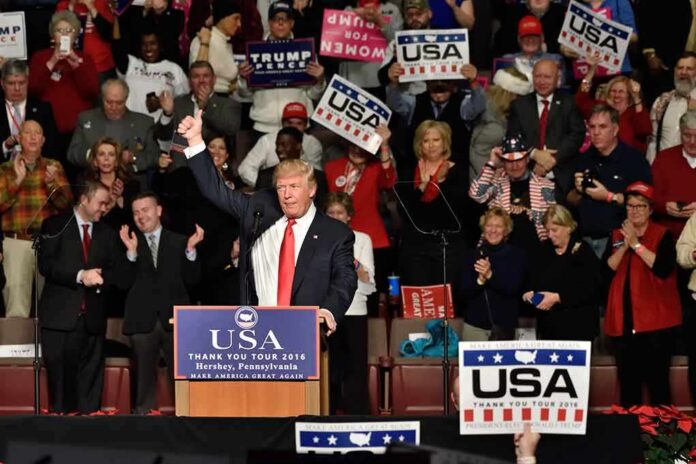
C-SPAN recorded President Trump wrapping a campaign appearance and breaking into his now-familiar “Y.M.C.A.” dance. The clip shows him smiling, clapping, and gesturing to the audience as the song plays, treating supporters to a light, celebratory close after his remarks. The moment is brief but deliberate. He stands at the front, acknowledges the crowd, and moves in rhythm. The video captures a simple truth: he finishes, the music hits, he dances, and the crowd engages.
Trump himself has framed the routine as part of his stage presence. On camera, he joked that his wife “hates when I dance” and noted he does it at the end, naming “Y.M.C.A.” directly. That acknowledgment matters. It signals intention, not accident. He uses the moment to connect and to send supporters home upbeat. The moves are playful and unchoreographed. They are easy to recognize and easy to share, which helps them travel across social media.
A Pattern, Not A One-Off: How Often He Does It
National media have chronicled the dance for years, showing it across different rallies and states. NBC News highlighted several instances, making clear that it is a recurring feature, not a rare stunt. Reporting during the 2020 race also described the “dad dance” as a grand finale to late-campaign events, with crowds responding as the song closed out the night. The routine endures because it is simple, familiar, and instantly frames the rally’s end as a shared celebration.
Some coverage calls the dance muted or improvised, rather than a full letter-by-letter arm routine. That is accurate. The videos show light, rhythmic moves, pointing, clapping, and knee pops, not a strict choreography. The point is not technical dance skill. The point is the bond with the audience and the signal that the work that day is done. The clip format also makes the gesture ideal for highlights, reels, and quick shares that keep Republicans energized between events.
Why The Routine Resonates With Supporters
Rallies are not only speeches. They are stagecraft shaped for television, phones, and the evening news. Scholars and reporters have described modern campaign events as performances designed to project authenticity and energy. Trump’s “Y.M.C.A.” moment fits that model. It gives attendees a closing beat and offers viewers a memorable clip. It tells a clear story: big crowd, strong message, upbeat sendoff. That closing scene carries far beyond the venue.
President Trump breaks out his signature dance moves to "YMCA" after wrapping up his campaign rally in Sioux City, Iowa.
The president dances onstage in front of supporters as the countdown continues pic.twitter.com/4SyokLh1dp
— Midnight Rider (@MR_karluskaP) October 23, 2026
For conservatives, the appeal is straightforward. The President sets the tone, ends on joy, and reminds people politics should answer real-life concerns without scolding or gloom. The dance does not replace policy. It punctuates the day’s case on borders, energy, costs, and security with a moment of unity. Trump owns the stage, invites his base into the moment, and leaves opponents to grumble while supporters smile and share the clip.
What We Can Say With Confidence
The Sioux City clip shows Trump dancing to “Y.M.C.A.” after his remarks, engaging supporters as the song plays. Trump has said he ends events with that dance and has joked about it being “not presidential,” which underscores that it is a conscious part of the program. News coverage has tracked the routine across cycles and venues, confirming it as a reliable rally closer, not an isolated incident. That is the record: a patterned, crowd-facing finale that signals momentum.
Sources:
facebook.com, c-span.org, thecut.com