

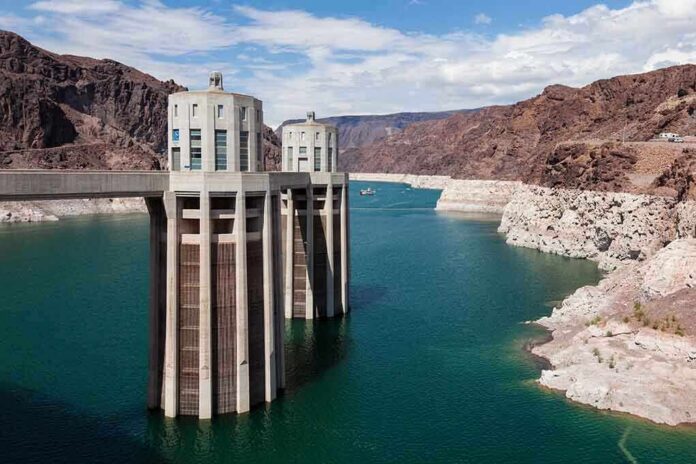
NASA confirmed Lake Powell has plunged to a new record low, putting water supplies and Western hydropower at risk.
Story Highlights
- NASA reported Lake Powell’s surface at 3,517.24 feet in early September 2026, a record low.
- Federal data show weak winter snow and low runoff drove the drop across the Colorado River Basin.
- The Bureau of Reclamation warned both Lake Powell and Lake Mead hit record lows in recent weeks.
- Grid reliability faces pressure as Glen Canyon Dam nears power-generation limits.
Record Low Confirmed by Satellite and Federal Readings
NASA reported that Lake Powell reached a record-low water surface in early September 2026, measuring 3,517.24 feet, after first breaking the prior mark in mid-August. A separate roundup of federal information echoed the milestone and tied it to an unusually dry and warm winter that starved the basin of snowmelt. Daily readings tracked the lake near this level through mid to late September, underscoring that the dip was not a brief blip but an ongoing stress on the system.
The Bureau of Reclamation stated that Lake Powell and Lake Mead both reached new lows in recent weeks, leaving the two-reservoir system at its weakest point since before Lake Powell first filled in the 1960s. Satellite images showed shorelines pulled far back from past edges, a clear visual of how much storage has vanished since wetter years. Reported levels also fell well below records set only a few years ago, showing how fast conditions have worsened in this dry cycle.
Why Levels Fell: Snowpack Failure and Long-Term Mismatch
Researchers and federal officials linked the fall to a sharp decline in winter snowpack and spring runoff across the Upper Colorado River, which delivers most inflows to Powell. That immediate hit stacked on decades of overdraw and a structural gap between supply and demand. The official record of decision for post‑2026 planning cites a 26‑year drought, historically low runoff, and reservoirs that keep testing prior lows, confirming this is a long-running strain, not a one‑season oddity.
Reclamation’s planning documents had warned that without major intervention, Lake Powell could slip near or below critical thresholds used for power generation at Glen Canyon Dam. State and regional managers now face a narrow margin between current levels and the point where turbines struggle to operate efficiently. That risk matters to families and small businesses that count on reliable, affordable power. When hydropower fades, utilities often turn to costlier sources, pushing bills higher for ratepayers who are already stretched.
Water Users, Power Customers, and the Road Ahead
Managers across the basin are weighing further cuts to keep the river system stable while they update rules for the years ahead. Analysts and agency updates describe an “uncharted territory” feel as combined Powell‑Mead storage sits near the lowest point since before Powell existed. Western farms, cities, and tribal communities depend on this water, and the strain is now forcing harder choices about how much each sector can use and how to keep vital deliveries moving in a lean year.
Lake Powell Falls to 3,517 Feet, a New Record
Read the full story: https://t.co/kFpyEYZRBl
Lake Powell hit a record-low 3,517 feet in September 2026-two feet below the 2023 record-as megadrought and a failed snowpack threatened water and power for 40 million people.… pic.twitter.com/w94LEC0inm
— wondernews.now (@wondernews_now) September 23, 2026
Glen Canyon Dam’s hydropower supports grid stability for multiple states, so operators will watch the elevation closely as fall and winter approach. Federal readings placed Powell in the 3,517‑foot range in mid to late September, still hovering near the new record. If winter 2026–2027 snowfall stays weak, managers may need tighter releases, steeper conservation, or emergency transfers to avoid deeper hits to water and power. If storms return, refilling will still take time after years of drawdown.
Sources:
sciencedaily.com, science.nasa.gov, yahoo.com, lakepowell.water-data.com, denvergazette.com, usbr.gov