

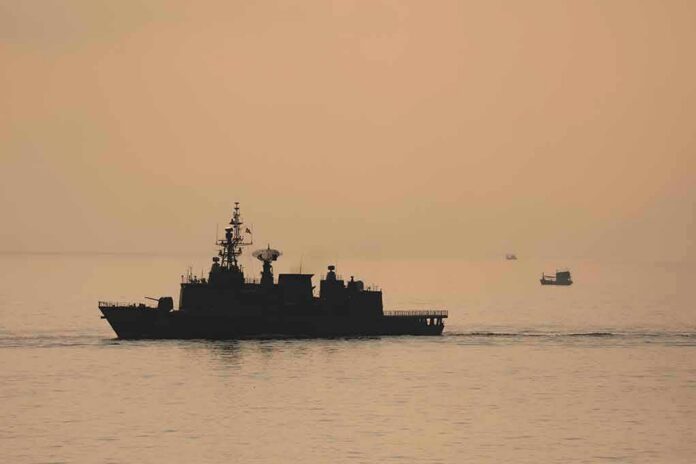
Iran says it has shut down the Strait of Hormuz and warned it will shoot at ships, while three United States aircraft carriers converge on the Middle East by Monday.
Story Snapshot
- Iran’s Revolutionary Guard navy declared the Strait of Hormuz closed and threatened to treat any passing ship as an enemy target.
- Yemen’s government-backed forces pulled back near the Bab el-Mandeb Strait, handing control to Iran-backed Houthi fighters.
- Three U.S. carrier strike groups are massing in the region as President Trump pushes diplomacy alongside military pressure.
- U.S. Central Command says Iran does not actually control the strait, despite Tehran’s claims.
- The United Nations and Saudi Arabia have separately accused Iran and the Houthis of weaponizing global shipping lanes.
Iran Declares the Strait Closed and Threatens Ships
Iran’s Revolutionary Guard Corps Navy announced Saturday night that the Strait of Hormuz would stay closed until the United States lifts its blockade on Iranian ports. The warning was blunt: no vessel should move from anchorage in the Persian Gulf or Sea of Oman, and any ship approaching the strait would be treated as helping the enemy. About one-fifth of the world’s oil passes through that narrow waterway every day.
A Second Front Opens at Bab el-Mandeb
Yemen’s internationally recognized government forces announced they were withdrawing from territory overlooking the Bab el-Mandeb Strait, a second critical chokepoint connecting the Red Sea to the Indian Ocean. That retreat leaves Iran-aligned Houthi fighters in control of the coastline, giving Tehran’s allies leverage over another major global trade route just as the Hormuz standoff escalates.
The timing is no coincidence to military planners. With Hormuz blocked on one side and Bab el-Mandeb falling on the other, Iran and its proxies are squeezing two of the world’s most important oil and shipping arteries at once. Analysts note this mirrors a known Iranian playbook: using threats, mines, and limited strikes to disrupt global trade without ever declaring a formal, full-scale war.
Three Carriers Converge as Trump Keeps Diplomacy on the Table
The USS Theodore Roosevelt carrier strike group entered the U.S. Central Command region on November 15, joining two other carrier groups already on station. The Roosevelt had departed Singapore and crossed the Strait of Malacca as President Trump simultaneously pursued diplomatic talks with Iran, showing Washington’s strategy of pairing hard power with an open door for negotiation. Three carriers near Iran sends an unmistakable signal of American resolve.
Central Command pushed back hard on Iran’s claims of control. Officials said Saturday that Iran does not actually command the Strait of Hormuz, even as regional tensions stayed high following Israeli strikes connected to the broader conflict. That statement matters for American readers worried about gas prices and energy security. It suggests the U.S. Navy still has the muscle to keep the waterway open despite Tehran’s bluster.
Washington and Riyadh Accuse Iran of Weaponizing the Seas
The United States told the United Nations Security Council that Iran is deliberately undermining freedom of navigation and using attacks on commercial ships as a tool of state power. American officials said Iranian missiles, drones, and illegal mines in Hormuz, combined with Houthi attacks near Bab el-Mandeb, now threaten global energy, food, and humanitarian supply chains. That’s not a minor diplomatic complaint. It’s an accusation that Iran is holding the world economy hostage.
Saudi Arabia has already moved to counter the threat, unveiling plans for a multinational maritime coalition built to protect freedom of navigation and secure trade and energy routes around Bab el-Mandeb and the Gulf of Aden. Fourteen nations have reportedly backed a related Saudi-led defensive alliance formed after the Houthis declared their own blockade targeting Saudi vessels. The message from Riyadh and Washington alike is the same: Iran’s proxies don’t get to dictate who sails through international waters.
Why This Matters at Home
For American families already squeezed by years of inflation and energy costs, a closed Strait of Hormuz is not an abstract foreign policy debate. It’s a direct threat to gas prices, grocery bills, and the broader economy. President Trump’s deployment of three carrier strike groups signals that this administration intends to keep international shipping lanes open rather than let Tehran dictate terms through intimidation and threats against civilian vessels.
Sources:
zerohedge.com, britannica.com, economictimes.indiatimes.com, gulfnews.com, maritime.dot.gov