

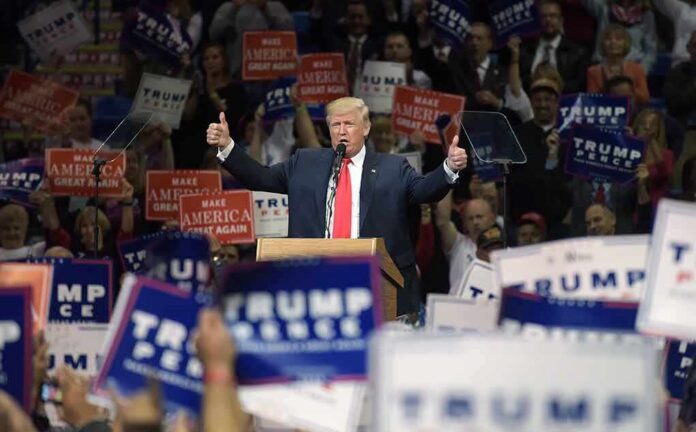
President Trump warned that if Democrats seize full control, he could be the last Republican president — and the Constitution’s checks could be bent to lock it in.
Story Highlights
- Trump told rally-goers he could be the last Republican president if Democrats win the White House and Congress.
- He linked Democratic control to adding electoral votes, Senate seats, House seats, and reshaping the Supreme Court.
- He described today’s Democratic Party as embracing communism and a grave threat to America.
- He warned Democrats would pursue another impeachment if they retake the House in 2026.
Trump’s Warning About One-Party Rule
President Trump told an Ohio crowd that if Democrats control the White House and both chambers of Congress, he could be the last Republican president. He tied that risk to moves that would add electoral votes, expand Senate and House power for Democrats, and change the Supreme Court. He framed the danger as structural, not just ideological. He said Democrats would lock in power through long-term changes that tilt the map and the courts, ending fair competition at the national level.
Trump’s case centers on how partisan control can drive structural changes. He warned that stacking the judiciary and shifting representation would weaken checks and balances. He argued this would sideline millions of conservative voters and set policies that raise energy costs, expand government, and erode borders. He cast the 2026 midterms and 2028 race as make-or-break fights for constitutional limits and free elections, not just another cycle. He urged Republicans to organize now to prevent a permanent left turn.
Rhetoric of Communism and Constitutional Stakes
At a Myrtle Beach rally, Trump said Democrats “skipped socialism and went communist,” calling communism the greatest threat. He tied that label to policies that centralize control, muzzle speech, and punish dissent. He linked those risks to real-life results many families know: higher prices, weaker safety, and cultural rot. He warned that the same approach would pressure the courts and agencies until individual rights, including gun rights and parental authority, take second place to party power.
While Democrats reject the “communist” tag, Trump’s warning matches a long pattern where parties frame the other side as an existential danger. Research shows fear appeals surge in tight races and from more ideological candidates, because they command attention and turnout. Trump’s base sees the threat in lived experience: inflation from overspending, border chaos, and school agendas that push aside parents. His framing uses those pain points to argue that concentrated power, not debate, is the left’s endgame.
Impeachment Threat and 2026 Midterm Stakes
Trump also told supporters that if Democrats win the House in 2026, they will try to impeach him again. He urged voters to “pretend I’m on the ballot” and protect the Republican majority. The message is simple: personnel is policy. House control sets the agenda, decides investigations, and shapes national stories for years. He said a Democratic House would stall border security, attack energy independence, and use hearings to grind down his administration’s reforms.
Republicans heard a call to action. Winning the House blocks impeach-and-investigate cycles. Holding the Senate protects judicial picks who read the Constitution as written. Keeping the White House stops rules and orders that raise energy costs, reward illegal immigration, and grow the administrative state. Trump’s bottom line is urgency: show up, volunteer, donate, and talk to neighbors now. If Republicans do the work, they can stop structural capture and keep elections real and competitive.
Sources:
mediaite.com, newsbreak.com, reuters.com