
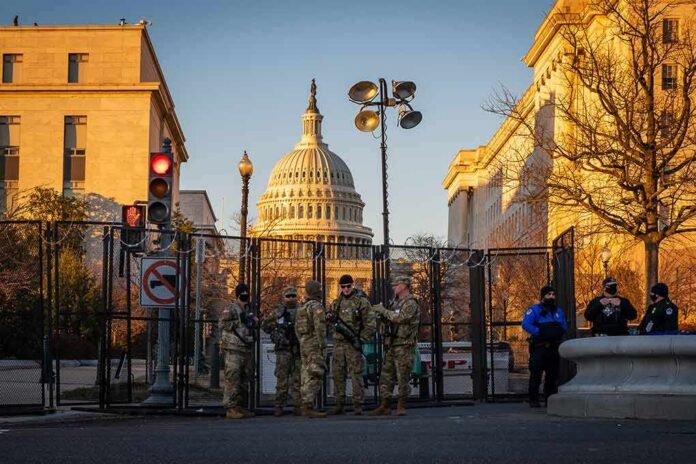
Two signed memos cleared National Guard troops to roll marked patrol cars, tactical vehicles, and boats across Washington, signaling a hard push to restore order while keeping clear lines under the law.
Story Highlights
- Defense Secretary Pete Hegseth approved up to 60 marked patrol cars and other equipment for D.C. missions.
- The authorization includes tactical vehicles, portable light towers, generators, and two patrol boats.
- Memos require “National Guard” markings and uniforms to avoid confusion with city police.
- Support roles continue alongside federal and local law enforcement under established legal limits.
Hegseth’s October 29 Authorization Expands Guard Tools For D.C. Patrol Support
Defense Secretary Pete Hegseth approved two memoranda dated October 29 that expand the District of Columbia National Guard’s equipment for patrol support. The Associated Press reported the memos authorize up to 60 marked patrol cars, military tactical vehicles, portable light towers, generators, and two patrol boats to aid federal and local law enforcement in Washington. A Pentagon official told The Hill the same caps and categories, confirming the ceiling and the intent to support ongoing public safety operations in the nation’s capital.
The Associated Press reported that Guard boats will provide operational maritime support, while vehicles and light towers will increase visibility and mobility for patrols. Reporting across multiple outlets, including The Washington Post, Politico, The Hill, Stars and Stripes, and USA Today-linked coverage, aligned on the October 29 timing and the core equipment list. That common thread shows a coordinated expansion designed to boost presence, deter crime, and help agencies cover more ground and water with clear identification and command boundaries.
Uniforms, Markings, And Mission Limits Aim To Preserve Civil-Military Lines
The memoranda reportedly require “National Guard” markings on patrol cars and uniforms for service members, so the public can tell Guard troops from city police officers at a glance. Those steps support a support-only posture rather than a shift to direct police work. Outlets noted the Guard’s expanded role remains under civilian control and tied to law enforcement requests. This keeps within the historic line between logistical support and executing the law, which Congress and courts have treated with care under the Posse Comitatus Act.
Congress’s research service explains that the United States allows military support to civilian authorities, but treating the military as day-to-day police is the exception, not the rule. The policy debate often turns on whether troops are assisting or directly enforcing the law. Marked vehicles, uniformed personnel, and federal-officer presence on certain missions are tools to maintain that line. The Guard’s role here is framed as support, not as a replacement for local police or federal agents.
Maritime Support, Tactical Vehicles, And Light Towers: What The Additions Do
Two National Guard patrol boats will provide maritime support near key areas, adding eyes and response options on waterways that cut through the city. Tactical vehicles and up to 60 marked patrol cars can extend patrol reach, move troops quickly, and support joint operations across neighborhoods. Light towers and generators increase visibility at night and power field posts, which can deter crime and help officers and troops see and respond faster when incidents break out.
United States Expanded National Guard patrols in Washington DC have been approved. New equipment includes light towers, dozens of vehicles, patrol boats, and the arming of some soldiers with rifles. Currently they are mostly military police, specially trained on and carrying… https://t.co/86aiw0sThl
— AVSEC Pro (@avsec_pro) November 7, 2026
Reports varied slightly on boat tasks in edge cases, like a water pursuit or perimeter hold, but the shared theme is support to federal and local law enforcement, not independent Guard arrests. The Hill highlighted that the authorization caps equipment at defined numbers, which sets operational bounds and planning clarity for agencies that will use or coordinate with that gear. Politico described the move as a visible expansion on city streets, which is part of the goal: clear presence and faster backup when police ask for it.
Public Safety Stakes And Conservative Lens On Law, Order, And Limits
Washington residents have lived with rising disorder and a sense that criminals act without fear. The Trump administration has pledged to back the badge, close gaps, and push tools where they are needed most. This authorization reflects that stance: backstop police, deter repeat offenders, and keep streets and parks safe at night. At the same time, the structure respects limits that guard against government overreach by keeping Guard missions in support, not substitution.
Supporters of strong public safety see this as common sense: use marked Guard cars, tactical vehicles, and boats to help officers cover more ground and protect families. Legal guardrails matter too. Congress’s research service shows that America has long allowed the Guard to assist during tense times, while keeping coercive authority with civilian law enforcement. Hegseth’s memos, with uniform and marking rules, aim for that balance: more security, clear roles, and fidelity to law and tradition.
Sources:
zerohedge.com, apnews.com, stripes.com, clickondetroit.com, politico.com, washingtonexaminer.com