
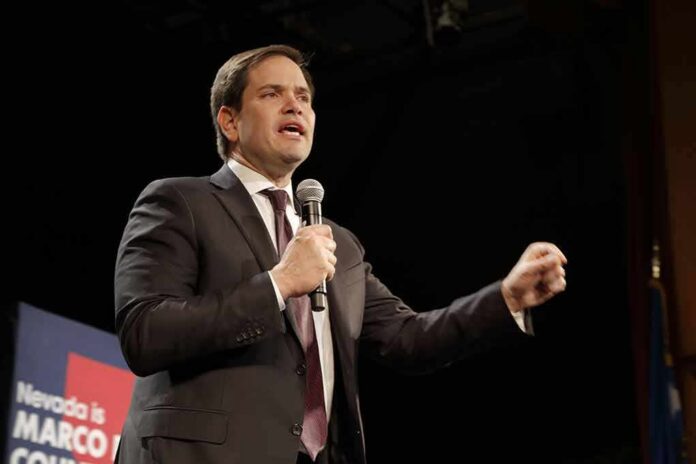
President Trump has signed a commission making Secretary of State Marco Rubio the permanent national security adviser, uniting two top national security roles under one leader.
Story Highlights
- Trump signed a commission naming Rubio permanent national security adviser, during the United Nations trip.
- Rubio keeps serving as Secretary of State while leading the National Security Council, echoing Henry Kissinger’s dual role.
- Reports say Rubio had served in an acting capacity since May 2025, so this formalizes the job he was already doing.
- The White House has not named a separate adviser, signaling continuity and tighter policy coordination.
Trump Finalizes Rubio’s Dual-Hat Leadership
White House and administration officials told multiple outlets that President Trump signed a commission permanently naming Marco Rubio as national security adviser, while he remains Secretary of State. The announcement came as Trump traveled to New York for the United Nations General Assembly, underscoring the administration’s focus on clear direction in foreign policy during a high-stakes week of diplomacy. The move puts the National Security Council and State Department under a single, trusted hand to drive message discipline and speed.
Rubio had already been doing the job. Reports say he stepped in as acting national security adviser in May 2025, after Mike Waltz’s departure, and has overseen key crises and negotiations since then. By signing the commission now, Trump converts a stopgap into a permanent structure. That means foreign counterparts know who speaks for the president, and U.S. agencies get one chain of command for strategy and execution. The job does not require Senate confirmation, so the commission itself is decisive.
A Rare Arrangement Last Seen With Kissinger
This is a rare setup. Rubio becomes the first person since Henry Kissinger to serve as both Secretary of State and national security adviser at the same time, a model last used in the 1970s. Kissinger’s dual role aimed for unified strategy and faster decisions during intense global challenges. Today’s threats demand similar clarity. When one official sets policy and also runs the National Security Council process, the government can cut duplication, align diplomacy with defense, and move with purpose.
The White House has not announced a separate national security adviser, which suggests Rubio retains both portfolios for now. Supporters see this as common-sense streamlining after years of bloated interagency sprawl. One leader can keep focus on America First priorities: a stronger military, fair deals for U.S. workers, secure borders, and energy dominance. Critics in past eras warned about too much power in one office. The administration answers that accountability is stronger when the public knows who is responsible for results.
Why It Matters For Conservative Priorities
Conservatives have long demanded a foreign policy that defends the Constitution, stops endless bureaucracy, and stands up to hostile regimes. Trump’s decision gives Rubio authority to match action with words, without turf fights or slow-rolling from career offices. Rubio can align sanctions, military posture, and talks in one plan. That helps deter foes and back U.S. allies who carry their share. It also helps stop leaks and mixed messages that have plagued Washington for years and weakened American leverage abroad.
The timing during the United Nations General Assembly sends a message: America sets its own course. While global bodies push climate quotas, migration compacts, and rules that raise our energy costs, the administration is centralizing strategy to protect the U.S. worker and taxpayer. A single point of leadership reduces the chance that globalist agendas slip in through back channels. It also puts speed behind actions that defend our border, counter terror threats, and shield our economy from predatory trade practices.
Continuity After a Long Acting Period
Because Rubio has already led the National Security Council in an acting capacity since 2025, agencies, allies, and adversaries know his style and priorities. Formalizing the role avoids a reset. It keeps active efforts on track, from countering Iran’s aggression to hardening supply chains and securing the homeland. During busy fall diplomacy, steadiness matters. The commission locks in the chain of command so America speaks with one voice. That clarity helps stop confusion that opponents exploit.
• President: Donald J. Trump — @realDonaldTrump (personal) and @POTUS (official)
• Vice President: J.D. Vance — @JDVance (personal) and @VP (official)
• Secretary of State: Marco Rubio — @SecRubio (official)
• Secretary of the Treasury: Scott Bessent — @SecScottBessent…— Anthony Lewis Jerdine (@realAJerdine) September 23, 2026
Some reports did not specify the exact day the commission was signed, but all agree the step made Rubio permanent in the job while he stays at State. That detail does not change the outcome: Rubio now holds both titles, as confirmed across major outlets. For readers, the practical impact is simple. Expect faster decisions, fewer mixed signals, and a sharper focus on U.S. strength. When the stakes are high, unity of command beats committee drift every time.
Sources:
pjmedia.com, usatoday.com, foxnews.com, washingtonexaminer.com, apnews.com