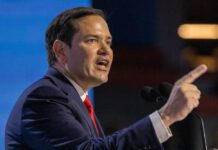

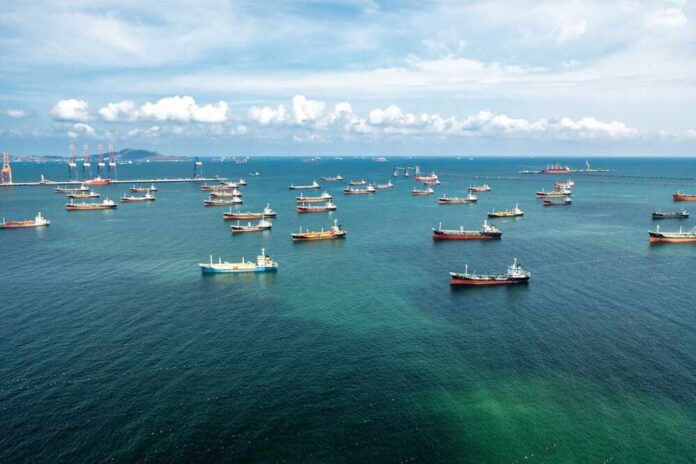
President Trump has just declared the United States will run the Strait of Hormuz, block Iranian ships, and charge a 20% fee on every cargo that passes through it.
Story Snapshot
- Trump says the US will be the “Guardian of the Hormuz Strait” and charge a 20% security reimbursement on all cargo.
- The administration is reinstating a blockade that targets only Iranian ships and their customers, while promising “fair and open use” for everyone else.
- The move hits back at Iran’s own fee plans and claims to control Hormuz, and comes as US forces strike Iranian targets.
- Legal experts say permanent tolls on an international strait clash with long-standing maritime law, raising global questions.
Trump Puts America in Charge of the World’s Most Critical Oil Chokepoint
President Donald Trump announced that the United States will assume the role of **“Guardian of the Hormuz Strait”**, a narrow waterway that carries a huge share of the world’s oil and gas. In a Truth Social post on Monday, he said the strait “is OPEN, and will remain OPEN, with or without Iran,” and that America will be reimbursed “at the rate of 20 per cent on all cargo shipped” for providing security. This marks a sharp, public claim that US power, not Iranian pressure, will decide whether the oil keeps flowing.
Trump also said the United States is **reinstating what he calls the “Iranian blockade,”** describing it as a policy that stops only Iranian ships and their customers. Reports say the naval move focuses on Iranian ports and vessels, while other nations’ ships are promised “fair and open use of the strait.” In plain terms, friendly and neutral countries still sail, but Tehran’s tankers and those doing business with Iran face American warships and a hard stop on their trade.
20% Cargo Fee: Reimbursement or New Global Shipping Toll?
Trump’s plan goes beyond military control and into money: he wants a **20% fee on the value of all cargo** passing through Hormuz, framed as reimbursement for keeping the waterway safe. He argues the United States has carried the burden of protecting global shipping for decades and should finally be paid for it. Earlier, he warned that any tolls after a ceasefire would be allowed only if “imposed by and for the United States of America,” again justifying them as payment for a “Guardian Angel” role in the Middle East.
This marks a shift from Trump’s earlier public line that the strait should stay “permanently toll-free” for global shipping. Over the past months, he has slammed Iranian plans to charge tankers, saying Iran “better not be” tolling Hormuz and threatening them if they did. Now he is flipping the script: no tolls for Iran, no tolls for anyone else, unless they pay the United States. For many conservative readers, this feels like long overdue burden-sharing, but it also opens new legal and diplomatic battles.
Iran Claims to Be Guardian Too, as Missiles Fly and Prices Surge
Iran’s leaders have pushed a very different story, saying **Iran alone controls security in Hormuz** under a recent memorandum of understanding and warning against “any interference” by other countries. Foreign Minister Abbas Araghchi has talked about Iran’s “historical duty” as protector of the strait and insisted that enemies’ ships will not get safe passage, while friendly nations like China and Russia are welcome. Tehran has also floated fee schemes of its own, including plans with Oman to collect money from transiting ships, though officials have described them as “voluntary” service charges.
These dueling claims come as US forces hit dozens of targets in Iran and Iran’s Revolutionary Guard launches missiles and drones at nearby countries like Bahrain, Jordan, Kuwait, and Oman. Oil prices have already surged on news of fresh strikes and a revived blockade, with reports of US benchmark crude jumping above $75 as traders brace for supply risks. For working families, higher fuel and electricity costs are a real worry, and any long fight over tolls and control in Hormuz could push prices even higher.
International Law and the Risk of Turning Hormuz into a Pay‑to‑Pass Zone
For decades, American policy has been that key sea lanes stay open and free, backed by US naval power but not taxed like a toll road. Maritime law experts point out that the United Nations Convention on the Law of the Sea, which shapes global practice, **prohibits charges for mere passage** through natural straits that connect the high seas. Coastal states can charge only for specific services, like pilotage or towage, not a blanket percentage fee on every cargo, whether oil, grain, or manufactured goods.
The American president has gone too far.
– Donald Trump, in his post, stated that the Strait of Hormuz is open and will remain open – in all caps – with or without Iran. From this point forward, the United States is assuming the title – again, in all caps – of Guardian of the… pic.twitter.com/EFPtqrzHQs
— 𝕊𝕡𝕣𝕚𝕟𝕥𝕖𝕣 𝕻𝕣𝕖𝕤𝕤 (@SprinterPress) July 14, 2026
Iran’s earlier toll ideas were widely criticized on these grounds, and even US and Chinese diplomats agreed that **no nation should impose tolls on international waterways**. Now Trump’s fee plan will face similar questions. Supporters see it as common sense: America protects the route, so big global shippers should help cover the cost. Critics warn that if Washington claims a right to toll Hormuz, other countries could try the same in their own chokepoints, slowly eroding the long‑standing principle of free passage that has helped keep trade moving and prices stable.
What It Means for American Conservatives Watching the Middle East
For many conservatives, Trump’s move speaks to a deep frustration: **America has paid to police the world while global elites and hostile regimes cash in.** Charging a clear fee for protection feels like basic fairness. It shifts some burden from US taxpayers to foreign corporations that depend on safe routes, and it sends a hard message to Iran after years of missile attacks, blockades, and threats to close Hormuz. It also matches Trump’s broader pushback against globalism that treats US power as a free public service.
At the same time, the plan raises real questions about how far any government should go in claiming control over international commons. Constitutional conservatives value limited government and predictable rules. If tolling Hormuz becomes normal, future leaders — in Washington or elsewhere — might use shipping fees and blockades not just for security but for revenue and leverage. For now, Trump has drawn a bold line: Iran will not tax the world’s energy lifeline, and if anyone pays, it will be to the United States that defends it.
Sources:
youtube.com, channelnewsasia.com, khaleejtimes.com, euronews.com, rferl.org, instagram.com, aa.com.tr, businessinsider.com, livemint.com, reuters.com, aljazeera.com, thehill.com, neodemocracy.blogspot.com, justsecurity.org, enotrans.org