
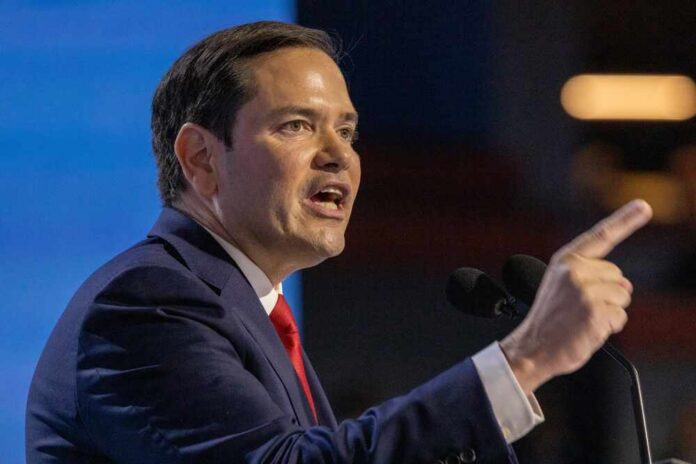
Secretary of State Marco Rubio confirmed the United States is controlling Venezuela’s oil money and approving its monthly budget to keep funds from corrupt hands, a hard-power move with major transparency questions.
Story Highlights
- U.S. will oversee Venezuela’s oil revenue and require monthly budgets before releasing funds.
- Oil proceeds start in a Qatar account, then move to a U.S. Treasury custodial account for controlled spending.
- Plan includes selling 30–50 million barrels at market prices to benefit the Venezuelan people, not regime insiders.
- Congress has not received audits or receipts after months, fueling concern over oversight gaps.
Rubio Outlines U.S. Control of Venezuelan Oil Revenue
Secretary Marco Rubio told the Senate that the United States will supervise Venezuela’s oil income and require a monthly budget from the interim government. Washington will review spending and approve releases to essential services like policing and healthcare. Rubio said this structure blocks graft and keeps cash from regime insiders. The Associated Press reported the plan and his testimony, which set clear conditions for how money gets used to help people inside Venezuela.
Rubio also said oil sale proceeds will first be deposited in Qatar and then moved into a U.S. Treasury custodial account. Funds will be disbursed only for preapproved needs, such as law enforcement and medical supplies. The New York Times and the Associated Press reported that monthly budgets must be submitted before money flows, placing accountability steps at each stage of release and tightening American leverage over the process and spending priorities.
Market-Rate Oil Sales Aim to Cut Corruption and Stabilize Services
Rubio and allied officials described a plan to seize and sell between 30 and 50 million barrels of Venezuelan oil at market prices. They said this prevents discount deals that favored politically connected buyers and ensures more value reaches the public. Reports said the goal is to direct proceeds to basic services, including parts of the power grid and healthcare, while keeping funds out of corrupt channels that starved everyday people for years under failed socialist rule.
Coverage from major outlets echoed the market-rate claim and the intent to benefit citizens. Time, CBS News, and The Hill each reported the 30–50 million barrel range and explained that sales at fair market prices would reduce skimming and improve transparency on value. The message from the administration is direct: get the highest legal price, protect the cash, and route it to priority needs inside Venezuela instead of to cronies or foreign brokers.
Transparency Gaps Test Trust in a High-Control System
Senators pressed Rubio about oversight and documentation. He confirmed Congress has not received audits, receipts, or contract lists despite months passing since the arrangement began. A State Department official said a private firm, KPMG, audits the revenue, but lawmakers have not seen reports. That gap leaves room for critics to question execution even if the design is sound. The uncertainty strains public trust and invites claims of secrecy that can overshadow concrete gains.
Rubio also faced questions about oil proceeds parked in Qatar. In a tense exchange, he confirmed that about two hundred million dollars remained in the account with no firm release date yet. He said the Qatar step is short term before transfer into a blocked U.S. Treasury account. Those details matter to taxpayers and to Venezuelans waiting on power repairs, medicine, and policing support that hinge on timely, verified disbursements.
Critics Frame ‘Running Venezuela From Afar’; Administration Cites Guardrails
Media framing has cast Rubio as “running Venezuela from afar,” suggesting de facto American control. The administration counters that strict custody, market sales, and approved budgets are guardrails to stop theft and speed relief. Facts on the table show real leverage and clear triggers for spending. The unresolved piece is proof: full audits, line-item spending, and a public list of who buys the oil would close doubts and validate a tough but lawful approach.
🚨 NYT REPORT: Marco Rubio is now RUNNING Venezuela remotely from D.C. like a boss – a de facto viceroy calling every shot.
Marco CONTROLS their finances, oil empire, and full government.
He has daily WhatsApp chats with acting leader Delcy.
America snatched Maduro and now… pic.twitter.com/5ApUEoZGFr
— Publius (@OcrazioCornPop) July 11, 2026
What conservatives should watch next is simple and concrete. First, whether Congress receives the KPMG audits and line items. Second, whether the Treasury custodial transfers occur on schedule. Third, whether contract awards are published with terms and amounts. These steps would harden the policy against corruption, silence the “imperial control” chorus, and show that disciplined American oversight can protect both U.S. interests and the long-suffering Venezuelan people.
Sources:
latintimes.com, apnews.com, time.com, nytimes.com, cbsnews.com, ms.now, youtube.com