
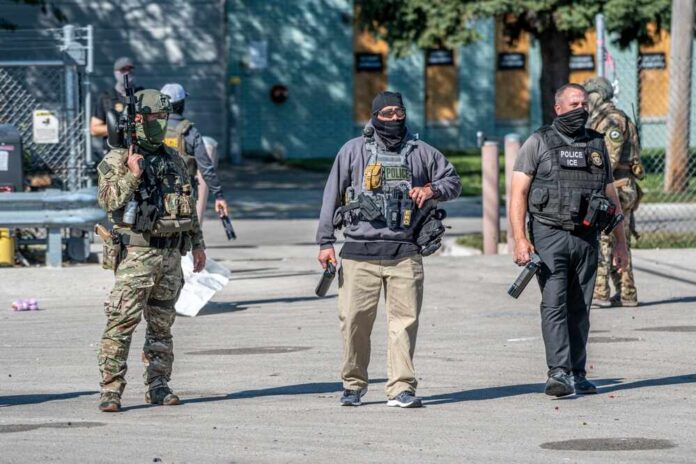
Minnesota Democrats are pushing to force ICE agents to unmask and display identifying information—setting up a fresh fight over public “accountability” versus agent safety and federal authority.
Quick Take
- Minnesota DFL lawmakers introduced bills to limit masks, require visible ID, and mandate marked vehicles for law enforcement operations tied to immigration enforcement.
- Supporters say the changes would rebuild trust after videos showed masked, plainclothes arrests in unmarked vehicles in the Twin Cities area.
- Critics argue the proposals could expose agents to doxxing and harassment, especially in a heated immigration climate.
- The effort is part of a broader Minnesota Senate DFL “ICE Accountability Agenda” unveiled in mid-February 2026.
Minnesota DFL Targets Masks, IDs, and Marked Vehicles
Rep. Leigh Finke, a DFL lawmaker from St. Paul, is sponsoring House proposals aimed at restricting masks for law enforcement during operations and requiring clearer identification—such as visible names or badge numbers—along with measures that would require marked law enforcement vehicles. The legislative push is framed by supporters as a response to reports and videos of masked federal immigration arrests in Minnesota, including incidents involving plainclothes agents and unmarked cars.
At the local level, St. Paul officials have also discussed rules that mirror the same theme: officers should be identifiable to the public while acting under government authority. That overlap matters because Minnesota already has rules limiting face coverings for state and local police in certain circumstances, and DFL lawmakers point to that as evidence that similar standards can be applied more broadly. The unresolved question is how far the state can go when federal agents are involved.
Senate Democrats Roll Out a Wider “ICE Accountability Agenda”
On the Senate side, DFL lawmakers rolled out an “ICE Accountability Agenda” that includes a mask-related proposal sponsored by Sen. Lindsey Port of Burnsville. The package, described as a multi-bill effort, extends beyond masks and identification to other concepts designed to constrain or scrutinize enforcement practices. Senate Judiciary Committee activity in late February signaled that leadership is taking the proposals seriously and intends to move them through hearings.
Supporters argue the agenda is about public trust and safety, claiming that masked, unidentified enforcement can escalate fear and confusion in communities already on edge. Their public messaging emphasizes visibility: if government agents are detaining people, the public should be able to see who they are and what authority they represent. That argument is presented as a corrective to what they describe as aggressive tactics, not as a blanket rejection of law enforcement.
Accountability vs. Doxxing Risk: What the Evidence Supports
The most provocative accusation from critics is that forcing agents to unmask can invite harassment or doxxing. The available research materials explicitly note that opponents cite doxxing risks as a reason for anonymity, while proponents stress transparency. What is not established in the provided sources is direct proof that the Minnesota bills are intended to enable “terrorizing” agents, even though that claim appears in partisan framing of the issue.
From a conservative perspective, the core concern is predictable: government should enforce immigration law effectively, and lawmakers should not craft rules that inadvertently put agents and their families at risk. At the same time, basic constitutional governance also relies on identifiable authority—especially when force is used. With limited details in the cited reporting about enforcement mechanisms, penalties, or carve-outs for high-risk operations, readers should treat sweeping claims on either side cautiously.
Federal Preemption and the Coming Legal Clash
Another major fault line is jurisdiction. Minnesota lawmakers and local officials can set standards for their own agencies, but regulating federal ICE operations raises the likelihood of federal preemption fights. Some reporting summarized in the research indicates a legal view that states may enforce certain rules unless they conflict with core federal duties. That “unless” is doing a lot of work: if the laws materially hinder ICE enforcement, litigation becomes likely.
Politically, the path forward is also complicated inside Minnesota. The Senate is DFL-controlled, while the House is tied 67–67, creating a narrow corridor for controversial legislation. Even if bills advance, federal-state conflict could turn a messaging push into an expensive courtroom battle, with taxpayers covering legal costs. The broader national context—now that President Trump is back in office—also increases the odds of sharper federal pushback against state-level attempts to box in immigration enforcement.
Sources:
ICE mask ban Minnesota St. Paul (Axios)
Senate DFL introduces ICE accountability agenda (FOX 9)
DFL lawmakers proposing 11 bills regarding ICE accountability (KSTP)
Minnesota House Session Daily story on DFL proposal (house.mn.gov)
Democrats pushing for ICE reforms as funding runs out (neal.house.gov)