

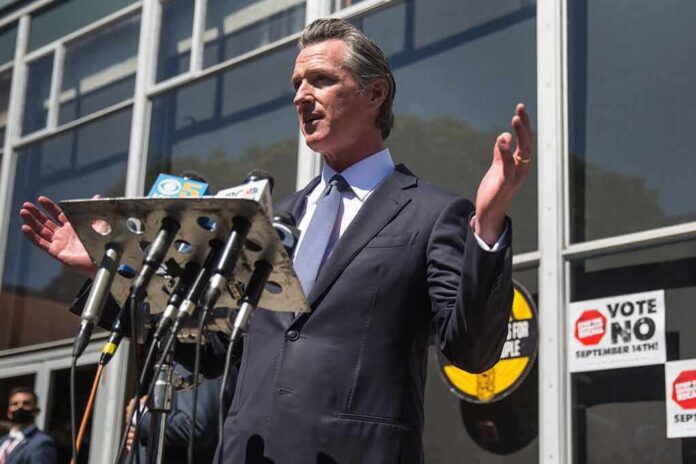
Gavin Newsom’s 2028 chances sank to about 7% after the midterms, as betting markets shifted toward other Democrats.
Story Highlights
- Multiple trackers logged Newsom near 7%, described as a record or lifetime low.
- Markets showed Jon Ossoff and Alexandria Ocasio-Cortez gaining ground as Newsom slipped.
- Tens of millions in trading backed the move, signaling broad participation.
- Platforms differed on exact odds, underscoring market-by-market variation.
Markets Record A Steep Drop In Newsom’s Standing
New York Post reporting on November 8 said Gavin Newsom’s implied chance for 2028 briefly fell to about 7%, which it called a record low after the midterms. A market tracker logged the same 7% level on November 6 and labeled it a lifetime low, down from 12% just a week earlier. A separate outlet described the same post-midterm repricing, linking the shift to a broader reshuffle among Democratic names. These snapshots show a clear, rapid decline, not a slow drift.
The New York Post also pointed to heavy market activity around the move, citing more than $28 million traded in markets tied to Newsom’s 2028 prospects. A tracker of nomination markets showed similar scale, with over $28 million traded by November 4. Large trading sums suggest many participants took positions, which makes the decline more meaningful than a thin, one-off quote. Prices move when traders act; they acted in size here according to the available figures.
Rivals Benefit As Traders Shift To Other Democrats
As Newsom slid, other Democrats advanced in the same period. Reports placed Senator Jon Ossoff near 27% and Representative Alexandria Ocasio-Cortez around 17% in key snapshots following the midterms. That change framed a new pecking order on some platforms, signaling that traders now see different leaders in the Democratic field. Those levels do not guarantee outcomes. They do show where market money lined up during the first days after the vote counts.
The timeline ties the move to the midterm window, but the evidence does not prove the election itself caused the drop. No campaign statement from Newsom explained the shift, and no exchange published a causal readout in the cited material. The strongest facts are the sequence and the prices: the odds fell after the midterms, and competition inside the party appeared to tighten. Traders responded to that mix with fast repricing across active markets.
Contract Differences And Platform Gaps Matter
Not every market showed the same number. Cross-platform views ranged widely, from about 7% on one venue to mid-teens elsewhere during the same general period. Some contracts priced a general-election win; others priced only the Democratic nomination. Those are different questions, so the odds will differ. This split explains why headlines cited “all-time low” while other screens still showed double digits for related, but not identical, bets.
Prediction markets offer a useful pulse, but they are not the same as polls or official forecasts. Reporters and trackers who covered the drop also noted that these prices reflect trader expectations and can move fast. That reminder fits long-running research discussion about how such markets perform across many races and how they handle uncertain events. The bottom line for readers is simple: the numbers show what traders think now, not what must happen next.
Why This Shift Resonates With Conservative Readers
California’s record under Newsom weighed on national debates for years, from high taxes to crime to energy costs. Markets now signaling weaker odds for his White House path echo a broad voter desire for safer streets, secure borders, and sane budgets. President Trump’s team is pressing those themes in Washington, while state-level results point to cracks in the left’s storyline on growth and governance. Traders appear to be marking that reality into their prices.
Democrats swept the midterms.
Gavin Newsom's 2028 odds just hit an all-time low: 7%.
The whole party caught a wave.
Newsom caught the undertow. https://t.co/DQEa4J6KFJ— Common Sense Report (@Fernand08130933) November 8, 2026
For families tired of failed experiments, the message is clear. Policies like unchecked spending and soft-on-crime rules carry a price. Markets are not moral judges, but they react when leaders lose the room. The post-midterm boards show a Democratic field in flux and a California governor losing steam. The numbers could change, but the signal today is simple enough: the country is moving on from ideas that did not work, and even the bettors are taking note.
Sources:
nypost.com, 2028tracker.com, polymarkettrader.com, kresmion.com, kalshi.com, dnyuz.com, predictmatters.com, vegasodds.com, cbc.ca