

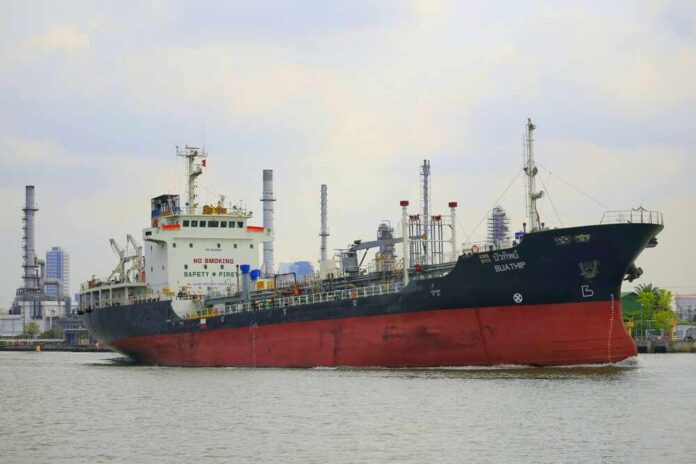
The world is learning—again—that when a single chokepoint like the Strait of Hormuz is threatened, American families can feel it at the gas pump within days.
At a Glance
- The International Energy Agency approved a 400 million–barrel emergency release—the largest in the group’s history—after tanker traffic through the Strait of Hormuz nearly stopped.
- Roughly 20 million barrels per day typically move through Hormuz, meaning the disruption touches about one-fifth of global oil supply.
- U.S. crude was reported around $86 per barrel on March 11 after recent spikes, while U.S. gas prices rose to about $3.57 per gallon from $2.97.
- IEA leadership stressed that restoring shipping through Hormuz matters more than any one-time reserve drawdown.
Largest-Ever IEA Release Aims to Calm a War-Driven Supply Shock
The International Energy Agency, a 32-nation group created after the 1970s oil shocks, announced on March 11, 2026 that it will release 400 million barrels of oil from strategic reserves. The stated purpose is to counter supply disruptions and price volatility tied to the U.S.-Israeli war with Iran and the resulting standstill in tanker traffic through the Strait of Hormuz. The IEA’s emergency move follows a member meeting held the prior day.
Energy markets reacted fast because the Strait of Hormuz is not a minor route; it is a global choke point. Reporting cited roughly 20 million barrels per day flowing through Hormuz before the conflict, and described tanker traffic as having “all but stopped” in recent days as fears grew of blockade conditions and broader escalation. In that context, 400 million barrels sounds enormous, yet it roughly matches about 20 days of the pre-war flow through Hormuz.
Price Whiplash Hits Consumers While the Endgame Remains Unclear
Price numbers included in coverage show why the IEA moved quickly. U.S. crude was reported at about $86 per barrel on March 11, up roughly 35% over a month, after hitting a recent peak around $119 on March 9. Retail gas was reported near $3.57 per gallon on March 11, up from about $2.97. That kind of sudden jump functions like a tax on working households, especially commuters and retirees on fixed incomes.
The political backdrop is complicated by mixed messaging around how long the conflict might last. Coverage described President Trump signaling the war “may soon be over” while also warning of harder strikes, a combination that can leave markets pricing both scenarios at once. Traders respond less to speeches than to physical flows, and the present reality is a shipping disruption in a corridor that the global economy depends on for daily energy supply.
Reserve Releases Can Buy Time, Not Replace Free Passage and Production
IEA Executive Director Fatih Birol framed the action as major, but he also emphasized that resuming tanker traffic through Hormuz is the key variable. That’s a practical point: strategic reserves are designed for emergencies, but they are finite. The IEA system reportedly held about 1.2 billion barrels before the announced drawdown, while the U.S. Strategic Petroleum Reserve was described around 400 million barrels in capacity terms and has been tapped before.
Industry voices also warned that logistics matter as much as headlines. GasBuddy’s Patrick de Haan, cited in coverage, argued effectiveness depends on the pace of release compared with the scale of the disruption. If the flow loss is on the order of 20 million barrels per day, then timing and delivery routes become decisive. A slow release may ease sentiment but still leave refiners and importers scrambling week to week if the chokepoint remains closed.
Security and Sovereignty Questions Surround an Energy Chokepoint
Coverage tied the market shock to security realities on the water. U.S. military planning reportedly included potential ship escorts through Hormuz, an illustration that energy security and national security are inseparable when adversaries can threaten global supply lines. Saudi Aramco was also cited warning of “catastrophic consequences” absent a resumption of normal traffic. Those warnings underscore why the strategic-reserve tool exists, even if it cannot substitute for stable transit.
DRUDGE REPPORT claims
are mostly BULLSHIT…IRAN RAMPS UP STRIKES
MORE DEFIANT
CARGO SHIPS HIT IN HORMUZ
NYT: TRUMP MISCALCULATED RESPONSE
FBI WARNING FOR CA DRONE ATTACKS
IEA LARGEST EVER OIL RELEASE— George Molnar (@GeorgeMolnar007) March 11, 2026
Uncertainties remain because the reporting available did not specify exactly how much oil each nation will contribute or the precise delivery schedule. That gap matters for Americans watching prices and for policymakers weighing how to preserve emergency stockpiles if the conflict drags on. The core takeaway is straightforward: the IEA can help soften a blow, but long-term stability depends on reopening the route, limiting escalation, and keeping energy policy focused on reliability.
Sources:
International Energy Agency Announces Largest Release of Reserve Oil Amid Iran War
Countries confirm biggest emergency oil release in history