
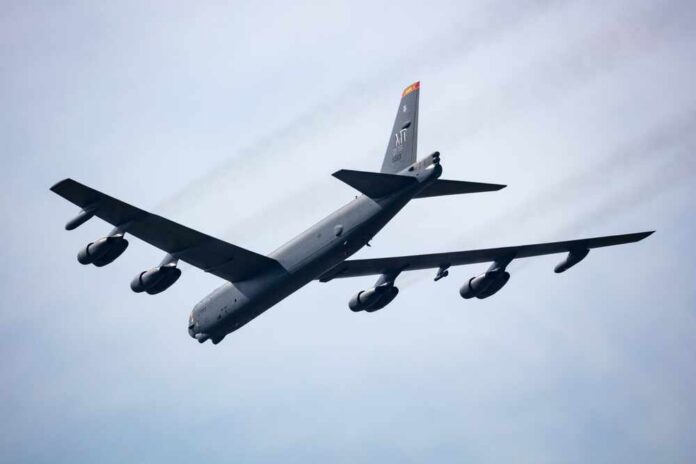
The U.S. Air Force is betting its strategic future on an audacious gamble: transforming a 1950s-era bomber into a cutting-edge weapons platform capable of dominating global conflicts through 2050.
Quick Take
- The B-52J modernization program extends the operational life of 76 aging bombers by up to 95 years through comprehensive technological upgrades rather than costly replacement.
- Advanced avionics derived from Navy fighter jets, precision-guided munitions integration, and hypersonic weapons capability transform legacy airframes into multi-role combat platforms.
- B-52J modernization costs a fraction of the B-21 Raider development program while filling a critical capability gap as older bombers retire and new platforms face delays.
- The strategy reflects pragmatic defense spending—maintaining American dominance in strategic bombing while managing fiscal constraints and industrial base stability.
A Practical Solution to Strategic Reality
The Air Force faces an uncomfortable truth: the B-1 Lancer is retiring due to maintenance costs and structural fatigue, the B-2 Spirit fleet numbers only 21 aging aircraft, and the B-21 Raider remains years away from full operational status with development costs exceeding $100 billion. Rather than accept a capability vacuum, the Air Force is pursuing the B-52J variant, equipping existing airframes with 21st-century systems. This approach acknowledges fiscal constraints while maintaining continuous strategic deterrence—a pragmatic decision that resonates with Americans frustrated by government waste and inefficiency.
Technological Transformation Meets Proven Reliability
The B-52J represents a fundamental upgrade across multiple systems. New radar technology derived from Navy F/A-18 Super Hornet fighters replaces legacy systems, enhancing targeting precision dramatically. The Internal Weapons Bay Upgrade allows internal carriage of up to eight precision-guided munitions plus six external pylons, reducing radar visibility while increasing payload flexibility. Rolls-Royce F108 turbofan engines improve fuel efficiency, extending range and reducing operational costs. These upgrades transform the B-52 from a Cold War-era area weapon into a precision strike platform capable of integrating emerging hypersonic missiles and network-centric warfare systems.
Fiscal Responsibility in Defense Modernization
The B-52J program exemplifies cost-conscious defense strategy. Modernizing existing airframes costs significantly less than accelerating B-21 development or pursuing alternative platforms. By amortizing modernization expenses across an extended operational life potentially reaching 2050, the Air Force reduces annual per-aircraft costs substantially. This efficiency allows the military to maintain strategic capability within constrained budget environments—a concern shared across the political spectrum as Americans debate proper allocation of taxpayer resources. The program preserves Boeing’s skilled aerospace workforce and sustains the defense industrial base without requiring massive new expenditures.
Strategic Implications for Great Power Competition
Extended B-52J capability directly addresses rising peer competition from China and Russia. The bomber’s exceptional range—8,800 miles unrefueled—makes it ideal for Indo-Pacific operations, where vast distances challenge conventional force projection. Sustained American bombing capability signals resolve to allies from Japan to NATO members while complicating adversary military planning. The modernization demonstrates commitment to maintaining U.S. dominance in strategic bombing through the mid-21st century, providing continuous presence in contested regions and reinforcing security commitments that underpin global stability.
The U.S. Air Force’s B-52J Is a ‘Radical Idea’: Take a 1950s Designed Bomber and Allow It To Wage War Possibly Until 2050shttps://t.co/lrwJnuUqaH
— 19FortyFive (@19_forty_five) May 5, 2026
The Pragmatic Path Forward
The B-52J program reflects broader frustrations Americans across the political spectrum share regarding government effectiveness. Rather than pursuing expensive new systems with uncertain timelines, the Air Force is maximizing existing assets through targeted modernization. This approach maintains operational capability, preserves institutional knowledge, and manages taxpayer resources responsibly. As the aircraft potentially serves through 2050, the B-52J demonstrates that sometimes the most radical idea is the most practical one: extend proven platforms intelligently rather than chase perpetual replacement cycles that drain budgets while leaving capability gaps.
Sources:
The New and Improved B-52J Bomber Summed Up in 4 Words
Air Force’s New B-52J Bomber Explained in 2 Words
B-52 Stratofortress Fact Sheet
B-52J: The Old New Bomber the Air Force Is Betting Everything On
B-52 Bomber: A Comprehensive Look at Its Capabilities
B-52 Future Stratofortress: The Upgrades That Will Transform the B-52H Into the B-52J