
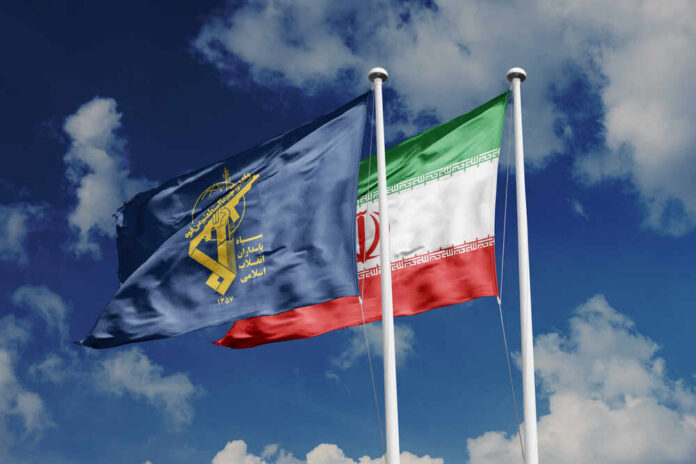
Iran’s Islamic Revolutionary Guard Corps has executed a silent coup, sidelining the elected president and isolating the new supreme leader behind a military security cordon as the regime faces unprecedented internal fractures.
Story Snapshot
- IRGC military council blocks President Pezeshkian’s appointments and assumes control of governance functions
- Supreme Leader Mojtaba Khamenei isolated under IRGC security perimeter, whereabouts unclear since father’s death
- Military expansion threatens U.S. diplomatic efforts and escalates regional tensions in Strait of Hormuz
- Power shift from clerical to military rule marks fundamental transformation of Iran’s governing structure
Revolutionary Guard Seizes Control Amid Leadership Vacuum
The Islamic Revolutionary Guard Corps has established de facto control over Iranian state functions following the death of Ayatollah Ali Khamenei in early 2026. A military council composed of senior IRGC commanders now manages critical governance and security decisions, blocking President Masoud Pezeshkian’s efforts to appoint key officials and denying him access to Supreme Leader Mojtaba Khamenei. The IRGC erected a security perimeter around the younger Khamenei, who has not appeared publicly since assuming leadership, fueling speculation about his capacity to govern and creating a power vacuum the military has exploited.
Moderate President Faces Political Deadlock
Masoud Pezeshkian, elected in early 2025 on a moderate reform platform, finds himself politically paralyzed as the IRGC systematically undermines his authority. Last Thursday, IRGC commander Ahmad Vahidi personally intervened to block Pezeshkian’s intelligence minister appointment, a brazen rejection of presidential prerogatives. The president’s urgent requests for meetings with Supreme Leader Mojtaba Khamenei have been ignored, leaving him unable to fulfill basic governmental functions. This represents a fundamental breakdown of Iran’s traditional power-sharing structure between elected civilians, clerical leadership, and military forces—a balance that has now collapsed entirely in favor of hardline military control.
Decades of Military Expansion Culminate in Takeover
The IRGC’s current dominance represents the culmination of over 30 years of steadily expanding influence since its formation after the 1979 Islamic Revolution. Originally created to protect the regime, the elite military force has embedded itself in major economic sectors, missile and nuclear programs, and government decision-making at every level. Behnam Ben Taleblu of the Foundation for Defense of Democracies observed that IRGC ascendancy was “always a matter of when, not if” given this decades-long trajectory. Ali Asghar Hejazi, a security official in the supreme leader’s office, had previously warned the Assembly of Experts against hereditary succession, predicting it would hand complete power to the IRGC—a prophecy now realized as military commanders override both civilian and clerical authority.
Regional Aggression and Economic Consequences
IRGC control has immediate implications for regional stability and Iran’s fragile economy. Military hardliners are escalating aggressive strategies in the Strait of Hormuz and broader West Asia conflicts, sidelining diplomatic channels that President Pezeshkian and other moderates sought to maintain. These actions threaten U.S. diplomatic overtures under the Trump administration, which had aimed to engage with Iranian moderates on nuclear and regional security issues. The shift to military rule also deepens economic strain on ordinary Iranian civilians, as IRGC-controlled sectors prioritize regime survival and regional ambitions over domestic prosperity, perpetuating the hardline policies that have isolated Iran internationally and stifled reform efforts domestically.
The transformation from clerical theocracy to military dictatorship marks a profound shift in Iran’s governing structure. With Mojtaba Khamenei physically inaccessible and President Pezeshkian rendered powerless, the IRGC military council now makes decisions without civilian or clerical oversight. This consolidation of power in military hands undermines the foundational structure of Iran’s post-revolutionary government and raises serious questions about whether any legitimate governance remains or whether the regime has devolved into pure military rule cloaked in theocratic rhetoric—a development with far-reaching consequences for regional security, nuclear negotiations, and the future of the Iranian people.
Sources:
Iran’s Revolutionary Guard sidelines president as military grip expands – Fox News
Iran’s military cuts off Khamenei from own govt, tightens grip over state functions – Times of India
Iran IRGC power shift Strait of Hormuz crisis – The Statesman