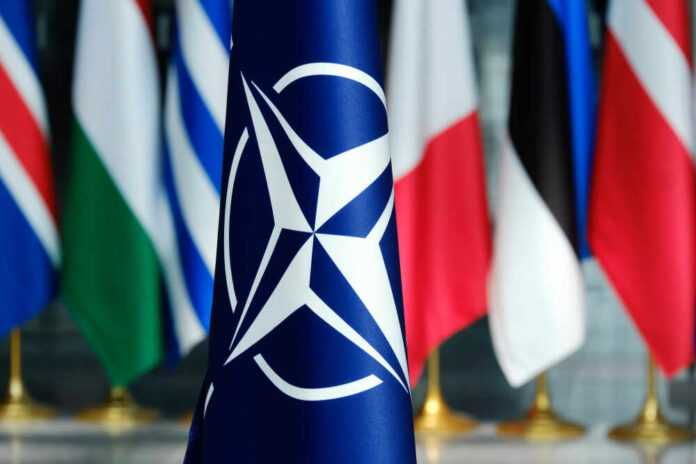
Trump’s latest NATO broadside—delivered in the shadow of a messy Iran conflict—has revived a once-unthinkable question: is America about to walk away from the alliance that defined the postwar world?
Quick Take
- President Trump publicly criticized NATO’s lack of support during the Iran conflict and again raised the prospect of U.S. withdrawal.
- A high-profile meeting with NATO Secretary General Mark Rutte came amid reports of the alliance’s worst internal crisis in decades.
- Commentary driving the debate splits sharply: some argue NATO has become an expensive “paper tiger,” while others warn the Iran episode could accelerate NATO’s unraveling.
- With a ceasefire reportedly violated and U.S. forces still committed in the Persian Gulf, the dispute highlights how unilateral military moves strain alliances—and taxpayers.
Trump’s NATO Warning After Iran: What Happened and Why It Matters
President Donald Trump’s renewed attacks on NATO followed the Iran conflict and the political blame that comes with it. According to commentary summarized in the provided research, Trump argued the alliance “wasn’t there” for the United States and publicly floated the idea of leaving NATO, even invoking Greenland as part of his broader message. That rhetoric escalated after a meeting with NATO Secretary General Mark Rutte, as the Iran ceasefire situation deteriorated and U.S. commitments in the region continued.
The most immediate significance is practical: alliances depend on predictable coordination, yet the research describes the Iran strike as undertaken without NATO consultation. That combination—unilateral action followed by demands for solidarity—creates a trust gap that neither side can easily close. For conservative voters who already believe global institutions frequently constrain American sovereignty while delivering little in return, Trump’s framing reinforces a long-running complaint: the U.S. pays and fights, while others hesitate when costs rise.
NATO’s Burden-Sharing Dispute Is Colliding With War Fatigue and Energy Reality
NATO was built for a Cold War security environment that ended in 1991, but it persisted and expanded long after the Soviet threat collapsed. The research argues that post–Cold War interventions broadened NATO’s footprint into conflicts far from North Atlantic defense, feeding skepticism among Americans who see endless commitments and soaring bills. European governments, meanwhile, face domestic pressure tied to energy costs and war fatigue, making them less willing to join another Middle East fight that could spike prices and deepen economic stress.
That dynamic matters in 2026 because it blends economics with security in a way voters feel directly. The research points to concerns that war-driven energy shocks can ripple into broader economic pain, radical politics, and social instability in Europe—factors that make allied governments even more cautious. At home, persistent deficit spending and inflation anxieties make foreign commitments politically brittle. When Washington and Europe start treating each other as unreliable partners, NATO’s core premise—collective defense backed by political unity—weakens.
The Competing Interpretations: “Silver Lining” vs. Warning Sign
Two competing narratives dominate the debate captured in the provided sources. One, advanced from an anti-interventionist angle, treats the Iran episode as proof NATO has become obsolete and financially unsustainable, arguing the U.S. should pursue “non-entangling” arrangements and shrink global basing. The other, framed as a caution, argues unilateral war choices and provocative rhetoric risk shattering the alliance, with speculation—explicitly unconfirmed in the research—about whether Greenland talk could further fracture relations.
Because much of the underlying material is opinion-heavy, readers should separate verified developments from interpretation. The research consistently reports Trump’s criticism of NATO and highlights the scale of the alliance’s internal strain during the Iran episode. However, specific claims about exact fiscal savings and the feasibility of rapid alliance withdrawal are presented as arguments rather than audited budget outcomes. The core verified takeaway is political: Trump’s public posture signals he is willing to revisit foundational commitments—and that alone forces allies, markets, and Congress to game out consequences.
What Comes Next: Alliance Credibility vs. America First Accountability
The near-term test is whether the administration turns rhetoric into formal steps, such as conditional funding, force posture changes, or a legal pathway toward withdrawal. The research notes U.S. forces remain positioned in the Persian Gulf after reports of ceasefire problems, underscoring that Middle East commitments can quickly expand regardless of campaign promises. For conservatives focused on limited government and fiscal restraint, the question becomes whether Washington can avoid writing blank checks—either for war or for alliances—without sacrificing deterrence.
Trump’s Iran Fiasco’s Silver Lining—The End Of NATO https://t.co/4CD55S61Ap
— David Stockman (@DA_Stockman) April 17, 2026
For skeptics on both left and right who believe elites profit while citizens pay, this episode lands as another stress test for accountability. If NATO partners expect U.S. protection while resisting shared risk, Americans will demand clearer terms. If Washington acts without consultation and then demands loyalty, allies will hedge. Either way, the dispute exposes a deeper reality: the federal government’s foreign-policy machinery can drift into high-cost commitments faster than voters can meaningfully consent—fueling the sense that the system serves institutions first and citizens second.
Sources:
Trump’s Iran Fiasco’s Silver Lining – The End of NATO
Will Iran War End NATO Alliance