
A private Vatican meeting with a top Democratic strategist—followed just 72 hours later by a coordinated TV broadside from three U.S. cardinals—has reignited fears that America’s politics are bleeding into the Church.
Quick Take
- A conservative-leaning report says Pope Leo XIV met privately with Obama strategist David Axelrod, with no details released.
- Within three days, Cardinals Blase Cupich, Robert McElroy, and Joseph Tobin appeared together on 60 Minutes to criticize Trump’s Iran policy and immigration enforcement.
- President Trump responded on Truth Social by attacking the Pope’s stance on crime and foreign policy, escalating a public standoff.
- Key elements remain unverified beyond a single opinion-style account, leaving the “coordination” claim largely circumstantial.
A 72-hour sequence that put Church authority into U.S. crossfire
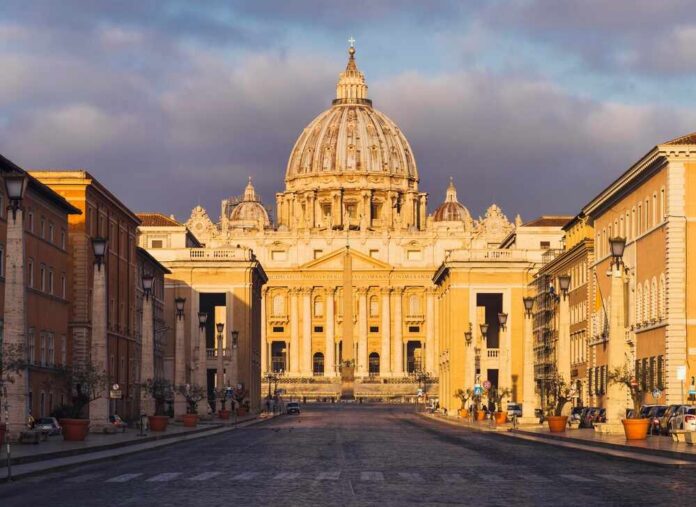
A KHQ opinion report describes a tight timeline that, if accurate, would be politically explosive: Pope Leo XIV reportedly held a private meeting at the Vatican with David Axelrod, Barack Obama’s former campaign strategist, about two weeks before the story ran. The Vatican did not release details about the discussion. Three days after that meeting, three prominent U.S. cardinals—Cupich, McElroy, and Tobin—appeared together on national television to criticize Trump administration policy.
The report frames the cardinals’ appearance as their “first-ever” joint interview and highlights their criticisms of Trump’s posture toward Iran and the administration’s approach to immigration enforcement. In today’s environment—where many voters already believe institutions are being used as political weapons—this kind of sequencing naturally raises eyebrows. Still, the only concrete, independently described facts in the research are the claimed meeting, the televised criticism, and the president’s public response.
What the cardinals said—and how Trump escalated the dispute
According to the same account, the three U.S. cardinals used the 60 Minutes platform to denounce Trump’s Iran policy and immigration enforcement, and to accuse the administration of “gamifying” war. Hours after the broadcast, Trump posted on Truth Social, calling the Pope “weak on crime” and “terrible for foreign policy.” The back-and-forth matters because it collapses a sensitive line: the Church’s moral critique versus a sitting president’s political counterattack.
For conservative Catholics, the deeper tension is practical, not abstract. When senior clergy appear in high-profile media formats to condemn a Republican administration during wartime and amid aggressive immigration enforcement, it invites the perception—fair or not—that religious authority is being used to shape election-year narratives and policy legitimacy. For liberal Catholics, the same events can read as moral leadership confronting government power. Either way, the public effect is polarization inside the pews.
Why the “Axelrod meeting” claim fuels suspicion—but remains thinly sourced
The most provocative element is Axelrod himself. The report stresses that he is a veteran Democratic operative and not Catholic, implying his presence signals political intent rather than routine interfaith or diplomatic outreach. But the research includes no Vatican readout, no agenda, no transcript, and no corroborating mainstream reporting. Without those basics, the claim functions more as a “smoke” indicator than “fire” evidence—suggestive, but not determinative.
This uncertainty is important for readers who are tired of both establishment messaging and internet-fueled conspiracies. The timeline may be real, and it may even be strategically planned, but the available material does not prove coordination. The most defensible takeaway is narrower: the Vatican’s silence about a politically sensitive visitor, combined with prominent U.S. churchmen choosing a major TV venue to attack the administration soon after, predictably looks political in a deeply partisan America.
The broader context: war, immigration, and a Vatican-U.S. relationship under strain
The report places the dispute against an escalating U.S.-Iran conflict that began in late February and a worsening Vatican-White House relationship. It says the Vatican declined an invitation connected to America’s 250th birthday celebrations on July 4, 2026, choosing instead to visit Lampedusa, the Italian island closely associated with migrant arrivals. Those choices fit the Vatican’s long-running emphasis on migrants, while clashing with Trump’s enforcement-forward approach at the border.
The same report also recounts an alleged January meeting in which Pentagon official Elbridge Colby supposedly warned the Vatican’s U.S. ambassador, Cardinal Christophe Pierre, about American military power and referenced “Avignon,” a historical symbol of papal captivity. The research itself flags doubts about the authenticity of that remark, underscoring how quickly provocative claims can ricochet through media ecosystems. With limited corroboration, the safer conclusion is that perception—more than proof—is driving the political fallout.
Sources:
The Vatican’s 72-Hour Timeline