

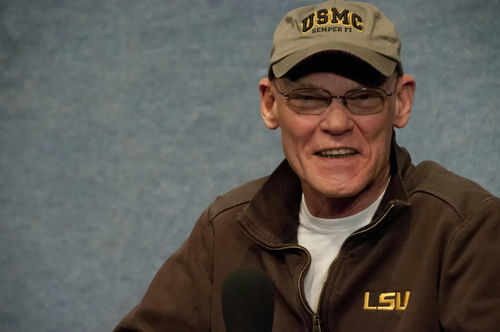
James Carville’s latest jab at President Trump shows how quickly today’s politics can slide from policy debate into apocalyptic name-calling—and then into plain personal insult.
Story Snapshot
- James Carville said he refuses to call Donald Trump the “Antichrist,” not out of restraint, but because he claims “the Antichrist would be smarter.”
- The comment came in a Politico video posted days after a shooting incident tied to the White House Correspondents’ Dinner timeline referenced in coverage.
- Carville pointed to prior “Antichrist” rhetoric aimed at Trump from figures he described as Republicans, including Rod Dreher and Tucker Carlson.
- The episode highlights how religious language is increasingly used as political ammunition, intensifying distrust and division across the electorate.
What Carville Said—and Why It Landed as More Than a One-Liner
James Carville’s remark came via a Politico video in which the veteran Democratic strategist addressed the idea—circulating in political media—that Donald Trump has been labeled the “Antichrist.” Carville said he has not used that label, but his reason was itself an insult: he argued the Antichrist “would be smarter” than Trump. The structure matters: it framed name-calling as moderation while still escalating contempt toward a sitting president.
The timing also amplified attention. Coverage described the video as being posted days after a shooting incident connected to the White House Correspondents’ Dinner sequence of events. That context matters because high-profile violence tends to raise public sensitivity around rhetoric that paints opponents as existential threats. Even without a direct call to action, language that invokes ultimate evil can harden attitudes and make ordinary democratic disagreement feel like spiritual warfare.
The “Antichrist” Label Is Spreading—and It’s Not Just a Left-Right Problem
Carville’s comments also pulled conservatives into the story. He referenced Rod Dreher, described as Vice President J.D. Vance’s “spiritual mentor,” and media personality Tucker Carlson as people who have called Trump the Antichrist. That detail complicates the easy narrative that this is only a left-wing rhetorical habit. It suggests a political culture where even influential voices on the right sometimes reach for end-times framing instead of focusing on policies and measurable outcomes.
That matters for conservative voters who want accountability, limited government, and stability. When politics becomes a contest of moral absolutes—saints versus demons—there is less room for sober evaluation of spending, border enforcement, energy prices, or public safety. It also becomes easier for entrenched institutions to dodge scrutiny, because every controversy turns into a screaming match about personalities rather than an audit of what government is doing, what it costs, and who benefits.
How This Rhetoric Fuels the “Government Is Failing Us” Mood Across the Country
Carville has previously said he has “Trump Derangement Syndrome” as a point of pride, and his Antichrist comment fits that brand of politics-as-performance. For many Americans—right, left, and in-between—this is exactly what feels broken: public figures compete to deliver the most viral put-down while voters face real pressures, from affordability to social disorder. Insults do not lower grocery bills or restore trust in agencies Americans already suspect are politicized.
The episode also intersects with a separate controversy referenced in reporting: an AI-generated image depicting Trump in a Christ-like way that was later deleted after backlash, including from conservatives who saw it as blasphemous. Put together, the pattern is clear even with limited detail available: religious symbolism is being weaponized from multiple directions. That can alienate religious Americans who don’t want sacred concepts dragged into partisan theater, and it can inflame those who do.
What the Public Can Actually Take From This Moment
The available sources mainly document the comment and the surrounding chatter rather than offering deeper polling or scholarly theological analysis. Still, the significance is straightforward: when high-profile figures normalize apocalyptic language, they help set incentives for everyone else to talk that way too. For conservatives focused on restoring institutional competence, it’s a reminder to demand specifics—on budgets, enforcement, and governance—because theatrical demonization is often a substitute for clear plans.
James Carville Says Trump Can’t Be the Antichrist Because He’s Too Dumb: ‘Antichrist Would Be Smarter’ https://t.co/1GMSzVtyEl
— Mediaite (@Mediaite) April 29, 2026
For liberals worried about discrimination or social welfare, the same principle applies: calling opponents cosmic evil is emotionally satisfying but politically corrosive. If Americans increasingly agree that government serves “elites” more than ordinary families, rhetoric like this doesn’t challenge that reality—it distracts from it. The durable takeaway is not the insult itself, but what it reveals about incentives in modern politics: attention, outrage, and tribal loyalty often beat competence and results.
Sources:
Which James speaks for you — Carville or Talarico?